Field of Science

The last great contrarian?


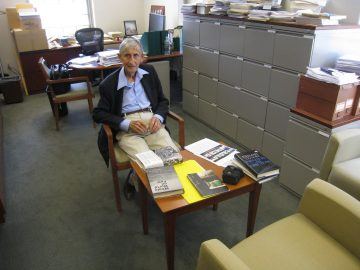
Freeman Dyson, photographed in 2013 in his office by the author
On February 28th this year, the world lost a remarkable scientist, thinker, writer and humanist, and many of us also lost a beloved, generous mentor and friend. Freeman Dyson was one of the last greats from the age of Einstein and Dirac who shaped our understanding of the physical universe in the language of mathematics. But what truly made him unique was his ability to bridge C. P. Snow’s two cultures with aplomb, with one foot firmly planted in the world of hard science and the other in the world of history, poetry and letters. Men like him come along very rarely indeed, and we are unfathomably poorer for his absence.
The world at large, however, knew Dyson not only as a leading scientist but as a “contrarian”. He didn’t like the word himself; he preferred to think of himself as a rebel. One of his best essays is called “The Scientist as Rebel”. In it he wrote, “Science is an alliance of free spirits in all cultures rebelling against the local tyranny that each culture imposes on its children.” The essay describes pioneers like Kurt Gödel, Albert Einstein, Robert Oppenheimer and Francis Crick who cast aside the chains of conventional wisdom, challenging beliefs and systems that were sometimes age-old, beliefs both scientific and social. Dyson could count himself as a member of this pantheon.
Although Dyson did not like to think of himself as particularly controversial, he was quite certainly a very unconventional thinker and someone who liked to go against the grain. His friend and fellow physicist Steven Weinberg said that when consensus was forming like ice on a surface, Dyson would start chipping away at it. In a roomful of nodding heads, he would be the one who would have his hand raised, asking counterfactual questions and pointing out where the logic was weak, where the evidence was lacking. And he did this without a trace of one-upmanship or wanting to put anyone down, with genuine curiosity, playfulness and warmth. His favorite motto was the founding motto of the Royal Society: “Nullius in verba”, or “Nobody’s word is final”.
Many chapters from Dyson’s own life illustrate this spirit of rebellion; some of it was by choice, some by necessity. First was his rebellion from pure mathematics. Dyson had learnt mathematics from G. H. Hardy, a man for whom the purity of mathematics was so sacred that, in a short and beautifully written book, he said he was actually proud of working on things that had absolutely no practical use. Dyson learnt mathematics from Hardy during the cold, dark days of the Second World War, when most of the students at Cambridge University had left to fight and Hardy taught a handful of students including Dyson in his rooms. Decades later Dyson could remember the tired, shrunken figure of Hardy lecturing from his chair, with the 17-year-old occasionally feeling like giving the old man a hug. Hardy imparted Dyson with a genuine love for the beauty of mathematics, and while Dyson worked on an astonishing variety of pure and applied problems during the rest of his life, his first love never left him and he kept coming back to it; when I attended his 90th birthday celebrations six years ago, about a third of the talks were about his occasional escapes into mathematics and the flowers they sprouted in other people’s gardens.
As war raged on the continent, Dyson was once taking a walk with a friend of his, the Indian mathematician Harish-Chandra who later became his colleague at the Institute for Advanced Study in Princeton. Harish-Chandra had started as a physicist, studying under Paul Dirac. Dyson had already started getting a taste of applied mathematics, working for Bomber Command where he was using statistics to figure out the most effective way to bomb Germany into surrender. “I am planning to leave physics for mathematics”, said Harish-Chandra. “I find physics to be unrigorous, messy, elusive”. “Interesting”, replied Dyson. “I am planning to leave mathematics for physics for exactly the same reasons.” Dyson was farseeing, and while mathematics would continue to be a rich source of discoveries, he could see that it was physics that was becoming the most promising discipline then. The atomic bomb, which as far as most people were concerned had won the war, sealed the decision in his mind to become a physicist and told him that physics and America were where the action was.
But Dyson was not even the most unconventional figure in this regard. Right after the war he ran into Francis Crick who had spent a depressing time during the war working on magnetic mines for the British admiralty. He was just then planning to switch to biology and join the famous Cavendish Laboratories where researchers under the physicist Lawrence Bragg were working on deciphering the structures of proteins. Bragg himself was one of the pioneers of x-ray crystallography and had decided to change the Cavendish’s direction, from its early pioneering work in physics under J. J. Thomson and Ernest Rutherford to new research in biology. When Dyson met Crick he explained his decision to switch to biology. Dyson told him biology was interesting but it was too early to be able to make major contributions to it. As Dyson recalled, he was happy that Crick disregarded his advice and went on to become perhaps the most important biologist of the 20th century, not only cracking the structure of DNA but deciphering the genetic code and influencing an entire generation of molecular biologists. I tell these stories to make the point that while Dyson was certainly an unconventional mind himself, it helped quite a bit that he was surrounded by equally unconventional and odd minds during his formative years as a student, people who switched fields with impunity and worked on completely new things. One might in fact argue that Cambridge was then a breeding ground for contrarians; in the next decade or two it would house minds like Thomas Gold, Fred Hoyle, Roger Penrose and Stephen Hawking, all known for the audacity and unconventional nature of their ideas.
This spirit of rebellion stayed with Dyson as he moved to the United States and started his apprenticeship under the tutelage of Hans Bethe, the legendary physicist who won a Nobel Prize for working out how the stars shine and led the theoretical physics division of the Manhattan Project. At Cornell where Bethe held court, Dyson met an even freer spirit, Richard Feynman. Dyson’s great mathematical skills were ideally suited to understand the new realm of quantum electrodynamics which Feynman, wunderkind Julian Schwinger and others were trying to understand. On a cross-country drive which became the stuff of folklore, Dyson had the unique opportunity to hear first Feynman’s version of his theory and then Schwinger’s of his, two versions which seemed irreconcilable. Dyson would show that they were two ways of looking at the same physical reality.
Years later Dyson would write a memorable essay called “Birds and Frogs”: some mathematicians are frogs who like to play in the mud and solve problems, he would say. Others are birds who soar and survey the landscape from a great height. Although he put himself squarely in the camp of frogs, the crucial work he did bridging Feynman and Schwinger’s theories and providing a unified view of quantum electrodynamics made him a bird. Throughout his life he was able to expertly navigate between the two domains.
Dyson was unconventional not just in his science but in his view of the social aspects of science, a view that he applied to himself with abandon. He famously never received a PhD; by that time it had become clear that he did not need one. Without a PhD the prodigy became a professor at Cornell and a fellow of the Royal Society, both before he turned 30. Over the years, dozens of PhD theses would be written based on Dyson’s work, but he would become a sharp critic of the entire system, a view that seems increasingly valid in an age when graduate students and postdoctoral researchers are often regarded as a source of cheap labor to grind out results and papers. Dyson thought that the PhD had become a kind of union card, forcing students and especially women who might want to start a family to spend most of their twenties working on single problems so that they would be deemed worthy enough to join a hallowed guild. It is also unfair to inventors who almost never have a PhD. I have worked with both PhDs and non-PhDs during my career and on balance can say that the non-PhDs have been more approachable, more hardworking and more creative. Unfortunately our research system, both in academic and industry, puts a premier on people having PhDs.
With his lack of a PhD and his disdain for a system that forces both students and professors to spend years working on a problem, Dyson the frog clearly realized that he wasn’t suited to a conventional academic career. But it also made him reassess what his particular strengths were. His great accomplishment had given him an enviable lifetime appointment at the Institute for Advanced Study in Princeton; Robert Oppenheimer who was the director had himself sung Dyson’s praises. For the next seven decades Dyson would become one of the most famous residents of the institute, but even his home institution was not spared from his contrarian take. He always thought the institute was too ivory tower and too much like an alien transplant in America– in contrast Ithaca and Cornell where he had lived before were the real American deal. He also disdained the tribalism among the institute’s mathematicians and their successful efforts to shut down John von Neumann’s computer project, a project which if it had been supported would have put the IAS on the map in the annals of modern computing.
During the early years Dyson kept on working on particle physics which had been his first proving ground, but a high water mark in Dyson’s career as a particle physicist came when he had a fortuitous meeting with Enrico Fermi in Chicago in 1953. Dyson and his students at Cornell were working on some results on particle scattering which seemed to give very good agreement with experiments done by Fermi. Fermi demolished the agreement in one fell swoop, saying that Dyson had neither a consistent mathematical theory nor a clear physical picture to explain the results. As far as the good curve fitting between theory and experiment was concerned, he quoted his friend Johnny von Neumann; with four parameters one can fit an elephant to a curve, with five one can make him wiggle his trunk. The conversation with Fermi, barely lasting fifteen minutes, dashed Dyson’s hopes to be a conventional physicist of high caliber. But his frustration was actually an astute observation and an epiphany: Fermi was the epitome of what a great physicist was supposed to be, combining great facility at experimentation and visualization of the physical picture with an equally good facility at calculation. Dyson’s forte was calculation.
It was partly the meeting with Fermi that convinced Dyson that his great strength was to apply mathematics to diverse problems rather than make great advances in what was then most fashionable in physics. This cleared the way for a remarkable career. His contributions in quantum electrodynamics were important enough, but after that Dyson switched to other fields, in particular condensed matter physics. In this realm his most important contribution concerned a fundamental question that can be asked simply: if most of the atom is empty space, what makes ordinary matter stable? Using a laborious proof that only one who was skilled in the highest realms of mathematical manipulation could muster, Dyson proved that the Pauli exclusion principle which prevents two electrons from occupying the same quantum state essentially keeps electrons apart and makes matter stable. The proof involved pages of hairy mathematics and was improved later by other researchers, but it did demonstrate Dyson’s great strengths as a professional calculator without peer. It also cemented his reputation as someone who would regularly toss gems aside that others would pick up and build into great edifices.
Until then, whatever some of the contrarian turns he took, Dyson was still known primarily as a theoretical physicist working in diverse parts of physics. But it was his work in the 1950s on engineering problems that truly demonstrated not only the scope of his intellect but the wondrous ambition of his ideas. The first engineering project he worked on was to design a nuclear reactor with physicist Edward Teller and others which would be intrinsically safe and “idiot-proof”; the safety in the reactor would have to come not from decisions by the operator but from the laws of physics. This reactor would be designed by collaboration between physicists, chemists and engineers. Dyson had to essentially learn an entire field of engineering, but at that time there were no true experts so the scientists who had gathered in a former red schoolhouse in La Jolla taught each other. The result of their deliberations was the TRIGA, the only nuclear reactor which has made a profit for its company. During TRIGA’s inauguration Dyson got a chance to take a solitary walk on the beach with the great Niels Bohr himself, but Bohr’s famous mumble and soft voice kept Dyson from receiving any enlightenment.
If TRIGA was earth, Project Orion was heaven. Buoyed by the enthusiasm of space travel, nuclear energy and rocketry in the 1950s, a small group of dreamers decided to build a spaceship powered by nuclear bombs. The idea was to sequentially explode bombs at a distance under a pusher plate on a spaceship and let the momentum carry the rocket away at great speed. “Saturn by 1970” was their motto, and it would also be a nice way to get rid of all those dangerous nuclear weapons lying around. Project Orion tested Dyson’s faculties and allowed his imagination to soar like nothing else. Once again we see the scientist as rebel, applying his skills to an audacious idea which had never before been explored and which could lead to a brave new world. The engineers on Project Orion remember being astonished by Dyson’s versatility as they saw a pure theoretical physicist calculate friction coefficients and load ratios, visualizing giant bombs going off under giant spaceships; while the project initially used small, tactical nuclear weapons, Dyson later imagined bigger, fusion-based weapons propelling the craft. A colleague named Brian Dunne captured Dyson’s unique style:
Freeman doesn’t have the Handbuchderphysik, the last-word sort of German precision. He doesn’t have the French quality of slap-dash, a point here well taken but the rest of it wrong. He doesn’t have the stiff British restraint. It’s a style he has developed that’s all his own.
Project Orion came to an end when radioactive fallout became a public concern and the test ban treaty of 1963 banned nuclear explosions in the atmosphere, but it had been a wild ride for this unconventional thinker. It was also an act of rebellion in another regard: ever since he hired him at the institute in Princeton, Robert Oppenheimer had thought that Dyson would continue his work on the purest of fundamental physics that Oppenheimer thought was the only thing worth doing. While forays into other areas of physics and nuclear engineering utilized Dyson’s abilities handsomely, Oppenheimer made it clear that he would not welcome Dyson back if he kept working on these areas for too long. Fortunately Dyson the contrarian found other ways to channel his unique abilities.
One of those ways was to think about communicating with aliens, another mainstay of 1950s and 60s interests. In 1960 Dyson wrote a serious paper in Science describing how an advanced extraterrestrial civilization might be able to disassemble a Jupiter-sized planet and surround itself with its pieces, trapping its parent star’s energy inside and utilizing it. Became these star systems would be cloaked by the shell of the planet’s fragments they would not be visible, but because they trapped energy it would escape as infrared radiation which could be detected. Unusual infrared radiation signatures could therefore be a way to find extraterrestrials. The original idea had not been Dyson’s and had been described by science fiction writer Olaf Stapledon in his story “Star Maker”, but its serious extension became emblematic of Dyson’s originality; take an audacious idea, even one that belongs to the realm of science fiction, and turn it into a serious scientific paper filled with mathematical calculations. Since the 1960 paper was published, Dyson Spheres have become a staple of modern science fiction, even making it into ‘Star Trek’.
The search for life in space was one of Dyson’s enduring interests and it gave voice to his creativity like little else. He disdained ideas like the Drake Equation that relied on highly uncertain armchair speculation without suggesting experiments. Along with Dyson Spheres, he also came up with an idea to find life on Europa by searching for freeze-dried fish in its orbit instead of water under its surface (the logic being that the former, while it sounds outlandish, is much easier to look for than the latter which involves very expensive drilling) and a way to grow giant plants in the reduced gravity of comets. But even assuming that humanity could escape the bonds that have always bound itself to planet earth, how long can life keep this up, this constant hopping around between inhospitable environments?
In Dyson’s view – literally until the end of time. In 1979, he wrote “Time Without End: Physics and Biology in an Open Universe”, perhaps his most audacious serious paper, covering thirteen pages in the distinguished journal Reviews of Modern Physics. In it he argued that living creatures could keep on feeding off dwindling sources of energy in an expanding universe and even keep communicating with each other, although admittedly not in a form that would be easily recognizable to modern day human beings. With this paper, he hoped to “hasten the arrival of the day when eschatology, the study of the end of the universe, will be a respectable scientific discipline and not merely a branch of theology.” Like all contrarians who deal with speculative ideas, Dyson was prepared to accept that this one might be incorrect. In the 1990s a new era in our understanding of the universe dawned when it was found that the expansion of the universe is accelerating. In this universe Dyson’s creatures would be doomed since they would be competing against energy sources rapidly going to zero and distances between galaxies going to infinity. Dyson graciously accepted as much in a new edition of his set of Gifford Lectures, “Infinite in all Directions”, but he still found solace: “If it turns out that we live in a constantly accelerating universe, we may complain that God designed it badly as a home for intelligent creatures, but we can be thankful that he gave us at least a few trillion years to enjoy it before the final darkness falls.”
1979 was also the year when Dyson started a new career, taking a step that is truly contrary for most working scientists. He wrote his autobiography, “Disturbing the Universe”; “Life begins at 55”, he said, because that was when he wrote his first book. Among top scientists there are very few who can write genuinely well, partly because there are very few who are genuinely steeped in both their scientific specialization as well as the broader traditions of literature. Fortunately Dyson’s upbringing had given him a unique facility with both science and the humanities – his mother was a lawyer who fought for women’s rights and his father was Sir George Dyson, one of England’s most well known composers of the time; his parents were highly cultured and socially responsible people, and they endowed Freeman with an unusual sensitivity to human affairs. He himself acknowledged his two strengths as “calculation and English prose”. Transitioning from largely doing hard science to largely doing writing and giving lectures served both Dyson and the world exceedingly well, and by doing this he was following a maxim G. H. Hardy once told him: “Young men should prove theorems. Old men should write books.”
“Disturbing the Universe” remains a remarkable book, filled not only with sharp observations on great scientists like Oppenheimer and Feynman but sprinklings from T. S. Eliot and Blake, full not just of discussions of physics and genetic engineering but reflections on world peace and human nature. It’s perhaps the finest memoir I have read of the scientist as citizen. All of Dyson’s ensuing books have mirrored these themes, combining highly original scientific ideas with meditations on war, peace and human affairs. He always saw people’s flaws astutely, but also saw their greatness and saw how both of these qualities combined to make a complete person. And he was as comfortable discussing minor but enlightening issues of family and friends, as he was the fate of the world. Most of all he cared about his family and was proud of his six children who now have sixteen children in all and are productive citizens.
Even when he was mainly writing books Dyson kept on making strikingly original contributions to science. In a 1999 interview he was asked what he thought would be his most important contribution to science. It would be hard to know until he had been dead for a hundred years, he sensibly said, and added that his son thought his contributions to the origins of life might be most important. Dyson was referring to a slim volume he had just published in which he had made the striking argument that life might have arose twice, once as pure metabolism and once as pure replication. Dyson’s starting point was Erwin Schrödinger’s equally slim book “What is Life?” and a set of lectures on self-reproducing automata that Johnny von Neumann had given in the 40s. Just like Dyson, Schrödinger and von Neumann were physicists and mathematicians who had made a side foray into biology. Just like Schrödinger’s book, Dyson’s book might stand the test of time and turn out to be an unusually important contribution. In fact recent findings of life arising by pure metabolism in hot vents under the sea could well support Dyson’s theories. This was Freeman Dyson at his best, starting multiple lines of research even during a minor trip off the beaten track into a field that he previously knew nothing about.
More original ideas followed including two from 2012 (when he was 89): one arguing that it might be impossible to detect individual gravitons and dissolve the wall between quantum theory and general relativity, and a paper on game theory that upended conventional wisdom in the field. He became somewhat controversial for arguing that extrasensory perception might be real but it may be just outside the bounds of our standard measuring equipment and experiments; I have similar feelings about traditional Chinese and Indian medicine, much of which deals with small but significant holistic effects and differs from person to person and therefore may escape the design of standard double blind clinical trials.
But in the last decade or so of his life, Dyson became most famous in the public eye because of his views on global warming. I regard this entire affair as unfortunate and blown out of proportion, more emblematic of how we have grown increasingly intolerant in recent times than of anything Dyson said or wrote. During my several meetings and email exchanges with him I discussed global warming, and he never denied the basic facts, only the consequences. I always thought that most of his views were valid and were steeped in sound skepticism and humility. He asked if we know for certain how much the good effects of climate change will outweigh the bad, and in particular whether increased CO2 might not be better for the growth of certain trees and for certain cold regions of the planet. He asked if in our zeal to criticize we are not paying attention to technological solutions that might mitigate the problem. Some of his ideas such as genetically engineering trees that might consume more CO2 were speculative, but one could argue that an extraordinary problem like climate change warrants the exploration of extraordinary ideas.
He realized that the climate is a very complex system about which it’s difficult to know everything, especially when computer modeling plays such an important role. There are some components of the climate like wind patterns that are better understood than others like the soil. One reason I very much empathized with him is because I have spent most of my career doing computer modeling on chemical systems much simpler than the climate. These systems often involve only two molecules interacting with each other, and yet we have found out how complicated modeling the action of different components in these systems are; as he and I often discussed, water especially seems to be a diabolical culprit to understand, both in cloud formation and chemical systems. I also found during our conversations that climate change is a minor interest of his, and most of the controversy seemed to be drummed up by others rather than by Dyson himself. Most of all he lamented the intense politicization of climate change that had made reasoned debate very difficult, and I could not agree more. If certain groups of individuals and groups took his views out of context and used them to shore up their own political agenda, it would be unfair to blame him for it.
When I heard about Dyson’s passing I felt devastated. Devastated not only because I had lost someone who I considered to be the biggest intellectual influence on my thinking after my father’s passing a few years ago, but because I wonder if the world is now willing to tolerate the tradition of skepticism and originality that he and fellow scientists he admired exemplified. When I hear people say that he was a contrarian, I think it should be clear that he was always a contrarian and we are all the better off for it. Being a contrarian enriched his life, took him in unexpected directions and uniquely contributed to his dialogue with the world. And if the word “contrarian” means someone who comes up with highly original ideas that challenge the status quo and bucks the trend, then Dyson was a contrarian in the best scientific tradition. He had displayed these qualities all his life, right from his transition to physics as a student to his forays in very diverse branches of science and engineering to his career as a writer of eloquent prose and his commentary on social issues. But if Dyson was the last contrarian it makes him even more unique and we are in trouble.
The reason I worry is that we increasingly seem to live in an age in which contrarian ideas of the kind Dyson exemplified are not just criticized but criticized through a moral lens. Unfortunately social media has wildly exacerbated this trend. Today when you express a contrarian view on social media, not only do people disagree with you and regard you as mistaken but they are also likely to regard you as immoral and even evil. This is a problem, and it’s a problem especially when a minority of people who are actually immoral get their opinions mixed up with those who are arguing in good faith. Moral criticism makes it much harder for individuals to speak their mind compared to criticism of other kinds. Now of course, throughout history moral judgement has been used as a tool for social ostracism, but as long as it did not expose you to the entire world it kept the criticism contained and within bounds. You may have felt a little dissuaded but you could still preach your gospel. Today when anything that you say to a small group of people can reach thousands of people on social media, when the ensuing din hounds you out of the chambers of debate, the scope of moral criticism gets tremendously magnified, magnified to such an extent that it becomes a whirlwind and silences everyone except those with unusually stout hearts.
We must return to an era when disagreements are just that, disagreements in good faith. There is too much at stake in our world today and the problems we are trying to solve are too complex to allow only one set of voices to be heard and opposing ones silenced. And because the problems are so complex, some of us will inevitably be wrong. But that’s how it should be. The best contrarians always realize that they can be wrong – Dyson once said that he would rather be wrong than be vague, and always admitted the former possibility – and it’s precisely that freedom to be wrong, the freedom to be listened to and disagreed with without moral ostracism and outrage that illuminates the path to the truth.
An old voice from Dyson’s past, his mentor Robert Oppenheimer, once said,
“There must be no barriers to freedom of inquiry. There is no place for dogma in science. The scientist is free, and must be free to ask any question, to doubt any assertion, to seek for any evidence, to correct any errors…and we know that as long as men are free to ask what they must, free to say what they think, free to think what they will, freedom can never be lost, and science can never regress.”
I hope that if Freeman Dyson was the great contrarian, he certainly won’t be the last one.

Freeman Dyson (1923-2020): A personal remembrance


I am terribly, ineffably sad to learn that my longtime correspondent and friend Freeman Dyson has passed on to the ages at age 96. I have written quite a bit about Freeman's science, but above all it's my personal friendship and correspondence with him over more than ten years and the wisdom and kindness that he imparted that I will cherish the most and that has left an indelible impression, a profound intellectual influence and, now, a palpable gap in my life. I feel like I have lost a close member of my own family.

No doubt much will be written about this remarkable man who was one of the leading scientific and literary lights of the 20th century. His imagination and contributions ranged over an entire universe of disciplines - pure and applied mathematics, theoretical and particle physics, game theory, nuclear reactor and spaceship design, origins of life, space exploration and astrophysics, genetic engineering - whose only unifying thread seemed to be the diversity of ideas they contained. Most of these he explored in rigorous scientific papers with reams of mathematics; some of these he explored in elegant prose written for the general public. He made groundbreaking contributions to an untold variety of fields, and as evidenced on his 90th birthday celebration, even his "minor" contributions would start ten or twenty year explorations. His many books contain deep humanism and originality and speak to uncommon wisdom, and they introduced an entire generation of non-scientific readers to the wonders of science. For Freeman diversity was the predominant, celebratory feature of the universe and human life.

It seems like only yesterday, but it's been twenty years since I first saw a strange, dusty book in the recesses of the college library titled "Disturbing the Universe", written by an author whose name I had never heard. The book was utterly captivating, and it displayed both a clarity and an eloquence that I had never seen in scientific writing before. Even now it remains one of the best introductions to the mind, life and credo of a working scientist who also embodies unusual humanity and sensitivity to human affairs. In crystal clear prose and often quoting the great poets and writers, Dyson described his journey in physics, engineering, arms disarmament, genetic engineering and other fields. 

But the book is also a portrait gallery of the people he met on his way. Not only did Freeman describe his close association and friendship with many of the greats of physics - Feynman, Oppenheimer, Bethe - but it was also clear that he was part of this rarefied tribe himself. He disagreed with Oppenheimer, proved himself to be Bethe's best student and had a unifying vision of light and matter on a memorable cross-country drive with Feynman. That he was extraordinarily precocious - elected a fellow of the Royal Society and made a professor at Cornell, all without ever having a PhD before he turned 30 - was also obvious. Scientifically he would be remembered most of all as one of the architects of modern quantum electrodynamics and particle physics. It's a measure of the man's achievements that the book was written when he was only 55, so by that time he had already accomplished more than what most brilliant scientists would in their lifetimes.

But there was something else that struck me even when I first read his memoir. This Dyson was not just a brilliant mathematician and physicist but he seemed to have a rarer, more interesting streak: he seemed to actually like saying outlandish things that go against the grain, and he then took them seriously and did calculations on them! He took the idea of extraterrestrial civilizations and humanity venturing into outer space seriously, and he wrote staid scientific papers arguing for life existing limitlessly in an expanding universe. He came up with the idea of Dyson spheres and civilizations disassembling planets to capture energy, and he saw an age when people would genetically engineer their favorite plants and animals in garages. He even suggested that people should seriously investigate extrasensory perception. And he was serious when he helped build a spaceship powered by hydrogen bombs and wanted to be among the first human beings to reach Saturn by 1970.

This was my first taste of what was probably Freeman's most enduring quality: he was a contrarian and a maverick, someone who liked playing the devil's advocate, the guy who always had his hand raised in a room full of nodding heads, not because he wanted to get a rise out of people but because he believed that science best progresses not through consensus but around the edges, when people ask questions. And he played this role throughout his life with such playfulness, warmth and genuine conviction that nobody could ever hate him for it. His favorite motto was the founding motto of the Royal Society - "Nullius in verba", or "Nobody's word is final". It's the founding motto of science itself.

Fast forward to ten years ahead when I was a lowly postdoc in New Jersey. Princeton was only about fifteen miles from where I lived and Dyson worked there. Would he respond to an email? I still remember how, barely an hour after I wrote he responded: "Yes, we can meet in Princeton. I hereby invite you to lunch at the institute. Please call me so we can decide on a date." I had to pinch myself but it was true. A few minutes later I heard his soft, cordial voice on the phone and we had a meeting scheduled.

November 10, 2010: With some trepidation I remember climbing the stairs to his office at the famous Institute for Advanced Study which once housed Einstein, Gödel, Oppenheimer and von Neumann. Inside was an elfin man hunched intently at a computer. "Prof. Dyson", I asked. No response. I asked again a bit more loudly, and the man in the chair jumped two feet in the air: Freeman Dyson's powers of concentration were legendary. 

The next three hours over lunch and in his study were utterly memorable, and it felt like taking a walk through a garden of intellectual treats. I was looking fondly yesterday at some of the notes I took from our meeting (I remember darting to a cafe after leaving and furiously scribbling this down, not knowing whether I would get a chance to meet Freeman again!), and the topics were really all over the place: climate models, water in molecular models, Obama, religion, South Africa's nuclear weapons program, gravitational waves, socialism, gravitons, reading on the Kindle, getting his genome sequenced, memories of physicists Subrahmanyan Chandrasekhar and Frank Yang, education in India, books about World War 2 and poetry. He was interested in every topic, no matter how grand or how mundane, and while he has written about the big picture many times, he has always said that he is first and foremost a problem solver. For me our conversation certainly confirmed Freeman's astonishingly wide ranging mind and interests, but it also confirmed how immensely approachable and down to earth he was, talking to me on at same level as he would to anyone else.

For the next few years, until I moved to California, I had the privilege of meeting him once almost every year. Each time he would invite me to the institute for lunch. Each time the conversation would last at least three hours if not more. Each time it would range over an incredible set of topics. There were clearly a few among these that we both were interested in; among them were the history of physics, good scientific writing and science as a tool-driven revolution. That last topic was of special interest since he had written a book about it and because chemistry is the preeminent example of a tool-driven revolution. Freeman was especially interested in chemistry, and he confessed it was the only discipline whose details he didn't know much about. He would always ask me to tell him what the latest developments were in the world of chemistry, especially protein chemistry.

Both of us shared our skepticism of computer models. He told me about problems with modeling water and clouds in climate models, I told him about problems with modeling water in proteins. He talked about statistical problems in image processing and related data analysis, I talked about similar problems in model validation in chemistry and drug discovery. Climate change was a topic that we sometimes discussed, but contrary to his portrayal in the media, it wasn't one he was very much interested in at all. I know that his skepticism about climate change will be discussed as part of his legacy, but for me it's a dead letter. I never once remember him denying or arguing the basic facts of climate; his objection was to the exaggerated claims, the intense politicization of the topic and the demonizing of those with dissenting opinions even when these opinions mirrored the basic facts but differed in the details. He questioned not the facts but the exact nature of the consequences, and he thought we simply don't know enough to understand the net balance of pros and cons and some humility should therefore be in order. Sadly the reaction his opinions drew from the public only reinforced his beliefs.

Even beyond his versatile mind and diverse interests, Freeman's overriding interest was always in people and this contributed to the kindness and generosity he always showed. I would say that as much as people have praised his brilliant contributions to science, the words "wise", "kind" and "generous" are the ones that have shown up the most in all the internet tributes to Freeman that I have seen. Science and people were certainly the two main themes that we discussed. This human warmth was reflected in his own family: six children and sixteen children, all of whom are accomplished and doing well. His son George who is an especially accomplished thinker and writer sent some of us a picture of Freeman blowing out candles on his 90th birthday celebration, surrounded by doting children and grandchildren. I would discuss my own family with him: I wrote to him when my beloved father very suddenly died and spoke of my father's overwhelming hunger for knowledge, and he told me how he had read William Prescott's account of the conquest of Mexico to his mother when she was old and unable to read and thought that the writing was so vivid that he was convinced Prescott was there. He recollected his visit to Tasmania where he had been to the densest forest he had seen in his life; I sent him some photos from my own trip to Tasmania when I visited my sister. For Freeman, as important as science was, people were the most important, and the overriding feeling he projected was one of optimism, always convinced that the combination of human decency and technology would make life better for everyone.

After I moved to California I continued our email correspondence. I sent him several posts I had written about a variety of scientific topics and he was always appreciative and had interesting things to say in response. The dozens of emails I am looking at now showcase the same wide range of topics that we discussed in person: physicist Patrick Blackett, family, Oppenheimer, religion, artificial intelligence, Hans Bethe, nuclear energy, black holes, more chemistry and more poetry. It's amusing to see how the trail of our emails roughly correlates with the different companies I worked at during the last decade and the kinds of research I did and how Freeman was always interested in knowing more; DNA-encoded libraries at my first company, protein chemistry at my second, more protein chemistry at my third and automated chemistry and robotics at my current one.

Freeman always had a nice, dry sense of humor delivered with incomparable British understatement, once comparing overzealous climate change activists to Tea Party Republicans and another time telling me how quietly reading a book when he was visiting his daughter in San Diego felt like Samuel Butler's memorable sojourn in rural New Zealand, described so well by George Dyson in his book "Darwin Among the Machines". But it was all in good fun. I loved gifting him books on his birthday: among the ones that he told me he enjoyed were Andrea Wulf's excellent biography of Alexander Humboldt, Peter Conradi's biography of poet and solider Frank Thompson, Lynn Eden's "Whole World on Fire" on how nuclear weapons experts exaggerated their need for more weapons by minimizing the effects of fire, and Leroy Hood's autobiography. Among the books he recommended to me and which I enjoyed were Clara Claiborne Park's "The Siege" about raising a child with autism, Albert Hirschman's "Exit, Voice, Loyalty", about individual choices in challenging organizational environments, and Hans Nossack's "The End", about the bombing of Hamburg. There were many others I will value.

The last time I corresponded with him was barely a month ago. I knew that he would visit his daughter in San Diego each winter, and my work would take me to the city often, so I definitely wanted to see him there. A month or so before my trip I got in touch about dates and he told me that he was not visiting this year because of medical reasons. I had an ominous feeling, but he characteristically asked me to send him latest updates on my work and tell him what I thought about software and robotics, which to him were "a bunch of useful tools smothered in public relations hype", a sentiment with which I couldn't agree more. I sent him a long description of the work that I was doing and told him I would love to see him when I am visiting New Jersey later this year. And then yesterday I heard the news. 

Although I feel devastated by the news, I know that Freeman had the kind of long and successful life that most people can only dream of: he made breakthrough contributions to science and technology over a truly vast range of fields, wrote books communicating the wonders of the cosmos to millions of people, raised a doting family including a bevy of grandchildren and traveled around the world, inspiring both extraordinary as well as ordinary people like myself. Although he's the kind of person who it would be convenient to believe is immortal, what more could one ask for from one's life? I was extraordinarily fortunate to know him for as long as I did.

Like most pieces of sad news this one took a day to sink in. This morning when I woke up, after experiencing that familiar, sweet, brief moment when wakefulness has still not found the terrible facts of the world that sleep has mercifully hidden away, it suddenly hit me with a sinking feeling that I’m in a world which doesn’t have Freeman Dyson in it, and I felt profoundly sad. I am terribly sad that he is no longer around and already dearly miss him, but I also despair that the kind of iconoclastic, rebellious, off-the-beaten-path, always hopeful and optimistic thinking he exemplified so well may not be tolerated so much in our society today with its increasing intolerance to dissenting ideas and rash of pessimistic thinking, and this thought makes his life even more precious and his passing consequently much more devastating in my mind. I dearly hope I am wrong, and now it's up to us to carry on Freeman's good work. 

After reflecting a bit this morning I ended up remembering what Freeman always used to say when we were going to meet, well into his nineties - “I look forward to seeing you. Lots to discuss”. So all I can say is please, let’s keep discussing, thinking, exploring. May we all have the enthusiasm and humanity Freeman had for as long as we can, and may we do it the way he always did: with good humor, eloquence and an untiring optimism and belief in the power of technology and individuals to make the world a better place.


The case for dumb kindness

On June 22, 1941, Nazi Germany attacked the Soviet Union in a typhoon of steel and firepower without precedent in history. In spite of telltale signs and repeated warnings, Joseph Stalin who had indulged in wishful thinking was caught completely off guard. He was so stunned that he became almost catatonic, shutting himself in his dacha, not even coming out to make a formal announcement. It was days later that he regained his composure and spoke to the nation from the heart, awakening a decrepit albeit enormous war machine that would change the fate of tens of millions forever. By this time, the German juggernaut had advanced almost to the doors of Moscow, and the Soviet Union threw everything that it had to stop Hitler from breaking down the door and bringing the whole rotten structure on the Russian people’s heads, as the Führer had boasted of doing.
Among the multitudes of citizens and soldiers mobilized was a shortsighted, overweight Jewish journalist named Vasily Grossman. Grossman had been declared unfit for regular duty because of his physical shortcomings, but he somehow squeezed himself all the way to the front through connections. During the next four years, he became one of the most celebrated war correspondents of all time, witnessing human conflict whose sheer brutality beggared belief. To pass the time in this most unreal of landscapes, Grossman had a single novel to keep him company – War and Peace. It was to prove to be a prophetic choice.
Not only was Grossman present during the siege and eventual victory at Stalingrad – a single battle in which more Soviet soldiers and citizens died than American soldiers during all of World War 2 – but he was also part of the Soviet advance into the occupied territories in which the Nazis had waged a racial war of extermination that would almost annihilate an entire race of people. While forward-deployed units of Nazi Einsatzgruppen killed more than a million Jews in Ukraine, Lithuania and other countries, this “holocaust by bullets” was only a precursor to the horror of Auschwitz and Treblinka. Grossman became the first journalist to enter Treblinka and describe what words could scarcely bring themselves to describe. Most of all, the Holocaust hit home for him in a devastatingly personal way – Grossman’s own mother was murdered by the Nazis in the village of Berdychiv; the prewar Jewish population of this small town numbering more than 40,000 was completely annihilated. This singular episode shaped Grossman’s worldview for the rest of his life.
Over the next ten years Grossman who had seen Stalin’s 1937 purges and the postwar takeover of Europe became witness to his own country’s descent into oppression, conquest and genocidal aspirations. The words that proclaimed liberty and brotherhood during the fight against the Nazis started sounding hollow. In 1960 he put the finishing touches to what was the culmination of his career and thinking – Life and Fate, a 900-page magnum opus that was on par with some of the greatest fiction of all time. Today Life and Fate stands shoulder to shoulder with the great novels. And similar to the great novels, it takes in the entire world and nothing seems to be missing from its pages. Love, hatred, war, peace, childhood, motherhood, jealousy, bravery, cowardice, introspection, economics, politics, science, philosophy…everything is contained in its universe. More importantly, like the great works of literature, like Shakespeare and Dante, Dickens and Hemingway, like Grossman’s compatriots Tolstoy and Dostoevsky, the themes in Life and Fate are timeless, transcending nationality, race, gender and even its wartime setting. It will be relevant two hundred years from now when men and women will still be fighting and killing and discussing and loving. The novel speaks to human beings struggling with common problems across the gulf of time. And it speaks doggedly against the identity politics that riddles our discourse so widely.
Like War and Peace, Life and Fate straddles almost a hundred and fifty characters spread over a variety of times and locations, from the quiet warmth of a matriarch’s dwelling to the absolute nihilism of an extermination camp to several battle locations on the front spread around Stalingrad. Here we encounter characters whose views of life have been forced to be stripped down to their bare bones because of the sheer bleak brutality around them and forced minimalism of their existence. While there are hundreds of major and minor characters, a few key ones stand out. Broadly speaking, the characters fan out from the person of Alexandra Vladimirovna, a factory worker and steely matriarch who had lived in Stalingrad before moving out because of the war, and her two daughters Lyudmila and Yevgenia. The action also centers on Yevgenia’s old husband Krymov who has been an important party official and her new lover Novikov who is a tank commander. Meanwhile, Lyudmila lives with her husband Victor Shtrum, who in many ways speaks for the conscience of the various other characters in the novel. At least in one sense the most interesting person is Mikhail Mostovskoy, a friend of the family who has ended up in a German concentration camp.
It’s hard to keep track of all the characters, but one of the most remarkable things is how even some of the minor, intermittent players leave an indelible memory because of their pronunciations and ideas. There are some extraordinarily poignant moments, such as when Lyudmila’s son Tolya is wounded on the front and she hurries to visit him in the hospital, only to find that he has died shortly before. She asks to be escorted to his grave and spends a moment of hauntingly beautiful, ethereal and yet earthly tragedy mourning at his side, covering him with his shawl so that he won’t be cold. It takes her several minutes to realize the bare truth of Tolya’s non-existence:
“The water of life, the water that had gushed over the ice and brought Tolya back from the darkness, had disappeared; the world created by the mother’s despair, the world that for a moment had broken its fetters and become reality, was no more.”
Perhaps there is no story more emotionally devastating in the book than the story of Sofya Levinton, a Jewish friend of Lyudmila’s who has the misfortune of being snared by the Nazis and put on a cattle train to Auschwitz. On the train Sofya runs into David, a six or seven year-old boy who also shared the misfortune of being cut off from his mother and put in a ghetto with his grandmother. When his grandmother died of disease, the woman she had entrusted David to was too busy trying to save herself. Like two atomic particles randomly bumping into each other by accident, David and Sofya bump into each other on the train. They have no one else, so they have each other. They accompany each other into the camp, into the dressing room, and finally into the gas chamber where there is no light, no life, no meaning. As the Zyklon B starts hissing from the openings above, David clings to the unmarried, childless Sofya:
“Sofya Levinton felt the boy’s body subside in her hands. Once again she had fallen behind him. In mineshafts where the air becomes poisoned, it is always the little creatures, the birds and mice, that die first. This boy, with his slight, bird-like body, had left before her.
‘I’ve become a mother,’ she thought.
That was her last thought.”
In another German concentration camp, Mikhail Mostovskoy has philosophical disputes with a few prisoners who are trying to shake his confidence in communism and are also trying to organize an escape. Mostovskoy is a true believer and is keeping the flame burning bright. But reality is not so easy. The denouement comes when he is called to the office of the camp commandant. His name is Liss. Liss is interested in certain documents which a dissident named Ikkonikov has thrust into Mostovskoy’s hands, right before refusing to help build a gas chamber and being executed as a result. But that is not Liss’s main concern, and he is not here to punish Mostovskoy. Instead he does something worse than provide an easy death: he brings the hammer down on Mostovskoy’s entire worldview when he tells him how similar Nazism and Stalinism are, how they are built on the backs of oppressed and murdered people, how true believers in both ideologies should ideally stand shoulder to shoulder with each other, how this whole war is therefore an unnecessary farce. Mostovskoy is shaken, and his loss of faith very much mirrors Grossman’s own by the time he wrote the book: with its murder and suppression of all dissent, complete control of people’s lives and total disregard for individual freedom, were fascism and communism that different?
But if Mostovskoy had any lingering doubts about whether his faith in collective action has been built on a house of cards, it collapses completely when he reads Ikkonikov’s pamphlets and hears him speaking from the grave. It’s strange: Ikkonikov is a minor character who appears perhaps in four or five pages of the volume, and the transcript of his documents occupies not more than ten pages in a book numbering almost a thousand pages, and yet in many ways his pamphlet is the single-most important part of the book, communicating as it does the overwhelming significance of individual kindness and action in the face of utter, unending conflict. Individual kindness is the only thing that remains when all humanity has been stripped away from both oppressor and oppressed; when every trace of nationality, race, gender and political views has been obliterated by sheer terror and murder, this kindness is the only elemental thing connecting all human beings simply because they are human beings and nothing else, it is this kindness, this dumb, senseless kindness, that will keep propelling humanity onwards when all else is lost. It is this kindness that goes by the name of ‘good’. As Ikkonikov says,
“Good is to be found neither in the sermons of religious teachers and prophets, nor in the teachings of sociologists and popular leaders, nor in the ethical systems of philosophers… And yet ordinary people bear love in their hearts, are naturally full of love and pity for any living thing. At the end of the day’s work they prefer the warmth of the hearth to a bonfire in the public square.
Yes, as well as this terrible Good with a capital ‘G’, there is everyday human kindness. The kindness of an old woman carrying a piece of bread to a prisoner, the kindness of a soldier allowing a wounded enemy to drink from his water-flask, the kindness of youth towards age, the kindness of a peasant hiding an old Jew in his loft. The kindness of a prison guard who risks his own liberty to pass on letters written by a prisoner not to his ideological comrades, but to his wife and mother.
The private kindness of one individual towards another; a petty, thoughtless kindness; an unwitnessed kindness. Something we could call senseless kindness. A kindness outside any system of social or religious good.
But if we think about it, we realize that this private, senseless, incidental kindness is in fact eternal. It is extended to everything living, even to a mouse, even to a bent branch that a man straightens as he walks by.
Even at the most terrible times, through all the mad acts carried out in the name of Universal Good and the glory of States, times when people were tossed about like branches in the wind, filling ditches and gullies like stones in an avalanche – even then this senseless, pathetic kindness remained scattered throughout life like atom…
This kindness, this stupid kindness, is what is most truly human in a human being. It is what sets man apart, the highest achievement of his soul. No, it says, life is not evil!”
And who promotes this kindness? Not religion with its conditional acceptance and demands to conform. Not the state which also imposes its own demands for conformity. Not even capitalism which makes kindness conditional on the invisible hand of selfish actions. In fact no system of organization can impose this kindness, no matter how much it speaks of it in glowing terms. It can only come about when all systems of organization have been obliterated, when humanity’s bare existence compels its members to recognize a quality in each other that is completely independent of every group identification, every kind of “ism”.
And who spoke of this kindness? Not the religious prophets who sought salvation in the one true God and heaven, not the commissars whose mind-numbing bureaucratic machinations threatened to grind every human particle of unique identity into the featureless dust of one level playing field, not even the scientific rationalists whose discoveries can only describe, not prescribe. No, to describe senseless, stupid, all-encompassing kindness one must look to the great poets and writers, not the philosophers. And through everyday characters and conversations, nobody demonstrates the timeless nature of individual kindness as well as Chekhov:
“Chekhov said: let’s put God – and all these grand progressive ideas – to one side. Let’s begin with man; let’s be kind and attentive to the individual man – whether he’s a bishop, a peasant, an industrial magnate, a convict in the Sakhalin Islands or a waiter in a restaurant. Let’s begin with respect, compassion and love for the individual – or we’ll never get anywhere.”
If you haven’t already, dear reader, I cannot exhort you enough to read Chekhov. Read his plays, read especially his short stories, read anything by him. Throughout Life and Fate the nature of indivisible, immutable bonds between human beings – whether it is a commander and his aide, an aging communist and her son-in-law, and of course the more common and enduring sets of relationships between sons and mothers, daughters and fathers – stand above and beyond the basic essentials of the narrative.
Another character, in a completely different set of circumstances on the Stalingrad front:
“Human groupings have one main purpose: to assert everyone’s right to be different, to be special, to think, feel and live in his or her own way. People join together in order to win or defend this right. But this is where a terrible, fateful error is born: the belief that these groupings in the name of a race, a God, a party or a State are the very purpose of life and not simply a means to an end. No! The only true and lasting meaning of the struggle for life lies in the individual, in his modest peculiarities and in his right to these peculiarities.”
If that is not a soaring counterpoint to and a damning indictment of the identity politics that has completely taken over our discourse today, I do not know what is.
When word of Grossman’s magnum opus got out the KGB stormed his apartment. They considered the novel so dangerous that they confiscated not only the manuscript but also the typewriter ribbons which were used to craft the novel. This level of paranoia could only exist in the Soviet Union. Why they did this is clear after reading it. Not only does Life and Fate show, through devastatingly understated examples of indelible characters who gradually become disillusioned, the hollow nature of the Soviet system’s promises and its similarity with the fascism that its patriotic adherents thought they were fighting, but it also demonstrated through the character of physicist Victor Shtrum, the anti-Semitism that while not as fatal as that in Nazi Germany, was slowly but surely brewing in the country’s corridors and the hearts and minds of its people. Even before the war ended it was clear that the Germans’ campaign of Jewish cleansing in Ukraine and parts of Russia could not have been carried out without the complicity of local populations who held grudges against Jews for decades. Grossman’s personal motivation because of his mother’s murder brought to his depiction of the Soviet Union’s initially “benign” and then increasingly oppressive anti-Semitism particularly strident and urgent force. The party line in the country refused to have writers like Grossman single out Jewish victims of the Holocaust because they knew that doing so would shine a mirror into their own faces. The combination of Grossman’s expose of the Soviets as being little different from the Nazis and anti-Semites to boot sealed his novel’s fate.
When Grossman asked when his book might see the light of day, a high-ranking party official named Suslov said there was no question of the volume being published for another two hundred years; by announcing such a draconian sentence on Grossman’s work, he inadvertently announced the novel’s incendiary nature. Grossman died in 1964 without seeing his book smuggled out and translated by Robert Chandler, a sad and lonely man in a Moscow apartment battling stomach cancer.
But his act of defiance, expressed in this profound book as an assertion of the fundamental nature of the individual and a rejection of collectivism of all kinds, spoke to the ages, escaped the fetters of its two hundred-year oppressors and brought about the collapse of the Soviet Union. And it could well bring about the collapse of the systems we take so much pride in because we fail to see how they are turning us into inchoate groups. So let us now practice thoughtless, stupid, unwitnessed kindness. It’s the one constant in life and fate.
First published on 3 Quarks Daily