Field of Science

Another much-feared chemical agent bites...tubulin

Bisphenol A this time. In a long list of tubulin binding agents. Unlike taxol and some of these agents however, it does not actually stabilize microtubules. What next in the list of tubulin binders? Water? Of course that.

On vacation

Apologies for the non-posting state. An out-of-country vacation is unexpectedly getting prolonged. Blogging will resume full steam in about two weeks. Till then, will drop a line whenever I can.

Here's one now; in ancient Ayurveda, it was claimed (and with a respectable degree of anecdotal data) that a remedy for snake venom was the ingestion of an ungodly amount of chilli powder solution. If the chilli powder did not kill the victims, some were known to revive. Then, to prevent death from chilli powder, the victim's insides were bathed in milk; capsaicin, a hydrophobic molecule, is soluble in fat but not water; hence the fallacy of victims of excessive jalapeno pepper attacks trying to ameliorate the pain with cold water.

P.S. Stuff in Ayurveda which has been scientifically validated now- Curcumin, colloidal Gold.

A novel paradigm in understanding antibiotic action?

We have gained a detailed understanding of antibiotic action over the last 30 years or so, or at least we think so. Almost all the major current antibiotics are thought to work through a handful of processes that disrupt or halt bacterial growth: cell wall growth inhibition, protein synthesis inhibition, metabolism inhibition and DNA synthesis inhibition.

But a paper published a couple of weeks ago in Cell demonstrates a novel and previously unthought of mode of action for antibiotics- free radical generation and subsequent bacterial cell death. The surprising thing is that the authors of the paper don't demonstrate this for a particular antibiotic. They think that all antibiotics may work the same way. If this is true, it will lead to a reevaluation of our understanding of all antibiotic action. In their hands, three of the best known antibiotics around that have very different modes of action- penicillin, norfloxacin and kanamycin- showed the generation of free radicals and subsequent bacterial death of growth inhibition.

They observed hydroxyl radical production after bacterial cells were treated with all three antibiotics. The radical formation was visualized through a fluorescein derivative that fluoresces after reacting with hydroxyl radicals (apparently it's not possible yet to directly test for radical formation in-vivo). To substantiate the radical phenomenon (pun intended), they added an iron chelator that chelates Fe(II) thus inhibiting the well-known Fenton reaction that produces hydroxyl radicals from the reaction of Fe(II) and hydrogen peroxide. After the iron chelator was added, bacterial survival increased, indicating that radicals were playing a role in inhibiting the survival. Similar behaviour was observed after addition of a hydroxyl radical quencher.

The authors think that all three classes of antibiotics act by inhibiting the electron transport chain and depleting NADH which is converted to NAD+ in the reducing potential generating set of reactions. This impairs the chain and generates superoxide that disrupts iron-sulfur clusters in the chain, generating Fe(II). The Fe(II) reacts with the H2O2 produced by the reaction of superoxide with superoxide dismutase, thus producing toxic hydroxyl radicals.

Whether this study will be unique or general remains to be seen. As with other such biological studies, it is fraught with complications, most importantly that of distinguishing between cause and consequence. What else happens when the iron chelator and radical quencher are added? Are the radicals the cause of bacterial death or simply a byproduct of some other process induced by the antibiotics?

In any case, this paper is very interesting and sounds like one of those ideas that may simply indicate an incidentally exciting observation, or a real sea-change in a well-established paradigm. It was judged significant enough though to be included in C & EN's end of year issue as a 2007 chemistry highlight of the year.

Another need for nuclear energy

This is what happens when there is inertia towards construction of reactors for peaceful purposes:
"Hospitals across North America have been forced to cancel tests for cancer and heart disease because the unexpected closure of a Canadian nuclear reactor has led to a sudden shortage of medical isotopes.

The 50-year-old National Research Universal (NRU) reactor located in Chalk River, Ontario, was shut down on 18 November for scheduled maintenance and was due back online by mid-December. But Atomic Energy Canada, which owns and operates the facility, extended the outage to install safety-related equipment, including upgrades to the reactor cooling pumps. The reactor supplies about 60% of the molybdenum isotopes used in medical applications globally, including molybdenum-99, which decays into technetium-99m and is used in about 16 million nuclear medicine procedures annually in the United States...The shortage has reignited a discussion over securing the US supply of medical isotopes by building a reactor in the United States."
Again, there's no sense if the debate about nuclear weapons and terrorist attacks is regularly conflated with peaceful and necessary uses of nuclear energy.

Semen gives us a Christmas gift

In what for me is one of the most novel papers I have read this year, researchers in the US, Spain and Germany have found that human semen has a protein that aids HIV in increasing its transmission and attachment to host cells in the female genital tract. This paper in Cell is fascinating and reveals a novel mode through which HIV acts to its advantage by latching on to a rare protein in semen. This protein can possibly increase the spread of infectious HIV through sex more than 100,000 times.

In a nutshell, the authors found a protein in human semen- prostatic acidic phosphatase (PAP)- which can kind of pick up infectious HIV particles and transmit them. This protein can increase the transmission of HIV several thousand fold. As an interesting and significant side-point, the rate of transmission of HIV through sex is actually pretty crummy and that is one of the reasons the AIDS epidemic is not as bad as it could have been (No, I am not advocating unsafe sex...unless your favourite game is Russian roulette)

But in an even more novel development, the authors find that PAP forms amyloid fibrils that constitutes the form in which HIV gets transmitted. HIV latches on to this amyloid form and then infects host cells much more efficiently. Interestingly, now about 30 disorders have been found in which amyloid has been involved. Nor is amyloid restricted to Alzheimer's Aß peptide. Many proteins can form the characteristic conformational signature of amyloid under the right conditions. Amyloid increasingly seems to be a timeless passenger whose fate has been possibly intertwined with ours for millennia.

I will leave it to you to read the paper and will probably have more detailed thoughts later. But the paper illustrates several points; firstly, how evolution again may have adapted HIV to take advantage of its natural environment. Semen is the lifeblood of HIV when it's sexually transmitted and any modification that allows the virus to thrive in semen and take advantage of the biomolecular machinery in semen will prove hugely important to it. Several other substances in semen also buttress HIV, a virus that is so fragile that exposure to the natural environment incapacitates it in seconds. Basic amines in semen like spermine for example can neutralise the dangerous acidic environment of the vagina. It is one of the grim ironies of nature that a life-form that is extraordinarily susceptible to the elements wreaks havoc in the human world on an unparalleled scale. The paper also illustrates a possible point of intervention in stopping the transmission of HIV, although much detail needs to be fleshed out before rational therapy can be contemplated.

But most importantly, the paper again indicates how fascinating science is, where novel insights keep on transforming both basic and applied science. Stem cells, a novel and hiterto unnoticed paradigm about how antibiotics work, and now this. Good year for the biomedical community and good year for Cell. And this paper is definitely one of the better Christmas gifts the medical world could have received.

Opinion

Amazing pumping

Ion pumps are the life force of living organisms. It's hard enough for anyone to publish a single ion pump crystal structure.

It's even harder for the same group to publish 3 ion pump structures in Nature.

Sodium-Potassium pump
Proton pump
Calcium pump

In the same issue of Nature.

This looks like a staggering amount of work. Amazing.

Editor's summary, News and Views

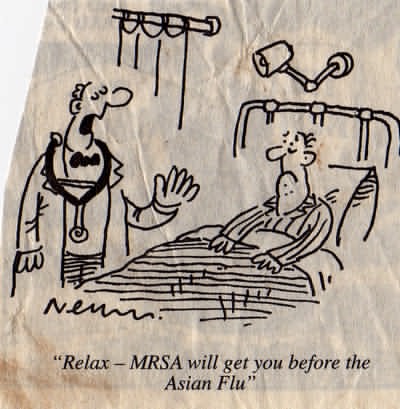
Time to take MRSA seriously

Image Hosted by ImageShack.us

The public is fascinated by exotic names. West Nile Virus. Ebola. Avian Flu. This is in spite of the fact that West Nile Virus killed 7 human beings in the US. For all the rhetoric about bioterrorism and anthrax and the siphoning off of much-needed funds into these ares by the administration, what finally kills us is what's in the backyard, not what's imported from abroad. What needs to be paid attention to is the much larger threat of antibiotic-resistant infectious diseases in this country. Before they consider threats from beyond borders, they need to consider threats within. The statistics are uncomfortable to say the least. Here's a very recent important JAMA report from October 2007: 18,000 deaths from MRSA. That's a stupendous number in this age of antibiotics if we think about it. It makes the number of MRSA victims more than the number of AIDS victims. Yes, more than the number of AIDS victims. That should put things in perspective.
"These data represent the first US nationwide estimates of the burden of invasive MRSA disease using population based, active case finding. Based on 8987 observed cases of MRSA and 1598 in-hospital deaths among patients with MRSA, we estimate that 94 360 invasive MRSA infections occurred in the United States in 2005; these infections were associated with death in 18 650 cases. The standardized incidence rate of invasiveMRSAfor calendar year 2005 was 31.8 per 100 000 persons. The incidence of other important invasive pathogens in 2005, such as invasive infections with S pneumoniae or Haemophilus influenzae, ranged from 14.0 per 100 000 to less than 1 per 100 000, largely due to the availability and success of vaccination."
For once, the Bushesque rhetoric "Be afraid" holds at least some water.

The impressive chemistry knowledge of talk-show hosts

I got this from Philip Ball's blog. Jeremy Paxman is a talk-show host in the UK. Apparently he has some quiz session where invariably a few science questions creep in. This is how the intrepid host tackles chemistry questions:
Paxman: “Which hydrated ferrous salt was once known as green vitriol?”
Student: “Iron sulphate.”
Paxman: “No, it’s just sulphate.”
Score one for the need to enroll talk-show hosts in science class, or maybe just a class in reasonableness.

You have my ears mate

Image Hosted by ImageShack.us
© BBC
Extraordinary desert creature , the long-eared jerboa, captured for the first time on tape. But what is a little unnerving is
"These amazing, remarkable creatures are on the verge of extinction and we know almost nothing about them," warned Dr Baillie.
I wonder how many other creatures we have already rendered extinct without knowing anything about them. I wonder when we will render extinct the species of frog whose skin holds the cure for AIDS. Then again, blame God. She rendered 99% of species extinct in the past.