Field of Science

Showing posts with label Carl Sagan. Show all posts

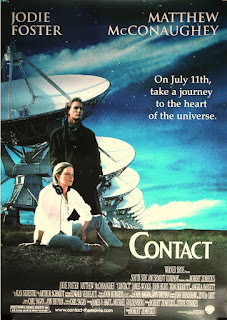
Has Carl Sagan's "Contact" aged well?

I have watched "Contact" several times and was watching it again the other day. Carl Sagan got a lot of things right in it, including the truth that even scientists have "faith" in matters disconnected with science. But one of the key parts of the film hasn't aged well for me.

For those who haven't seen it or read the book, Ellie Arroway, a brilliant astronomer played by Jodie Foster, is on a shortlist of people selected to be passengers on an interstellar machine constructed according to blueprints received by radio transmission from the Vega constellation. As earth's first ambassador to space, she is interviewed by a panel on her views on different topics. What would be the most important question she would ask the alien civilization?
An old flame who is on the panel - and who has a personal vested interest in not having her go since he still has romantic feelings for her - asks her squarely if she believes in God. The other members of the panel think that it would be unwise to pick as earth's first interstellar ambassador, someone who does not believe what 95% of the world's population believes. They think that one of the foremost questions Ellie should ask the aliens, should she meet them, is, "What God do you worship?". Elie being a scientist naturally says that she can't believe anything without demonstrated evidence. Candidate rejected.
It seems to me that Sagan really had an opportunity here, if not in the film then in the book, to showcase the theological and intellectual debates and problems concerning religion. The first question Ellie should have asked the panelists is: "When you ask whether I believe in God, I would ask you, *What* God? Those 95% of people you are referring to worship a zillion different Gods, from Jesus to Brahma. But there's even more, now-extinct Gods that their ancestors believed in, including Odin and Huitzilopochtli. Which God am I supposed to believe in? And do we think the aliens wouldn't ask me which one of these many Gods I believe in? What if I say the wrong name?". That would have driven home the central dilemma with believing in God right there.
But there might have been another, much more important question regarding religion that Arroway could have asked, and it would have been one that is independent of specific Gods. Religion clearly serves an important biological and evolutionary purpose, one explicated by numerous scientists. Instead of asking what God the aliens worship, the scientifically relevant question would be, "What are your deepest beliefs and how do you satisfy them?". This would have been a relevant question that is science, and yet one that would have provided an important answer about religion as, in Daniel Dennett's words, a "natural phenomenon".
As it turns out, the answer Arroway gives regarding the question is one I would have given myself: she says she would have asked the aliens how they did it; how they avoided blowing themselves up while developing such advanced technology. Especially in our present circumstances, asking a technologically advanced civilization that seems to have lasted much longer than us how they prevented self-extinction would be perhaps the most question we can ask.
But I can understand why Sagan had his character ask that question: it sets her up for the climax. After being transported to another world, Arroway sees and has a conversation with her loving father, one who had done everything he could to develop her interest and skills in science before tragically dying of a heart attack when Ellie was ten. When Ellie comes back after having that heartrending conversation, she comes to know that from the point of view of people here on earth, she was gone for only a short time, and her audiovisual equipment recorded nothing but noise. She is kept holding on to her vision of what is effectively an out-of-body experience and conversation with her father by the same slender thread which she had rejected before - faith. Sagan's point is that even scientists can have powerful experiences which they have to take on faith because there's no other way to explain them.
But upon watching that part again I still wasn't convinced of what Sagan was trying to say. If he was trying to propose reconciliation between science and religion, he was picking the wrong argument based on faith here. A scientist's "faith" that the sun will rise tomorrow is very different from faith that Jesus was born of a virgin. The former is predicated on well-understood laws of science that result in a probabilistic model which we can believe with high confidence; if the sun indeed failed to rise tomorrow, not just common sense but much of our understanding of physics, astronomy and planetary science would suddenly be called into question. That means that other phenomena that depend on this understanding would also be called into question. A scientist may take some things on "faith", but this is not really faith so much as it is informed judgement based on confidence limits and well-constructed models of reality.
Ultimately though, as much as I think Sagan could have done a much better job with these matters, I think the most important point he makes is still valid: that point simply is that, as monumentally useful and important science is, holding on to it is very hard and needs a lot of rock-solid conviction. That's a message we can all be on board with

Is Big Data shackling mankind's sense of creative wonder?

This is my latest monthly column for the site 3 Quarks Daily. 

Primitive science began when mankind looked upward at the sky and downward at the earth and asked why. Modern science began when Galileo and Kepler and Newton answered these questions using the language of mathematics and started codifying them into general scientific laws. Since then scientific discovery has been constantly driven by curiosity, and many of the most important answers have come from questions of the kind asked by a child: Why is the sky blue? Why is grass green? Why do monkeys look similar to us? How does a hummingbird flap its wings? With the powerful tool of curiosity came the even more powerful fulcrum of creativity around which all of science hinged. Einstein’s imagining himself on a light beam was a thoroughly creative act; so were Ada Lovelace’s thoughts about a calculating machine as doing something beyond mere calculation, James Watson and Francis Crick’s DNA model-building exercise, Enrico Fermi’s sudden decision to put a block of paraffin wax in the path of neutrons.

What is common to all these flights of fancy is that they were spontaneous, often spur-of-the-moment, informed at best by meager data and mostly by intuition. If Einstein, Lovelace and Fermi had paused to reconsider their thoughts because of the absence of hard evidence or statistical data, they might at the very least been discouraged from exploring these creative ideas further. And yet that is what I think the future Einsteins and Lovelaces of our day are in danger of doing. They are in danger of doing this because they are increasingly living in a world where statistics and data-driven decisions are becoming the beginning and end of everything, where young minds are constantly cautioned to not speculate before they have enough data.

We live in an age where Big Data, More Data and Still More Data seem to be all consuming, looming over decisions both big and mundane; from driving to ordering pet food to getting a mammogram. We are being told that we should not make any decision pending its substantiation through statistics and large-scale data analysis. Now, I will be the first one to advocate making decisions based on data and statistics, especially in an era where sloppy thinking and speculation based on incomplete or non-existent data seems to have turned into the very air which the media and large segments of the population breathe. Statistics has especially been found to be both paramount and sorely lacking in making decisions, and books like Daniel Kahneman’s “Thinking Fast and Slow” and Nate Silver’s “The Signal and the Noise” have stressed how humans are intrinsically bad at probabilistic and statistical thinking and how this disadvantage leads to them consistently making wrong decisions. It seems that a restructuring of our collective thinking process that is grounded in data would be a good thing for everyone.

But there are inherent problems with implementing this principle, quite apart from the severe limitations on creative speculation that an excess of data-based thinking imposes. Firstly, except in rare cases, we simply don’t have all the data that is necessary for making a good decision. Data itself is not insight, it’s simply raw material for insight. This problem is seen in the nature of the scientific process itself; in the words of the scientist and humanist Jacob Bronowski, in every scientific investigation we decide where to make a “cut” in nature, a cut that isolates the system of interest from the rest of the universe. Even late into the process, we can never truly know whether the part of the universe we have left out is relevant. Our knowledge of what we have left out is thus not just a “known unknown” but often an “unknown unknown”. Secondly and equally importantly, the quality of the data often takes second stage to its quantity; too many companies and research organizations seem to think that more data is always good, even when more data can mean more bad data. Thirdly, even with a vast amount of data, human beings are incapable of digesting this surfeit and making sure that their decisions include all of it. And fourthly and most importantly, making decisions based on data is often a self-fulfilling prophecy; the hypothesis we form and the conclusions we reach are inherently constrained by the data. We get obsessed with the data that we have and develop tunnel vision, and we ignore the importance of the data that we don’t have. This means that all our results are only going to be as good as the existing data.

Consider a seminal basic scientific discovery like the detection of the Higgs Boson, forty years after the prediction was made. There is little doubt that this was a supreme achievement, a technical tour de force that came about only because of the collective intelligence and collaboration of hundreds of scientists, engineers, technicians, bureaucrats and governments. The finding was of course a textbook example of how everyday science works: a theory makes a prediction and a well-designed experiment confirms or refutes the prediction. But how much more novelty the LHC would have found had the parameters been significantly tweaked, if the imagination of the collider and its operator been set loose? Maybe it would not have found the Higgs then, but it would have discovered something wholly different and unexpected. There would certainly have been more noise, but there would also have been more signal that would have led to discoveries which nobody predicted and which might have charted new vistas in physics. One of the major complaints about modern fundamental physics, especially in areas like string theory, is that it is experiment-poor and theory-rich. But experiments can only find something new when they don’t stay too close to the theoretical framework. You cannot always let prevailing theory dictate what experiments should do.

The success of the LHC in finding the Higgs and nothing but the Higgs points to the self-fulfilling prophecy of data that I mentioned: the experiment was set up to find or disprove the Higgs and the data contained within it the existence or absence of the Higgs. True creative science comes from generating hypotheses beyond the domain of the initial hypotheses and the resulting data. These hypotheses have to be confined within the boundaries of the known laws of nature, but there still has to be enough wiggle room to at least push against these boundaries, if not try to break free of them. My contention is that we are gradually becoming so enamored of data that it is clipping and tying down our wings, not allowing us to roam free in the air and explore daring new intellectual landscapes. It’s very much a case of the drunk under the lamppost, looking for his keys there because that’s where the light is.

A related problem with the religion of “dataism” is the tendency to dismiss anything that constitutes anecdotal evidence, even if it can lead to creative exploration. “Yes, but that’s an n of 1” is a refrain that you must have heard from many a data-entranced statistics geek. It’s important to not regard anecdotal evidence as sacrosanct, but it’s equally wrong in my opinion to simply dismiss it and move on. Isaac Asimov reminded us that great discoveries in science are made when an odd observation or fact makes someone go, “Hmm, that’s interesting”. But if instead, the reaction is going to be “Interesting, but that’s just an n of 1, so I am going to move on”, you are potentially giving up on hidden gems of discovery.

With anecdotal data also comes storytelling which has always been an integral part not just of science but of the human experience. Both arouse our sense of wonder and curiosity; we are left fascinated and free to imagine and explore precisely because of the paucity of data and the lone voice from the deep. Very few scientists and thinkers drove home the importance of taking anecdotal storytelling seriously as well as the late Oliver Sacks. If one reads Sacks’s books, every one of them is populated with fascinating stories of individual men and women with neurological deficits or abilities that shed valuable light on the workings of the brain. If Sacks had dismissed these anecdotes as insufficiently data-rich, he would have missed discovering the essence of important neurological disorders. Sacks also extolled the value of looking at historical data, another source of wisdom that would very easily be dismissed by hard scientists who think all historical data suspect because of its absence of large-scale statistical validation. Sacks regarded historical reports as especially neglected and refreshingly valuable sources of novel insights; in his early days, his insistence that his hospital’s weekly journal club discuss the papers of their nineteenth century forebears was met largely with indifference. But this exploration off the beaten track paid dividends. For instance, he once realized that he had rediscovered a key hallucinogenic aspect of severe migraines when he came across a paper on similar self-reported symptoms by the English astronomer John Herschel, written more than a hundred years ago. A data scientist would surely dismiss Herschel’s report as nothing more than a fluke.

The dismissal of historical data is especially visible in our modern system of medicine which ignores many medical reports of the kind that people like Sacks found valuable. It does an even better job ignoring the vast amount of information contained in the medical repositories of ancient systems of medicines, such as the Chinese and Indian pharmacopeias. Now, admittedly there are a lot of inconsistencies in these reports so they cannot all be taken literally, but neither is the process of ignoring them fruitful. Like all uncertain but potentially useful data, they need to be dug up, investigated and validated so that we can keep the gold and throw out the dross. The great potential value of ancient systems of medicine was made apparent when two years ago, the Nobel Prize for medicine was awarded to Chinese medicinal chemist Tu Youyou for her lifesaving discovery of the antimalarial drug artemisinin. Youyou was inspired to make the discovery when she found a process for low-temperature chemical extraction of the drug in a 1600-year-old Chinese text titled “Emergency Prescriptions Kept Up One’s Sleeve”. This obscure and low-visibility data point would have been certainly dismissed by statistics-enamored medicinal chemists in the West, even if they had known where to find it. Part of recognizing the importance of Eastern systems of medicine consists in recognizing their very different philosophy; while Western medicine seeks to attack the disease and is highly reductionist, Eastern medicine takes a much more holistic approach in which it seeks to modify the physiology of the individual itself. This kind of philosophy is harder to study in the traditional double-blinded, placebo-controlled clinical trial that has been the mainstay of successful Western medicine, but the difficulty of implementing a particular scientific paradigm should not be an argument against its serious study or adoption. As Sacks’s and Youyou’s examples demonstrate, gems of discovery still lie hidden in anecdotal and historical reports, especially in medicine where even today we understand so little about entities like the human brain.

Whether it’s the LHC or medical research, the practice of gathering data and relying only on that data is making us stay close to the ground when we could have been soaring high in the air without these constraints. Data is critical for substantiating a scientific idea, but I would argue that it actually makes it harder to explore wild, creative scientific ideas in the first place, ideas that often come from anecdotal evidence, storytelling and speculation. A bigger place for data leaves increasingly smaller room for authentic and spontaneous creativity. Sadly, today’s publishing culture also rooms little room for pure speculation-driven hypothesizing. As just one example of how different things have become in the last forty years, in 1960 the physicist Freeman Dyson wrote a paper in Science speculating on possible ways to detect alien civilizations based on their capture of heat energy from their parent star. Dyson’s paper contained enough calculations to make it at least a mildly serious piece of work, but I feel confident that in 2017 his paper would probably get rejected from major journals like Science and Nature which have lost their taste for interesting speculation and have become obsessed with data-driven research.

Speculation and curiosity have been mainstays of human thinking since our origins. When our ancestors sat around fires and told stories of gods, demons and spirit animals to their grandchildren, it made the wide-eyed children wonder and want to know more about these mysterious entities that their elders were describing. This feeling of wonder led the children to ask questions. Many of these questions led down wrong alleys, but the ones that survived later scrutiny launched important ideas. Today we would dismiss these undisciplined mental meanderings as superstition, but there is little doubt that they involve the same kind of basic curiosity that drives a scientist. There is perhaps no better example of a civilization that went down this path than ancient Greece. Greece was a civilization full of animated spirits and Gods that controlled men’s destinies and the forces of nature. The Greeks certainly found memorable ways to enshrine these beliefs in their plays and literature, but the same cauldron that imagined Zeus and Athena also created Aristotle and Plato. Aristotle and Plato’s universe was a universe of causes and humors, of earth and water, of abstract geometrical entities divorced from real world substantiation. Both men speculated with fierce abandon. And yet both made seminal contributions to Western science and philosophy even as their ideas were accepted, circulated, refined and refuted for the next two thousand years. Now imagine if Aristotle and Plato had refused to speculate on causes and human anatomy and physiology because they had insufficient data, if they had turned away from imagining because the evidence wasn’t there.

We need to remember that much of science arose as poetic speculations on the cosmos. Data kills the poetic urge in science, an urge that the humanities have recognized for a long time and which science has had in plenty. Richard Feynman once wrote,

“Poets say that science takes away the beauty of the stars and turns them into mere globs of gas atoms. But nothing is ‘mere’. I too can see the stars on a desert night, but do I see less or more? The vastness of the heavens stretches my imagination; stuck on this carousel my little eye can catch one-million-year-old light…What men are poets who can speak of Jupiter as if he were a man, but if he is an immense spinning sphere of methane and ammonia must be silent?”

Feynman was speaking to the sense of wonder that science should evoke in all of us. Carl Sagan realized this too when he said that not only is science compatible with spirituality, but it’s a profound source of spirituality. To realize that the world is a multilayered, many-splendored thing, to realize that everything around us is connected through particles and forces, to realize that every time we take a breath or fly on a plane we are being held alive and aloft by the wonderful and weird principles of mechanics and electromagnetism and atomic physics, and to realize that these phenomena are actually real as opposed to the fictional revelations of religion, should be as much a spiritual experience as anything else in one’s life. In this sense, knowing about quantum mechanics or molecular biology is no different from listening to the Goldberg Variations or gazing up at the Sistine Chapel. But this spiritual experience can come only when we let our imaginations run free, constraining them in the straitjacket of skepticism only after they have furiously streaked across the sky of wonder. The first woman, when she asked what the stars were made of, did not ask for a p value.

Carl Sagan's 1995 prediction of our technocratic dystopia

In 1995, just a year before his death, Carl Sagan published a bestselling book called “The Demon-Haunted World” which lamented what Sagan saw as the increasing encroachment of pseudoscience on people’s minds. It was an eloquent and wide-ranging volume. Sagan was mostly talking about obvious pseudoscientific claptrap such as alien abductions, psychokinesis and astrology. But he was also an astute observer of human nature who was well-educated in the humanities. His broad understanding of human beings led him to write the following paragraph which was innocuously buried in the middle of the second chapter.

“I have a foreboding of an America in my children's or grandchildren's time -- when the United States is a service and information economy; when nearly all the manufacturing industries have slipped away to other countries; when awesome technological powers are in the hands of a very few, and no one representing the public interest can even grasp the issues; when the people have lost the ability to set their own agendas or knowledgeably question those in authority; when, clutching our crystals and nervously consulting our horoscopes, our critical faculties in decline, unable to distinguish between what feels good and what's true, we slide, almost without noticing, back into superstition and darkness.”
As if these words were not ominous enough, Sagan follows up just a page later with another paragraph which is presumably designed to reduce us to a frightened, whimpering mass.

“I worry that, especially as the Millennium edges nearer, pseudoscience and superstition will seem year by year more tempting, the siren song of unreason more sonorous and attractive. Where have we heard it before? Whenever our ethnic or national prejudices are aroused, in times of scarcity, during challenges to national self-esteem or nerve, when we agonize about our diminished cosmic place and purpose, or when fanaticism is bubbling up around us - then, habits of thought familiar from ages past reach for the controls.

The candle flame gutters. Its little pool of light trembles. Darkness gathers. The demons begin to stir.”

What’s striking about this writing is its almost clairvoyant prescience. The phrases “fake news” and “post-factual world” were not used during Sagan’s times, but he is clearly describing them when he talks about people being “unable to distinguish between what’s real and what feels good”. And the rise of nationalist prejudice seems to have occurred almost exactly as he described.

It’s also interesting how Sagan’s prediction of the outsourcing of manufacturing mirrors the concerns of so many people who voted for Trump. The difference is that Sagan was not taking aim at immigrants, partisan politics, China or similar factors; he was simply seeing the disappearance of manufacturing as an essential consequence of its tradeoff with the rise of the information economy. We are now acutely living that tradeoff and it has cost us mightily.

One thing that’s difficult to say is whether Sagan was also anticipating the impact of technology on the displacement of jobs. Automation had already been around in the 90s and the computer was becoming a force to reckon with, but speech and image recognition and the subsequent impact of machine learning on these tasks was in its fledgling days. Sagan didn’t know about these fields: nonetheless, the march of technology also feeds into his concern about people gradually descending into ignorance because they cannot understand the world around them, even as technological comprehension stays in the hands of a privileged few.

In terms of people “losing the ability to set their own agendas or question those in power”, consider how many of us, let alone those in power, can grasp the science and technology behind deep learning, climate change, genome editing or even our iPhones? And yet these tools are subtly inserting them in pretty much all aspects of life, and there will soon be a time when no part of our daily existence is untouched by them. Yet it will also be a time when we use these technologies without understanding them, essentially safeguarding them with our lives, liberties and pursuit of happiness. Then, if something goes wrong, as it inevitably does with any complex system, we will be in deep trouble because of our lack of comprehension. Not only will there be chaos everywhere, but because we mindlessly used technology as a black box, we wouldn’t have the first clue about how to fix it.

Equally problematic is the paradox in which as technology becomes more user-friendly, it becomes more and more easy to apply it with abandon without understanding its strengths and limitations. My own field of computer-aided drug design (CADD) is a good example. Twenty years ago, software tools in my field were the realm of experts. But graphical user interfaces, slick marketing and cheap computing power have now put them in the hands of non-experts. While this has led to a useful democratization of these tools, it had also led to their abuse and overapplication. For instance, most of these techniques have been used without a proper understanding of statistics, not only leading to incorrect results being published but also to a waste of resources and time in the always time-strapped pharmaceutical and biotech industries.

This same paradox is now going to underlie deep learning and AI which are far more hyped and consequential than computer-aided drug design. Yesterday I read an interview with computer scientist Andrew Ng from Stanford who enthusiastically advocated that millions of people be taught AI techniques. Ng and others are well-meaning, but what’s not discussed is the potential catastrophe that could arise from putting imperfect tools in the hands of millions of people who don’t understand how they work and who suddenly start applying them to important aspects of our lives. To illustrate the utility of large-scale education in deep learning, Ng gives the example of how the emergence of commercial electric installations suddenly led to a demand for large numbers of electrical engineers. The difference was that electricity was far more deterministic and well-understood compared to AI. If it went wrong we largely knew how to fix it because we knew enough about the behavior of electrons, wiring and circuitry.

The problem with many AI algorithms like neural nets is that not only are they black boxes but their exactly utility is still a big unknown. In fact, AI is such a fledgling field that even the experts don’t really understand its domains of applicability, so it’s too much to believe that people who acquire AI diplomas in a semester or two will do any better. I would rather have a small number of experts develop and use imperfect technology than millions adopt technologies which are untested, especially when they are being used not just in our daily lives but in critical services like healthcare, transportation and banking.

As far as “those in power” are concerned, Sagan hints at the fact that they may no longer be politicians but technocrats. Both government and Silicon Valley technocrats have already taken over many aspects of our lives, but their hold seems to only tighten. One little appreciated story from that recent Google memo fiasco was written by journalist Elaine Ou who focused on a very different aspect of the incident; the way it points toward the technological elite carefully controlling what we read, digest and debate based on their own social and political preferences. As Ou says,

“Suppressing intellectual debate on college campuses is bad enough. Doing the same in Silicon Valley, which has essentially become a finishing school for elite universities, compounds the problem. Its engineers build products that potentially shape our digital lives. At Google, they oversee a search algorithm that seeks to surface “authoritative” results and demote low-quality content. This algorithm is tuned by an internal team of evaluators. If the company silences dissent within its own ranks, why should we trust it to manage our access to information?”

I personally find this idea that technological access can be controlled by the political or moral preferences of a self-appointed minority to be deeply disturbing. Far from all information being freely available at our fingertips, it will instead ensure that we increasingly read the biased, carefully shaped perspective of this minority. For example, this recent event at Google has indicated the social opinions of several of its most senior personnel as well as of those engineers who more directly control the flow of vast amounts of information permeating our lives every day. The question is not whether you agree or disagree with their views, it’s that there’s a good chance that these opinions will increasingly and subtly – sometimes without their proponents even knowing it – embed themselves into the pieces of code that influence what we see and hear pretty much every minute of our hyperconnected world. And this is not about simply switching the channel. When politics is embedded in technology itself, you cannot really switch the channel until you switch the entire technological foundation, something that’s almost impossible to accomplish in an age of oligopolies. This is an outcome that should worry even the most enthusiastic proponent of information technology, and it certainly should worry every civil libertarian. Even Carl Sagan was probably not thinking about this when he was talking about “awesome technological powers being in the hands of a very few”.

The real fear is that ignorance borne of technological control will be so subtle, gradual and all-pervasive that it will make us slide back, “almost without noticing”, not into superstition and darkness but into a false sense of security, self-importance and connectivity. In that sense it would very much resemble the situation in “The Matrix”. Politicians have used the strategy for ages, but ceding it to all-powerful machines enveloping us in their byte-lined embrace will be the ultimate capitulation. Giving people the illusion of freedom works better than any actual efforts at curbing freedom. Perfect control works when those who are controlled keep on believing the opposite. We can be ruled by demons when they come disguised as Gods.