Field of Science

Showing posts with label history of science. Show all posts

Richard L. Garwin (1928-2025): Force of Nature


There are physicists, and then there are physicists. There are engineers, and then there are engineers. There are government advisors, and then there are government advisors.

And then there’s Dick Garwin.

Richard L. Garwin, who his friends and colleagues called Dick, has died at the age of 97. He was a man whose soul imbibed technical brilliance and whose life threaded the narrow corridor between Promethean power and principled restraint. A scientist of prodigious intellect and unyielding moral seriousness, his career spanned the detonations of the Cold War and the dimming of the Enlightenment spirit in American public life. He was, without fanfare or affectation, the quintessential citizen‑scientist—at once a master of equations and a steward of consequence. When you needed objective scientific advice on virtually any technological or defense‑related question, you asked Dick Garwin, even when you did not like the advice. Especially when you did not like it. And yet he was described as “the most influential scientist you have never heard of”, legendary in the world of physics and national security but virtually unknown outside it.

He was born in Cleveland in 1928 to Jewish immigrants from Eastern Europe, and quickly distinguished himself as a student whose mind moved with the inexorable clarity of first principles. His father was an electronics technician and high school science teacher who moonlighted as a movie projectionist. As a young child Garwin was already taking things apart, with the promise of reassembling them. By the age of 21 he had earned his Ph.D. under Enrico Fermi, who—legend has it—once remarked that Garwin was the only true genius he had ever met. This was not idle flattery. After Fermi, Dick Garwin might be the closest thing we have had to a universal scientist who understood the applied workings of every branch of physics and technology. There was no system whose principles he did not comprehend, whether mechanical, electrical or thermodynamic, no machine that he could not fix, no calculation that fazed him. Just two years after getting his Ph.D., Garwin would design the first working hydrogen bomb, a device of unprecedented and appalling potency, whose test, dubbed “Ivy Mike,” would usher in a new and even graver chapter of the nuclear age.

Yet Garwin was never intoxicated by power. Because he thought the creation of the hydrogen bomb was driven by the exigencies of the age, he did not regret his work, but neither did he revel in it, seeking instead to control its worst excesses. For decades his contribution remained unknown, and he never bothered to update the record, saying that he could either get something done or get credit for it, but not both. Unlike many of his contemporaries, who leapt eagerly into the vortex of Cold War prestige and developed the braggadocio to go along with it, Garwin remained a paradoxical figure: at once the architect of supreme destructive force and one of its most persistent critics. He understood—perhaps more than any other scientist of his generation—that technical brilliance without ethical deliberation is merely efficiency in the service of catastrophe. He understood that his main job was to shoot down boondoggles and billion‑dollar bad ideas which were a defense department specialty. As perhaps the best example of how he saw his main function as offering stone‑cold sober advice based on the best technical analysis, he along with Hans Bethe pointed out fatal flaws with the Johnson administration’s ABM system and the Reagan administration’s SDI (Strategic Defense Initiative, derisively called Star Wars) system. As a member of Nixon’s science advisory council, he killed the proposal for a supersonic jetliner after citing noise pollution and structural concerns. In return the vindictive Nixon killed the science advisory council.

Garwin would advise every president from Truman to Obama, Republican and Democrat alike, offering a rare and vanishing example of a mind that could not be bought, flattered, or ideologically corralled. George W. Bush awarded him the National Medal of Science; Obama the nation’s highest civilian honor, the Presidential Medal of Freedom. He advised Kennedy during the Cuban Missile Crisis, pushed for the Anti‑Ballistic Missile Treaty under Nixon, helped Obama deal with the Deep Horizon Oil Spill and warned, presciently, of the folly of weaponizing space. From submarines to space weapons, from missile defense to nuclear disarmament, from oil spills to solar power, there was no field in which Garwin was not an expert, often the preeminent expert. Long after his hydrogen bomb design became a grim historical footnote, his advocacy for arms control, transparency, and rational defense policy continued unabated—earnest, unfashionable, and, above all, indispensable. As the physicist Freeman Dyson who was one of his fellow technical experts put it, Garwin was a prime example of how one man with a backpack could beat an army of government bureaucrats, if only that man’s name was Dick Garwin.

But to speak only of his role in the nuclear age is to risk caricature. Garwin’s genius was dazzlingly catholic. His parallel career at IBM mirrored some of the great technological innovations of our modern age. IBM prized him so highly that they allowed him to spend a third of his time doing classified government work on their dime. And their astute hiring decision paid off in spades. Garwin’s fingerprints are found in the design of gravitational wave detectors, in the refinement of MRI technology, in the development of GPS and satellite reconnaissance systems. He contributed to the understanding of superconductivity, to the design of the compact disc and the touch screen, to cryptography and to high‑energy physics – he narrowly missed the Nobel Prize for an experiment he conducted in his 20s to demonstrate what’s called parity violation in beta decay. And he did all this with a kind of quiet, omnidirectional intensity that shunned limelight but advanced civilization in tangible ways.

Garwin authored over 500 scientific papers, many of them marked not just by precision but by restraint—proposing solutions rather than pronouncements, elevating fact over flourish. He felt it his public responsibility to put almost the entire corpus of his unclassified work online at the Garwin Archive – more than 1600 pages of presentations, talks and technical analysis covering almost every defense‑related topic. If the academy in recent decades has become a theater of self‑display, Garwin belonged to an older order: one in which brilliance did not demand amplification, and integrity required no branding. As he said in a documentary made about him a few years ago, the preservation of our democracy was his lodestar; nothing else mattered if that goal could not be achieved.

Garwin kept on working, traveling, advising, relentlessly, until almost his last day. When he was 88 I had the privilege of having an email exchange with him about a project I was working on. My one‑paragraph question was answered with four paragraphs less than an hour after my message; characteristic of Dick, he also pointed me to technical tools that could aid my query. He sent me a touching obituary he had written of his wife of more than sixty‑five years, Lois, who had just died and who had been his pillar in supporting him and raising their three children.

It is difficult not to view Garwin’s passing as something more than a personal loss. It is the departure of a type—perhaps the last of a type. A scientist who not only understood the arcana of physics, but who grasped the frailty of human institutions and the perils of unmediated power. A man who could, with equal ease, work out a thermonuclear cascade and dismantle a delusion in a Senate hearing room. That such a figure would exit the stage at a moment not just when the world sorely needs him but when the machinery of government not only disregards scientific counsel but actively spurns it – preferring instead the solipsistic comfort of invented facts fueled by ideological biases – renders his absence all the more acute. Garwin represented the moral and intellectual ballast that keeps a civilization grounded, and without which it begins to drift. There were a select few handful like him – Hans Bethe, Freeman Dyson, Sidney Drell. But he was the last. That we are now adrift makes his departure feel less like the close of a chapter than the dimming of the last light on the horizon. His life, to those who knew it, offers a retort to cynicism. In an age when expertise is increasingly sneered at, and when the distinction between persuasion and knowledge is recklessly blurred, Richard Garwin stood for the proposition that facts still matter, that thought must precede action, and that it is possible—however rarely—for brilliance to be in the service of restraint rather than abandon.

Timeless Figures, #1: Albert Einstein

So much has been written about Albert Einstein over the ages that it is sometimes easy to take for granted and forget what made him special. Most of us know the earth-shattering impact his special and general theories of relativity had on physics, but it is easier to forget the very special man whose character traits undoubtedly made these soaring works of the human intellect possible.

Einstein’s parents, Hermann and Pauline, were intelligent and diligent. Hermann had an affinity for mathematics but had to become an apprentice and a professional to make ends meet. Pauline had an affinity for music and German literature. Their son inherited both talents, although later in life – perhaps repulsed by the Nazis’ obsessions with heredity – he attributed his success simply to heightened curiosity rather than inheritance. But given the respectable but by no means outstanding degree of his parents’ intellect, it is hard to deny that Einstein was the product of a very lucky genetic lottery.


In later popular accounts, Einstein was typically portrayed as a lazy student lost in his world, with a lackluster performance in school. But like other Einstein myths, this was false; he consistently received the highest grades grades, especially in mathematics and the sciences. His bent for science was clear at an early age and was illustrated especially by two episodes whose vivid impressions on him he could recall even decades later. One was the gift of a compass when he was five years old and sick: Albert was enthralled by the fact that the needle always pointed North, and this alerted him to “something deeply hidden” in the laws of Nature. The second was when his uncle Jakob introduced him to algebra: “We go hunting for an animal whose name we don’t know, so we call it x. When we bag our game, we pounce on it and give it its right name.”


It was early on that Einstein demonstrated his two most important traits, more important even than the glittering intellect that had been bestowed upon him. One was an open disdain for conformity and authoritarianism, whether it was in renouncing his German citizenship at the startling age of sixteen to avoid military conscription, impertinently questioning his professors or marrying his girlfriend Mileva Marić against his parents’ approval. Later these same traits would lead him to discover a revolutionary theory of physics (assuming that the speed of light was constant took an enormous amount of courage), snub his nose at German militarism and antisemitism, leave the country of his birth for good and carry on political activism in his adopted country. An accompanying trait was fearlessness; fearlessness at being mocked for his scientific and political beliefs. Both traits were enveloped in a self-effacing humor that let him see the absurd in life and the world. Undoubtedly these traits, and especially the humor, kept him sane at the brink of scientific discovery and in a world gone half-mad.


The story of Einstein’s lackluster educational performance is well-known. He lived a Bohemian existence and preferred to hang out with his friends in coffee shops, discussing philosophy and science and playing music on his violin. His admission to the famed ETH in Zurich failed because he did not do well enough in the general examination and had to take remedial courses. After he got in on his second attempt, he met the twenty-year-old Mileva – the only woman in his class – and was instantly smitten. His letters to her are full of passionate pronouncements, dirty limericks and poetry.


Graduating from the ETH, Einstein had trouble finding a teaching and research position. There is a letter from around his time from an anguished Hermann to the distinguished physical chemist Wilhelm Ostwald, later the winner of a Nobel Prize, asking for the good professor to give his son a job as an assistant. There is no reply from Ostwald on record. It was thanks to his friend Marcel Grossman’s father that Einstein found a job as a patent clerk, “third-class”, at the Swiss patent office in Bern. Grossmann was to later play a major role in Einstein’s mathematical enlightenment.


Einstein’s time at the patent office from 190 to 1909 and his ‘annus mirabilis’ of 1905, in which he produced five revolutionary papers that forever changed our understanding of physics, is well documented; these included the paper in which he introduced his famous equation relating mass to energy. In all of his science, Einstein’s two most important qualities were summed up by his biographer Abraham Pais: they were an appreciation for invariants (quantities that are independent of the frame of reference) and for statistical fluctuations. The former would enable him to explain relativity, the latter phenomena like Brownian motion and Bose-Einstein condensation.


What is perhaps less appreciated is the contribution of his humdrum daily job to the theory of relativity. Relativity sprang not from abstract manipulation of algebraic symbols but from imaginative thought experiments concerning everyday objects - clocks, rulers, trains, elevators. It was his time at the patent office that immersed Einstein in the details of mechanical implements. His daily job involved sharpening the often fuzzy, vague, partially thought-out ideas of inventors to make them legally defensible and workable in practice. He was quite good at this analysis and received praise from his supervisor as one of the most competent young men in the office. It is impossible to overestimate the impact of this immersion in the details of technical contrivances on Einstein’s future work on the frontiers of physics. Crucially, the job at the patent office left him free to focus on his physics and family in the evenings.


Einstein’s family life was not happy, to say the least, and he was not by any means the role model of the family man. Mileva, who herself had sacrificed a promising career, took care of the house and children and acted as an important sounding board for Einstein’s initial ideas, so much so that controversy later arose as to how much she might have contributed to them (there is no evidence that the key ideas came from anyone but Einstein). Einstein repaid her by omitting her name from the acknowledgments of his relativity paper, mentioning only his ETH friend Michele Besso who was another sounding board. The marriage was strained and often acrimonious. Einstein wrecked it by beginning an affair with his cousin, Elsa, in 1912; he would later have several affairs. When Mileva learned of his adultery, she moved to Zurich, taking their sons Eduard and Hans Albert. In 1919, after having her agree to a harsh set of conditions for remaining married to him, Einstein finally asked Mileva for a divorce; in return, he predicted that he would win the Nobel Prize and would give her the money from it. He did win it two years later, amusingly not for relativity, which even then was too abstract for the prize committee, but for his explanation of the photoelectric effect that grounded the nature of light in particles called photons.


After his annus mirabilis during which Einstein formulated the special theory of relativity, Einstein spent a hard ten years before coming up with the general theory of relativity. Both ideas were revolutionary, but Paul Dirac later remarked that while other scientists like Poincare and Lorentz might have stumbled upon the first one, it might have taken forever for anyone to discover the second one; its tenets were that original and novel. Einstein’s formulation of general relativity replaced gravity as a Newtonian force with gravity as a fundamental curvature of spacetime. He arrived at this startling, unexpected conclusion the same way that he had arrived at special relativity’s conclusions - by thinking of thought experiments. With special relativity, it was asking how the world would look like if he rode on a beam of light, a question he had first asked himself when he was sixteen. With general relativity it was realizing that a man in free fall would not feel his own weight - he called this thought the happiest thought of his life.


Unlike special relativity which could be explained with high school algebra - the physics was what was novel - general relativity needed mathematics that Einstein had never encountered. This is where his patent office friend Marcel Grossmann was crucial. After Einstein explained the requirements of general relativity, most notably the requirement of general covariance that would enable the laws of physics to look the same in all reference frames, Grossman told him that two branches of 19th-century mathematics would help him accomplish this. One was Riemannian geometry, developed by the German mathematical genius Bernhard Riemann, which extended plane geometry to curved surfaces. The other was the algebra of tensors, which are generalized extensions of vectors. 


That Einstein needed Grossmann’s insights to help him is a testament to his greatness as a physicist rather than a mathematician. It explains why there was no scientist like Einstein in the 20th century: while physicists like Paul Dirac, Wolfgang Pauli and Werner Heisenberg were more mathematically adept than Einstein, his feel for the physical picture and the thought experiment were unsurpassed. Among other physicists, probably only Richard Feynman and Enrico Fermi came close to this facility for visualizing the physical picture. In his later life, this facility left Einstein, and his failures would be explained by a peculiar over-reliance on mathematics which he had wisely avoided in his younger years.


1915, when war was engulfing the continent, saw Einstein putting the finishing touches on general relativity as a professor in Berlin; when he saw the equation explaining the longstanding problem of the anomalous precession of the orbit of Mercury, its deep truth made him feel like something had snapped inside him. Einstein was deeply shocked by Germany’s bombastic militarism and march toward war. His pacifism writ large, he refused to sign a letter supporting the war signed by ninety-three German scientific and artistic luminaries including Nobel laureates like Max Planck, Paul Ehrlich and Emil Fischer. Because of the war, experimental confirmation of general relativity had to wait until 1919, when an expedition to Africa led by the British astronomer Arthur Eddington confirmed a key prediction of the theory observable only during a total eclipse of the sun - the bending of starlight.


The prediction catapulted Einstein to the status of the world’s most famous scientist. Crowds thronged to hear him speak, and Eddington’s validation of his theory was also seen as the joining of nationalities that had been broken by a horrific war. In lecture tours of Asia and America, Einstein was welcomed as a celebrity; he met Charlie Chaplain and Upton Sinclair, and parents pushed their way through crowds to have their children meet him. But at home, where the “stab in the back” theory attributing Germany’s loss to communists and Jews was already being swallowed by many, including a young corporal named Adolf Hitler who had been blinded by poison gas, Einstein started finding a hostile reception. The Nobel laureates Johannes Stark and Philip Lenard had started agitating against him, and the general sullen mood of Germany because of the harsh terms imposed by the Treaty of Versailles made it easy for the population to search for easy scapegoats. Einstein’s friend Walther Rathenau, whose crucial actions as minister of production had made it possible for Germany to continue the war until 1919, was assassinated in 1922 by ultranationalists. Because of his internationalism and pacifism during the war, Einstein was a marked man and had good cause to fear for his own life.


His physics temporarily quelled conflict. The 1920s provided a fascinating contrast of sorts, between soaring and crippling economic deprivation on the one hand and unprecedented developments in physics on the other. The creation of quantum mechanics, beginning with Niels Bohr’s formulation of the structure of the atom in 1913 and continuing with work by Max Born, Werner Heisenberg, Paul Dirac and others, provided new fodder for Einstein. The same Einstein who had been a revolutionary in relativity became a conservative in quantum mechanics, although his positions were oversimplified later. He never rejected the success of quantum mechanics - through his explanation of the photoelectric effect, he was one of the originators of it, after all - but because of the intrinsic uncertainty and probabilistic interpretations it introduced, never thought it was a deep, final explanation of the world’s workings. His skepticism did not stop him from making two major contributions to it even in the 1920s; along with helping the Indian physicist Satyendranath Bose develop a novel form of quantum statistics, Einstein laid the foundations of what later became the laser.


But his philosophical problems with quantum mechanics continued for the rest of his life. They also led to a deep friendship with Niels Bohr. When Bohr had formulated his theory of atomic structure, Einstein had called it the “highest form of musicality in the sphere of thought”. Bohr was as deep a thinker in physics as Einstein; he and Einstein became intimate friends as well as spirited adversaries, forming a relationship which held fast and strong until the end of their lives. Each time Einstein would come up with what was purportedly a violation of a fundamental quantum principle like Heisenberg’s uncertainty principle, such as in the famous 1927 Solvay Conference, Bohr would reply with a rejoinder that sometimes embarrassingly relied on explanations based on Einstein’s own theories of relativity. Bohr’s “Discussions with Einstein on Epistemological Problems in Atomic Physics” is the most complete account of his disagreements.


In the 1930s, storm clouds gathered over Europe again as the Nazi party won increasingly larger shares of votes in the Reichstag elections. In January 1933, using perfectly legal means effected by a foolish and deluded Hindenburg and his associates, Adolf Hitler became chancellor of journey. A month later, Einstein, who had experienced increasing attacks and personal antisemitism since the 1920s and who was visiting the United States, announced that he would no longer return to Germany. That March, he renounced his German citizenship for the second time; he would not return to the country of his birth and high accomplishments for the rest of his life. By that time, knowing what direction the winds were blowing, Einstein had already discussed positions at Oxford, Caltech and the newly conceived Institute for Advanced Study. Future institute director Abraham Flexner was an ardent believer in what he called the “usefulness of useless knowledge.” With no teaching and administrative duties, Einstein accepted the IAS offer, becoming the baggy pant-wearing, shaggy-haired, affable sage of the small, provincial town of Princeton, NJ, for the next thirty years.


Einstein may have been a genius, but he was certainly not immune to mistakes. Two stand out, not so much because they demonstrate Einstein’s failures as his mode of thinking. In 1917, Einstein applied his general theory of relativity to the entire universe, essentially founding modern cosmology. Curiously, he found out that his toy universe would not remain static but would instead expand like a balloon. To keep it static, he introduced a “cosmological constant” that would retard its expansion. But in 1922, the Russian physicist Alexander Friedmann found that Einstein’s equations are valid in a non-static universe. Einstein often called the cosmological constant his “biggest mistake”, but by the 1930s, thanks to the pioneering experimental observations of the American astronomer Edwin Hubble, he had accepted the notion of an expanding universe. In the 1990s, a positive value for the cosmological constant acquired new meaning when independent teams found that the expansion of the universe is accelerating.


Einstein’s second mistake is more interesting: he never accepted the existence of black holes and even wrote a paper arguing against their existence. Freeman Dyson’s explanation for Einstein’s refusal was that by the late 1930s when Robert Oppenheimer and his students had postulated black holes, Einstein had become the mathematical platonist he would turn into during his later years; black holes with their singularities were simply too ugly for him. Einstein’s abhorrence of black holes is a good example of how an excessive emphasis on preconceived beauty can blind even great minds to the logical consequences of their own theories.


Einstein’s time in Princeton was far from the most productive time of his life. He was a celebrity and his advice was sought by dignitaries and crackpots. He met FDR and formed a strong relationship with his Jewish Secretary of the Treasury, Henry Morgenthau. He regularly spoke against the Nazi regime even as the Nazis ransacked his house and burnt his books. But he was no longer at the frontier of physics, which was centered mostly around nuclear physics. In 1932 the neutron was discovered, and physicists had a new tool with which to probe the interior of the atom. Unknown to Einstein, scientists in Italy, Germany, Great Britain and other countries started investigating the effect of neutrons on different nuclei. At the end of 1938, German scientists Otto Hahn and Fritz Strassmann discovered nuclear fission, and physicists across Europe and America quickly realized the possibility of an atomic bomb. Foremost among these was the Hungarian-born American physicist Leo Szilard, who had conceived of a nuclear chain reaction while standing at a traffic light in London in 1933. Szilard and Einstein went back to their times in Berlin, when they had filed a joint patent for an intrinsically safe refrigerator. Szilard realized the urgency of the United States building a nuclear bomb before Germany and sought out Einstein as the only scientist with enough stature to convey the message to President Roosevelt. The famous Einstein-Szilard letter did convince FDR to start a nascent atomic bomb program, which kicked into high gear and became the Manhattan Project after Pearl Harbor. But ironically, Einstein because of his German and pacifist background was never granted a security clearance by the government and invited to join the project.


Later Einstein rued the violent uses to which his science had been put, quipping that he should have rather become a watchmaker or plumber; in an obituary, Oppenheimer puckishly suggested that Einstein had no idea how challenging an American plumber’s job was. However, his disdain for nuclear weapons led Einstein to become a powerful voice of peace and sanity in a world that was becoming increasingly paranoid because of the Cold War. He addressed radio audiences, supported civil rights and socialist dissidents, including former students like David Bohm who had been trapped in Joseph McCarthy’s red scare, and agitated against McCarthy’s thuggery. When Oppenheimer, who was technically Einstein's boss as the director of the Institute for Advanced Study, lost his security clearance because of a witch hunt, Einstein advised him to fling his security clearance at an ungrateful government. Most consequentially, Einstein who had embraced the cause of Zionism for decades, supported the creation of a home for Jewish people in Palestine. But Einstein would almost certainly have been horrified by some of Israel’s right-wing nationalism today; as his later letters indicate, he always wanted Palestine to be equally free to Jews and Arabs, with open entry for all.


Einstein’s scientific and political rebellion won him few friends, although as the world’s most famous scientist, he continued to be idolized. In physics, he had let the particle physics revolution sweep past him and kept on expressing his skepticism of quantum mechanics. The young revolutionary had become an old conservative, leading Oppenheimer to trenchantly remark that he was a “lighthouse, not a beacon.” With his trademark self-effacing humor, Einstein was well aware that he was being treated more like a sacred relic rather than a practicing scientist; in 1942, he described himself as having become “a lonely old man who is displayed now and then as a curiosity because he doesn't wear socks.” Lonely after Elsa had died in 1936, he kept on scribbling equations in quest of a grand unified theory combining gravity and electromagnetism, not realizing that he would critically need the strong and weak nuclear forces that were just being revealed.


On April 17, 1955, Einstein suffered internal bleeding because of a ruptured abdominal aneurysm. Surgery could have prolonged his life for a short period, but he refused, saying  "I want to go when I want. It is tasteless to prolong life artificially. I have done my share; it is time to go. I will do it elegantly.” He died in Princeton Hospital the next day.


Einstein’s life illustrates many lessons, but none more than the importance of curiosity and fearlessness and being true to himself. While the world changed momentously during his life, Einstein did not change in his essentials. His love of science and music and men, his commitment to pacifism and the international brotherhood of men and women, and his almost religious (although secularly so) feeling for the beauty and unity of nature’s laws stayed with him all his life. We are unlikely to see another like him for a long time, although he leaves us with lessons worth emulating for a lifetime.

Jack Dunitz (1923-2021): Chemist And Writer Extraordinaire

Every once in a while there is a person of consummate achievement in a field, a person who while widely known to workers in that field is virtually unknown outside it and whose achievements should be known much better. One such person in the field of chemistry was Jack Dunitz. Over his long life of 98 years Dunitz inspired chemists across varied branches of chemistry. Many of his papers inspired me when I was in college and graduate school, and if the mark of a good scientific paper is that you find yourself regularly quoting it without even realizing it, then Dunitz’s papers have few rivals.

Two rare qualities in particular made Dunitz stand out: simple thinking that extended across chemistry, and clarity of prose. He was the master of the semi-quantitative argument. Most scientists, especially in this day and age, are specialists who rarely venture outside their narrow areas of expertise. And it is even rarer to find scientists – in any field – who wrote with the clarity that Dunitz did. When he was later asked in an interview what led to his fondness for exceptionally clear prose, his answer was simple: “I was always interested in literature, and therefore in clear expression.” Which is as good a case for coupling scientific with literary training as I can think of.

Dunitz who was born in Glasgow and got his PhD there in 1947 had both the talent and the good fortune to have been trained by three of the best chemists and crystallographers of the 20th century: Linus Pauling, Dorothy Hodgkin and Leopold Ruzicka, all Nobel Laureates. In my personal opinion Dunitz himself could have easily qualified for a kind of lifetime achievement Nobel himself. While being a generalist, Dunitz’s speciality was the science and art of x-ray crystallography, and few could match his acumen in the application of this tool to structural chemistry.

X-ray crystallography was developed by physicists in the first half of the 20th century to peer inside molecules, the way x-rays and MRI peer inside the human body. Just like those two techniques tell us the locations and structures of various organs in our body, x-ray crystallography tells us where the atoms in a molecule are exactly located, what the lengths of the various bonds are and what the stoichiometry – the exact composition of a complex mixture – is. If you had to point out one technique that has truly revolutionized chemistry, laying the entire chemical universe ranging from rocks and minerals to proteins and nucleic acids bare, it is x-ray crystallography. Dozens of Nobel Prizes for figuring out the structures of increasingly complex molecules, starting with table salt and progressing on through DNA, hemoglobin and the entire ribosome – the multi-component assembly that synthesizes proteins in living organisms – have been awarded through the decades.

One such Nobel Prize was given to James Watson and Francis Crick for figuring out the structure of DNA, a feat made possible by the world-class x-ray crystallography on DNA done by Rosalind Franklin and Raymond Gosling. Dunitz who got his PhD in Glasgow and was working in Oxford in 1953 saw history in the making as he and a colleague drove up to Cambridge to see the ball-and-stick model of DNA using metal plates and tubes that Watson and Crick had constructed. In fact after making a suggestion to Pauling who had figured out the fundamental structure of proteins at Caltech, Dunitz might have contributed an immortal alphabet to the language of life:

While my own work at Caltech had nothing to do with protein structure, Pauling used to talk to me occasionally about his models and what one could learn from them. In his lecture, he had talked about spirals. In conversation a few days later, I told him that for me the word “spiral” referred to a curve in a plane. As his polypeptide coils were three-dimensional figures, I suggested they were better described as “helices.” Pauling’s erudition did not stop at the natural sciences. He answered, quite correctly, that the words “spiral” and “helix” are practically synonymous and can be used almost interchangeably, but he thanked me for my suggestion because he preferred “helix” and declared that he would always use it henceforth. Perhaps he felt that by calling his structure a helix there would be less risk of confusion with the various other models that had been proposed earlier. In their 1950 short preliminary communication, Pauling and Corey wrote exclusively about spirals, but in the series of papers published the following year the spiral had already given way to the helix. There was no going back. A few years later we had the DNA double helix, not the DNA double spiral.

After seeing the power of crystallography to crack open the very structure of life, Dunitz spent the rest of his career in that field at the famed ETH in Zurich, capping an incredible 64-year-long career with his death in 2021; his last paper, written when he was 96, was appropriately a critique of certain chemical terminology and titled “Bad Language“.

Dunitz was truly unusual in ranging across the broad spectrum of chemical disciplines. Organic, inorganic and biological chemistry all came within his purview, aided by the powerful interdisciplinary generality of the tool of x-ray crystallography which he wielded with aplomb. Over his long career he published more than 350 scientific papers and penned several foundational books. It would be impossible to review his entire corpus, so I now review three of his papers which made a striking impression on me, which I have cited and read many times over the years, and which I think showcase his striking originality in marshaling simple models and arguments across a variety of fields.

Hydrogen Bonding
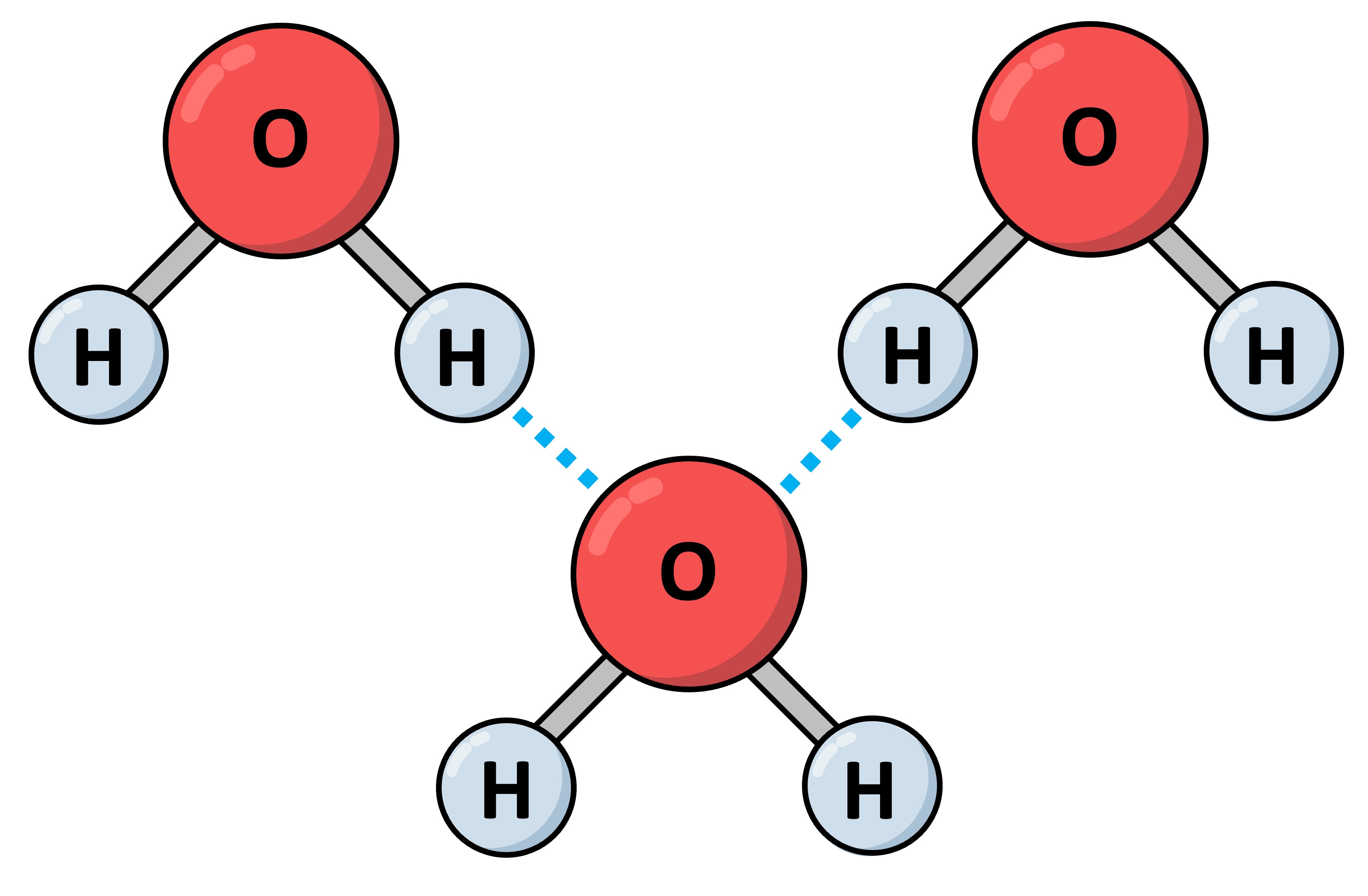
Hydrogen bonds in water molecules: the hydrogens of one molecule form fleeting interactions with the oxygens of the other (Image credit: Bioninja)

Perhaps my favorite paper of Dunitz’s is a 1997 paper titled “Organic Fluorine Hardly Ever Accepts Hydrogen Bonds”. Some explication is needed here. Hydrogen bonds are weak, fleeting bonds between hydrogen and other atoms which, while weak, are absolutely critical in keeping all kinds of molecules including proteins and nucleic acids together. In fact, water would not be a liquid without hydrogen bonds and life as we know it would not exist without them. It is their very transient nature that make hydrogen bonds “on-demand” bonds; they can be formed when needed and rapidly dissolved when no longer needed. Linus Pauling, often considered the most important chemist of the 20th century, had underscored the importance of hydrogen bonds in the 1930s in his seminal book, “The Nature of the Chemical Bond”. Typically hydrogen bonds are formed between hydrogen and what are called ‘electronegative’ atoms, ones like oxygen and nitrogen. Electronegative atoms have a particular affinity for electrons, attracting the electron clouds of atoms like hydrogen; the most common hydrogen bonds therefore are ones between oxygen and nitrogen.

There is another element on the periodic table, a most unusual one, which should be even more powerful at forming hydrogen bonds, except that it isn’t. That element is fluorine. Fluorine is in fact the most electronegative element on the periodic table, which is why we would expect it to form hydrogen bonds with furious abandon. But while inorganic fluorine found in compounds like hydrofluoric acid – a diabolically corrosive and dangerous substance – does form these hydrogen bonds, organic fluorine (fluorine bonded to carbon, that is) found in compounds like polytetrafluoroethylene – PTFE or Teflon – does not. In fact it is precisely fluorine’s reluctance to form hydrogen bonds with water in Teflon that makes it such an effective coating for non-stick cookware.

This behavior of fluorine is what the facts indicate, but the facts in this case don’t line up well with chemical theory which expects hydrogen bonding tendencies to increase with electronegativity. Fortunately there is a big database of “solved” crystal structures of organic molecules that includes molecules containing fluorine; it was only waiting for the right person to come along to interpret it. Dunitz’s paper was perhaps the first one to exhaustively analyze this database and then come up with a convincing chemical explanation for the counterintuitive observation that fluorine hardly ever forms hydrogen bonds. He looked at almost 6000 structures with fluorine and determined that hardly a dozen form hydrogen bonds between the fluorine and other hydrogen atoms. The details of why fluorine is reluctant to form hydrogen bonds is beyond the scope of this post (and explained in a further paper by Dunitz), but the qualitative explanation is simple: imagine that an electronegative element like oxygen has “hands” that pull others toward it. The problem with fluorine is that it is so electronegative that it simply keeps its hands to itself.

Even today I keep meeting chemists who, based on what seems like entirely sound chemical logic, expect fluorine to form hydrogen bonds. They recommend that one make drug molecules with fluorine that would enable them to stick better to and form hydrogen bonds with proteins that they want to block, proteins that have gone haywire in cancer, for instance. It is then that I find myself waving Dunitz’s paper – sometimes literally since I still “believe” in paper copies – with the fervent enthusiasm of a preacher.

The second paper from Dunitz that I often highlight shows Dunitz’s masterful application of simple, semi-quantitative arguments to addressing an important question. One of the most important things that scientists want to know when thinking about biological molecules like proteins is how they interact with water. All biological molecules are swimming in a vast sea of water; in fact water not just ubiquitously surrounds these molecules but is also an intimate participant in their behavior. Knowing the thermodynamics of this system – the strength of binding in particular between proteins and other molecules and water – is critical in engineering better drugs and proteins. Two factors are key in quantifying this binding: enthalpy and entropy. Roughly speaking, enthalpy concerns itself with the strength of the interactions between two molecules and entropy concerns itself with how loosely or tightly they bind, whether they stay in place or whether they jiggle around. While enthalpy is often easy to estimate, entropy is not.

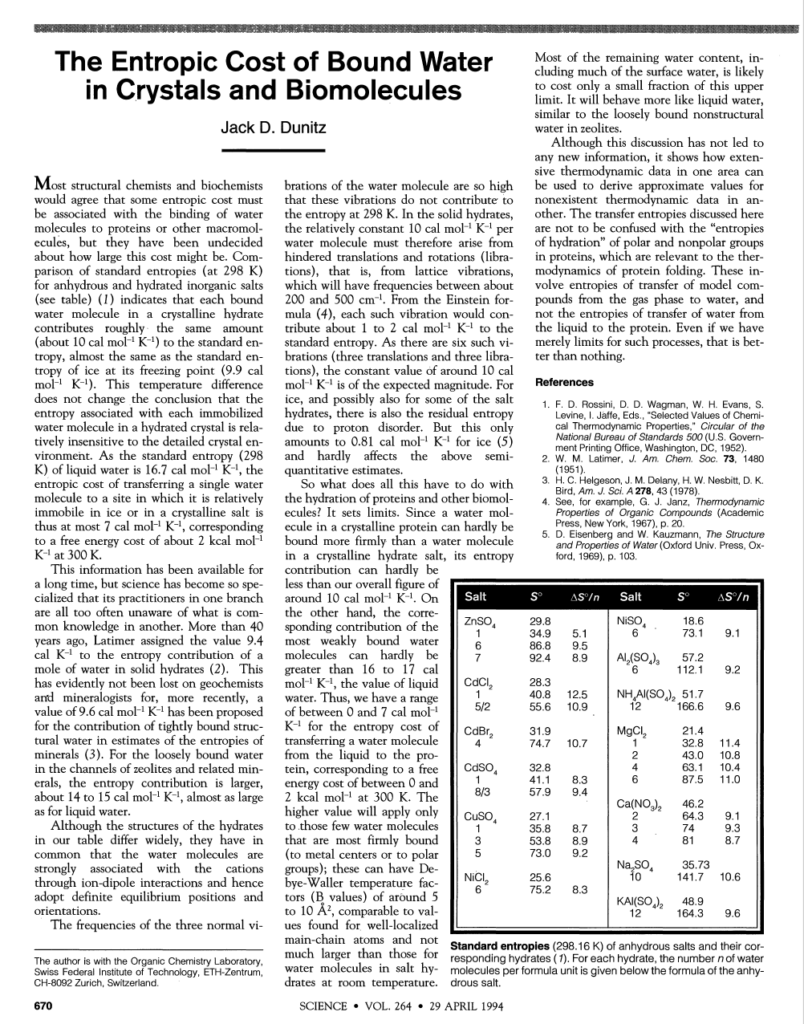
Image credit: Science

In 1994, Dunitz wrote a one-page paper in the journal ‘Science’ titled “The Entropic Cost of Bound Water Molecules in Crystals and Biomolecules” in which, using the simplest of data and arguments, he came up with a reliable number quantifying the entropy of a single water molecule binding to biological molecules. One of his strengths here which is also showcased in the fluorine paper is his ability to look at old data and come up with new explanations. He starts by looking at data on hydrates, simple salts like zinc sulfate which are surrounded by water molecules. He also looks at old data on the thermodynamics of the melting and freezing of ice which would also gives estimates on the entropy of water molecules; he points out something telling which is now a far more serious problem in our specialized world, namely that “this information has been available for a long time, but science has become so specialized that its practitioners in one branch are all too often unaware of what is common knowledge in another.”

How is thermodynamic information on ice, liquid water and hydrate salts relevant to what goes on with proteins? Because, as Dunitz astutely observes, this thermodynamics sets an upper limit on the entropy question for water around proteins: salts bind water molecules most tightly, so surely proteins would bind them more weakly? Using these arguments, Dunitz arrives at a value for the entropy of a bound water molecule which is now commonly used in calculations. The paper demonstrates characteristic Dunitzian strengths which should be widely emulated: scrupulous attention to existing data, including data going back decades, simple back-of-the-envelope calculations, and proof by analogy.

The last paper among Dunitz’s great corpus of works is a paper which exemplifies a particularly fine example of speculative as well as interdisciplinary thinking. It questioned a fact which everyone knows but no one really thinks about: Why is body temperature for animals like humans who can maintain their temperature about 36 degrees celsius, and why is it maintained across such a huge range of organisms? As we know, unless they are sick, homeothermic animals like ourselves are very efficient at regulating body heat. An explanation provided by some previous scientists pointed to the specific heat of water. Specific heat is the amount of heat required to change the temperature of a substance by one degree. Water has a very large specific heat compared to many other substances, which is just one of many of its remarkably unusual properties. But this specific heat happens to reach its lowest value at about 36 degrees celsius, just the optimum temperature mentioned above. The previous explanation said that water at this temperature was least resistant to changes in its temperature and quickly dissipated whatever heat was added to or subtracted from it.

Dunitz and his co-author, Steven Benner, found this argument “appealing, but not correct” in their response, published in the journal Nature in 1986. First, they identify what seems to be an obvious but overlooked problem: the smaller the specific heat, the easier it will be to cause fluctuations in temperature, making it harder for an organism to survive, not easier. They also realize that the previous argument only applies to pure water; water in living organisms is a complex aqueous mixture consisting of water, biomolecules like proteins and salts. So what could be responsible for the precise temperature regulation? Dunitz and Benner don’t pretend to know the answer, but they focus on two of water’s unique properties in particular, its hydrophobicity (or tendency to repel greasy, oil-like substances) and its viscosity. As temperature rises, water becomes less viscous and therefore facilitates chemical reactions in it. However, hydrophobicity also lessens with temperature, which could lead to unwanted mingling between water and greasy substances. Dunitz and Benner speculate that a temperature of 36 degrees is a Goldilocks-like zone, one where the viscosity is low enough for chemical reactions to speedily occur but hydrophobicity is high enough to prevent greasy substances from dissolving too easily.

To me this paper is a superb example of informed speculation, not pretending to solve a problem but offering a tantalizing potential solution and gently but firmly demolishing an existing explanation. It is widely believed that life anywhere in the universe would have to be based on water. Dunitz and Brenner’s analysis of the temperature dependence of water’s unique viscosity and hydrophobicity provides another window on why this substance is so unique for supporting life.

These three papers may serve to exemplify the range of Dunitz’s contributions, and they are but a slice of his vast corpus. In another analysis, he used a purely mathematical argument about the geometry of a pentagon to predict the experimentally-verified geometry of cyclopentane, a molecule with five carbon atoms arranged in a ring. His is a textbook name in many ways, none more so than in the eponymous “Bürgi-Dunitz angle” which describes the angle of attack of a reacting molecule and the precise geometric configuration of the reactants in an important class of organic reactions, one which has yielded great dividends of both academic and industrial interest.

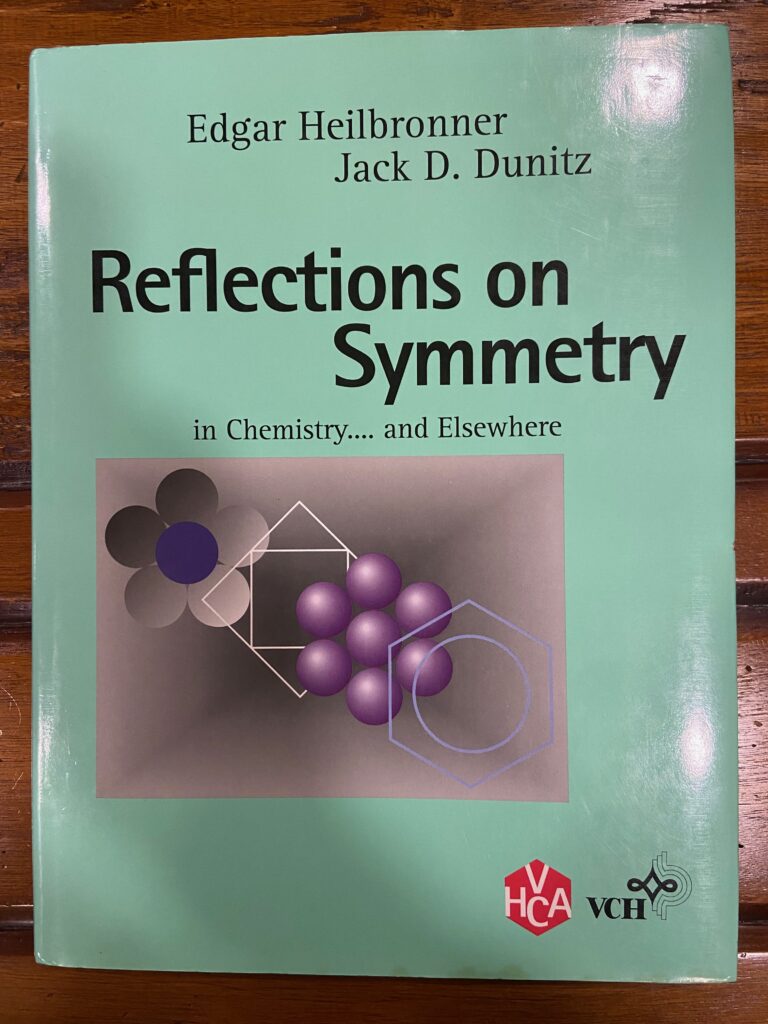
Apart from scientific papers spanning a remarkable variety of topics, Dunitz also wrote books that are considered foundational in the field. Perhaps my favorite book of his is written for laymen. “Reflections on Symmetry: In Chemistry…and Elsewhere“, written with his co-author Edgar Heilbronner, is a marvelous look at symmetry, perhaps the deepest quality of nature. Symmetry is absolutely fundamental not just for chemistry and biology but in the deepest reaches of physics, including quantum mechanics and particle physics. Dunitz and Heilbronner’s book is a romp through aspects of symmetry in fields as disparate as medieval mathematics, Islamic and modern art and of course, chemistry. It is a beautiful book, filled with illustrations and elegant arguments.

Jack Dunitz was one of those scientists who enrich everything they touch, across a wide range of domains, with insight, revelation and beauty. The simplicity and importance of his arguments, humility as a man and fearlessness in tackling disparate problems will be a candle that will keep lighting the minds of aspiring chemists and other scientists for eons to come.


How Niels Bohr predicted Rydberg atoms


In Niels Bohr's original 1913 formulation of the quantum atom, the Bohr radius r was proportional to n^2, n being the principal quantum number. Highly excited states would correspond to very large values of n and Bohr predicted these "giant" atoms would exist. Since the volume scales as r^3 or n^6, for n=33 you should see a "hydrogenic" atom a billion times larger than a ground state hydrogen atom. However, no spectral lines corresponding to such atoms were observed. So was Bohr's theory wrong?

No! Bohr pointed out that unlike physicists, *astronomers* had observed faint spectral lines in the spectra or stars and nebulae, consistent with his theory. Because of the large proportion of gas and low density, he predicted such highly excited states would exist.

Because of the extremely low densities, these excited states could live for as long as 1 second - a lifetime for an atom. In 1957, astronomers looking for electron-proton recombination in the interstellar medium serendipitously observed spectra from hydrogen atoms for n=110! In the 1970s, after Bohr's death, the advent of tunable dye lasers finally made it possible to observe these excited states in the lab. Because of their long lifetimes and huge electric dipole moments, these atoms have potential applications in quantum computing.


These "atoms" are called Rydberg atoms because Johannes Rydberg had hypothesized about these large-quantum-number states in the 19th century. But Bohr provided a physical basis and an explanation, so they should really be called Rydberg-Bohr atoms at the least. Today, Rydberg atoms have diverse applications ranging from lasers to quantum computing to plasma physics to radio receivers for military applications. But it all goes back - almost as an afterthought - to Bohr's original pioneering 1913 paper and should be recognized as such.