Field of Science

Showing posts with label Einstein. Show all posts

Timeless Figures, #1: Albert Einstein

So much has been written about Albert Einstein over the ages that it is sometimes easy to take for granted and forget what made him special. Most of us know the earth-shattering impact his special and general theories of relativity had on physics, but it is easier to forget the very special man whose character traits undoubtedly made these soaring works of the human intellect possible.

Einstein’s parents, Hermann and Pauline, were intelligent and diligent. Hermann had an affinity for mathematics but had to become an apprentice and a professional to make ends meet. Pauline had an affinity for music and German literature. Their son inherited both talents, although later in life – perhaps repulsed by the Nazis’ obsessions with heredity – he attributed his success simply to heightened curiosity rather than inheritance. But given the respectable but by no means outstanding degree of his parents’ intellect, it is hard to deny that Einstein was the product of a very lucky genetic lottery.


In later popular accounts, Einstein was typically portrayed as a lazy student lost in his world, with a lackluster performance in school. But like other Einstein myths, this was false; he consistently received the highest grades grades, especially in mathematics and the sciences. His bent for science was clear at an early age and was illustrated especially by two episodes whose vivid impressions on him he could recall even decades later. One was the gift of a compass when he was five years old and sick: Albert was enthralled by the fact that the needle always pointed North, and this alerted him to “something deeply hidden” in the laws of Nature. The second was when his uncle Jakob introduced him to algebra: “We go hunting for an animal whose name we don’t know, so we call it x. When we bag our game, we pounce on it and give it its right name.”


It was early on that Einstein demonstrated his two most important traits, more important even than the glittering intellect that had been bestowed upon him. One was an open disdain for conformity and authoritarianism, whether it was in renouncing his German citizenship at the startling age of sixteen to avoid military conscription, impertinently questioning his professors or marrying his girlfriend Mileva Marić against his parents’ approval. Later these same traits would lead him to discover a revolutionary theory of physics (assuming that the speed of light was constant took an enormous amount of courage), snub his nose at German militarism and antisemitism, leave the country of his birth for good and carry on political activism in his adopted country. An accompanying trait was fearlessness; fearlessness at being mocked for his scientific and political beliefs. Both traits were enveloped in a self-effacing humor that let him see the absurd in life and the world. Undoubtedly these traits, and especially the humor, kept him sane at the brink of scientific discovery and in a world gone half-mad.


The story of Einstein’s lackluster educational performance is well-known. He lived a Bohemian existence and preferred to hang out with his friends in coffee shops, discussing philosophy and science and playing music on his violin. His admission to the famed ETH in Zurich failed because he did not do well enough in the general examination and had to take remedial courses. After he got in on his second attempt, he met the twenty-year-old Mileva – the only woman in his class – and was instantly smitten. His letters to her are full of passionate pronouncements, dirty limericks and poetry.


Graduating from the ETH, Einstein had trouble finding a teaching and research position. There is a letter from around his time from an anguished Hermann to the distinguished physical chemist Wilhelm Ostwald, later the winner of a Nobel Prize, asking for the good professor to give his son a job as an assistant. There is no reply from Ostwald on record. It was thanks to his friend Marcel Grossman’s father that Einstein found a job as a patent clerk, “third-class”, at the Swiss patent office in Bern. Grossmann was to later play a major role in Einstein’s mathematical enlightenment.


Einstein’s time at the patent office from 190 to 1909 and his ‘annus mirabilis’ of 1905, in which he produced five revolutionary papers that forever changed our understanding of physics, is well documented; these included the paper in which he introduced his famous equation relating mass to energy. In all of his science, Einstein’s two most important qualities were summed up by his biographer Abraham Pais: they were an appreciation for invariants (quantities that are independent of the frame of reference) and for statistical fluctuations. The former would enable him to explain relativity, the latter phenomena like Brownian motion and Bose-Einstein condensation.


What is perhaps less appreciated is the contribution of his humdrum daily job to the theory of relativity. Relativity sprang not from abstract manipulation of algebraic symbols but from imaginative thought experiments concerning everyday objects - clocks, rulers, trains, elevators. It was his time at the patent office that immersed Einstein in the details of mechanical implements. His daily job involved sharpening the often fuzzy, vague, partially thought-out ideas of inventors to make them legally defensible and workable in practice. He was quite good at this analysis and received praise from his supervisor as one of the most competent young men in the office. It is impossible to overestimate the impact of this immersion in the details of technical contrivances on Einstein’s future work on the frontiers of physics. Crucially, the job at the patent office left him free to focus on his physics and family in the evenings.


Einstein’s family life was not happy, to say the least, and he was not by any means the role model of the family man. Mileva, who herself had sacrificed a promising career, took care of the house and children and acted as an important sounding board for Einstein’s initial ideas, so much so that controversy later arose as to how much she might have contributed to them (there is no evidence that the key ideas came from anyone but Einstein). Einstein repaid her by omitting her name from the acknowledgments of his relativity paper, mentioning only his ETH friend Michele Besso who was another sounding board. The marriage was strained and often acrimonious. Einstein wrecked it by beginning an affair with his cousin, Elsa, in 1912; he would later have several affairs. When Mileva learned of his adultery, she moved to Zurich, taking their sons Eduard and Hans Albert. In 1919, after having her agree to a harsh set of conditions for remaining married to him, Einstein finally asked Mileva for a divorce; in return, he predicted that he would win the Nobel Prize and would give her the money from it. He did win it two years later, amusingly not for relativity, which even then was too abstract for the prize committee, but for his explanation of the photoelectric effect that grounded the nature of light in particles called photons.


After his annus mirabilis during which Einstein formulated the special theory of relativity, Einstein spent a hard ten years before coming up with the general theory of relativity. Both ideas were revolutionary, but Paul Dirac later remarked that while other scientists like Poincare and Lorentz might have stumbled upon the first one, it might have taken forever for anyone to discover the second one; its tenets were that original and novel. Einstein’s formulation of general relativity replaced gravity as a Newtonian force with gravity as a fundamental curvature of spacetime. He arrived at this startling, unexpected conclusion the same way that he had arrived at special relativity’s conclusions - by thinking of thought experiments. With special relativity, it was asking how the world would look like if he rode on a beam of light, a question he had first asked himself when he was sixteen. With general relativity it was realizing that a man in free fall would not feel his own weight - he called this thought the happiest thought of his life.


Unlike special relativity which could be explained with high school algebra - the physics was what was novel - general relativity needed mathematics that Einstein had never encountered. This is where his patent office friend Marcel Grossmann was crucial. After Einstein explained the requirements of general relativity, most notably the requirement of general covariance that would enable the laws of physics to look the same in all reference frames, Grossman told him that two branches of 19th-century mathematics would help him accomplish this. One was Riemannian geometry, developed by the German mathematical genius Bernhard Riemann, which extended plane geometry to curved surfaces. The other was the algebra of tensors, which are generalized extensions of vectors. 


That Einstein needed Grossmann’s insights to help him is a testament to his greatness as a physicist rather than a mathematician. It explains why there was no scientist like Einstein in the 20th century: while physicists like Paul Dirac, Wolfgang Pauli and Werner Heisenberg were more mathematically adept than Einstein, his feel for the physical picture and the thought experiment were unsurpassed. Among other physicists, probably only Richard Feynman and Enrico Fermi came close to this facility for visualizing the physical picture. In his later life, this facility left Einstein, and his failures would be explained by a peculiar over-reliance on mathematics which he had wisely avoided in his younger years.


1915, when war was engulfing the continent, saw Einstein putting the finishing touches on general relativity as a professor in Berlin; when he saw the equation explaining the longstanding problem of the anomalous precession of the orbit of Mercury, its deep truth made him feel like something had snapped inside him. Einstein was deeply shocked by Germany’s bombastic militarism and march toward war. His pacifism writ large, he refused to sign a letter supporting the war signed by ninety-three German scientific and artistic luminaries including Nobel laureates like Max Planck, Paul Ehrlich and Emil Fischer. Because of the war, experimental confirmation of general relativity had to wait until 1919, when an expedition to Africa led by the British astronomer Arthur Eddington confirmed a key prediction of the theory observable only during a total eclipse of the sun - the bending of starlight.


The prediction catapulted Einstein to the status of the world’s most famous scientist. Crowds thronged to hear him speak, and Eddington’s validation of his theory was also seen as the joining of nationalities that had been broken by a horrific war. In lecture tours of Asia and America, Einstein was welcomed as a celebrity; he met Charlie Chaplain and Upton Sinclair, and parents pushed their way through crowds to have their children meet him. But at home, where the “stab in the back” theory attributing Germany’s loss to communists and Jews was already being swallowed by many, including a young corporal named Adolf Hitler who had been blinded by poison gas, Einstein started finding a hostile reception. The Nobel laureates Johannes Stark and Philip Lenard had started agitating against him, and the general sullen mood of Germany because of the harsh terms imposed by the Treaty of Versailles made it easy for the population to search for easy scapegoats. Einstein’s friend Walther Rathenau, whose crucial actions as minister of production had made it possible for Germany to continue the war until 1919, was assassinated in 1922 by ultranationalists. Because of his internationalism and pacifism during the war, Einstein was a marked man and had good cause to fear for his own life.


His physics temporarily quelled conflict. The 1920s provided a fascinating contrast of sorts, between soaring and crippling economic deprivation on the one hand and unprecedented developments in physics on the other. The creation of quantum mechanics, beginning with Niels Bohr’s formulation of the structure of the atom in 1913 and continuing with work by Max Born, Werner Heisenberg, Paul Dirac and others, provided new fodder for Einstein. The same Einstein who had been a revolutionary in relativity became a conservative in quantum mechanics, although his positions were oversimplified later. He never rejected the success of quantum mechanics - through his explanation of the photoelectric effect, he was one of the originators of it, after all - but because of the intrinsic uncertainty and probabilistic interpretations it introduced, never thought it was a deep, final explanation of the world’s workings. His skepticism did not stop him from making two major contributions to it even in the 1920s; along with helping the Indian physicist Satyendranath Bose develop a novel form of quantum statistics, Einstein laid the foundations of what later became the laser.


But his philosophical problems with quantum mechanics continued for the rest of his life. They also led to a deep friendship with Niels Bohr. When Bohr had formulated his theory of atomic structure, Einstein had called it the “highest form of musicality in the sphere of thought”. Bohr was as deep a thinker in physics as Einstein; he and Einstein became intimate friends as well as spirited adversaries, forming a relationship which held fast and strong until the end of their lives. Each time Einstein would come up with what was purportedly a violation of a fundamental quantum principle like Heisenberg’s uncertainty principle, such as in the famous 1927 Solvay Conference, Bohr would reply with a rejoinder that sometimes embarrassingly relied on explanations based on Einstein’s own theories of relativity. Bohr’s “Discussions with Einstein on Epistemological Problems in Atomic Physics” is the most complete account of his disagreements.


In the 1930s, storm clouds gathered over Europe again as the Nazi party won increasingly larger shares of votes in the Reichstag elections. In January 1933, using perfectly legal means effected by a foolish and deluded Hindenburg and his associates, Adolf Hitler became chancellor of journey. A month later, Einstein, who had experienced increasing attacks and personal antisemitism since the 1920s and who was visiting the United States, announced that he would no longer return to Germany. That March, he renounced his German citizenship for the second time; he would not return to the country of his birth and high accomplishments for the rest of his life. By that time, knowing what direction the winds were blowing, Einstein had already discussed positions at Oxford, Caltech and the newly conceived Institute for Advanced Study. Future institute director Abraham Flexner was an ardent believer in what he called the “usefulness of useless knowledge.” With no teaching and administrative duties, Einstein accepted the IAS offer, becoming the baggy pant-wearing, shaggy-haired, affable sage of the small, provincial town of Princeton, NJ, for the next thirty years.


Einstein may have been a genius, but he was certainly not immune to mistakes. Two stand out, not so much because they demonstrate Einstein’s failures as his mode of thinking. In 1917, Einstein applied his general theory of relativity to the entire universe, essentially founding modern cosmology. Curiously, he found out that his toy universe would not remain static but would instead expand like a balloon. To keep it static, he introduced a “cosmological constant” that would retard its expansion. But in 1922, the Russian physicist Alexander Friedmann found that Einstein’s equations are valid in a non-static universe. Einstein often called the cosmological constant his “biggest mistake”, but by the 1930s, thanks to the pioneering experimental observations of the American astronomer Edwin Hubble, he had accepted the notion of an expanding universe. In the 1990s, a positive value for the cosmological constant acquired new meaning when independent teams found that the expansion of the universe is accelerating.


Einstein’s second mistake is more interesting: he never accepted the existence of black holes and even wrote a paper arguing against their existence. Freeman Dyson’s explanation for Einstein’s refusal was that by the late 1930s when Robert Oppenheimer and his students had postulated black holes, Einstein had become the mathematical platonist he would turn into during his later years; black holes with their singularities were simply too ugly for him. Einstein’s abhorrence of black holes is a good example of how an excessive emphasis on preconceived beauty can blind even great minds to the logical consequences of their own theories.


Einstein’s time in Princeton was far from the most productive time of his life. He was a celebrity and his advice was sought by dignitaries and crackpots. He met FDR and formed a strong relationship with his Jewish Secretary of the Treasury, Henry Morgenthau. He regularly spoke against the Nazi regime even as the Nazis ransacked his house and burnt his books. But he was no longer at the frontier of physics, which was centered mostly around nuclear physics. In 1932 the neutron was discovered, and physicists had a new tool with which to probe the interior of the atom. Unknown to Einstein, scientists in Italy, Germany, Great Britain and other countries started investigating the effect of neutrons on different nuclei. At the end of 1938, German scientists Otto Hahn and Fritz Strassmann discovered nuclear fission, and physicists across Europe and America quickly realized the possibility of an atomic bomb. Foremost among these was the Hungarian-born American physicist Leo Szilard, who had conceived of a nuclear chain reaction while standing at a traffic light in London in 1933. Szilard and Einstein went back to their times in Berlin, when they had filed a joint patent for an intrinsically safe refrigerator. Szilard realized the urgency of the United States building a nuclear bomb before Germany and sought out Einstein as the only scientist with enough stature to convey the message to President Roosevelt. The famous Einstein-Szilard letter did convince FDR to start a nascent atomic bomb program, which kicked into high gear and became the Manhattan Project after Pearl Harbor. But ironically, Einstein because of his German and pacifist background was never granted a security clearance by the government and invited to join the project.


Later Einstein rued the violent uses to which his science had been put, quipping that he should have rather become a watchmaker or plumber; in an obituary, Oppenheimer puckishly suggested that Einstein had no idea how challenging an American plumber’s job was. However, his disdain for nuclear weapons led Einstein to become a powerful voice of peace and sanity in a world that was becoming increasingly paranoid because of the Cold War. He addressed radio audiences, supported civil rights and socialist dissidents, including former students like David Bohm who had been trapped in Joseph McCarthy’s red scare, and agitated against McCarthy’s thuggery. When Oppenheimer, who was technically Einstein's boss as the director of the Institute for Advanced Study, lost his security clearance because of a witch hunt, Einstein advised him to fling his security clearance at an ungrateful government. Most consequentially, Einstein who had embraced the cause of Zionism for decades, supported the creation of a home for Jewish people in Palestine. But Einstein would almost certainly have been horrified by some of Israel’s right-wing nationalism today; as his later letters indicate, he always wanted Palestine to be equally free to Jews and Arabs, with open entry for all.


Einstein’s scientific and political rebellion won him few friends, although as the world’s most famous scientist, he continued to be idolized. In physics, he had let the particle physics revolution sweep past him and kept on expressing his skepticism of quantum mechanics. The young revolutionary had become an old conservative, leading Oppenheimer to trenchantly remark that he was a “lighthouse, not a beacon.” With his trademark self-effacing humor, Einstein was well aware that he was being treated more like a sacred relic rather than a practicing scientist; in 1942, he described himself as having become “a lonely old man who is displayed now and then as a curiosity because he doesn't wear socks.” Lonely after Elsa had died in 1936, he kept on scribbling equations in quest of a grand unified theory combining gravity and electromagnetism, not realizing that he would critically need the strong and weak nuclear forces that were just being revealed.


On April 17, 1955, Einstein suffered internal bleeding because of a ruptured abdominal aneurysm. Surgery could have prolonged his life for a short period, but he refused, saying  "I want to go when I want. It is tasteless to prolong life artificially. I have done my share; it is time to go. I will do it elegantly.” He died in Princeton Hospital the next day.


Einstein’s life illustrates many lessons, but none more than the importance of curiosity and fearlessness and being true to himself. While the world changed momentously during his life, Einstein did not change in his essentials. His love of science and music and men, his commitment to pacifism and the international brotherhood of men and women, and his almost religious (although secularly so) feeling for the beauty and unity of nature’s laws stayed with him all his life. We are unlikely to see another like him for a long time, although he leaves us with lessons worth emulating for a lifetime.

Kurt Gödel's open world

Two men walking in Princeton, New Jersey on a stuffy day. One shaggy-looking with unkempt hair, avuncular, wearing a hat and suspenders, looking like an old farmer. The other an elfin man, trim, owl-like, also wearing a fedora and a slim white suit, looking like a banker. The elfin man and the shaggy man used to make their way home from work every day. Passersby and motorists would strain their heads to look. Everyone knew who the shaggy man was; almost nobody knew who his elfin companion was. And yet when asked, the shaggy man would say that his own work no longer meant much to him, and the only reason he came to work was to have the privilege of walking home with the elfin man. The shaggy man was Albert Einstein. His walking companion was Kurt Gödel.

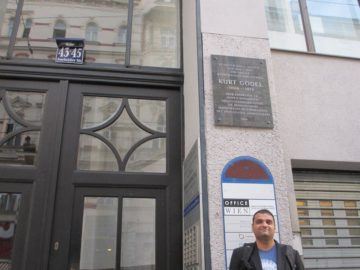
What made Gödel, a figure unknown to the public, so revered among his colleagues? The superlatives kept coming. Einstein called him the greatest logician since Aristotle. The legendary mathematician John von Neumann who was his colleague argued for his extraction from fascism-riddled Europe, writing a letter to the director of his institute saying that “Gödel is absolutely irreplaceable; he is the only mathematician about whom I dare make this assertion.” And when I made a pilgrimage to Gödel’s house during a trip to his native Vienna a few years ago, the plaque in front of the house made his claim to posterity clear: “In this house lived from 1930-1937, the great mathematician and logician Kurt Gödel. Here he discovered his famous incompleteness theorem, the most significant mathematical discovery of the twentieth century.”

The author in front of the house in Vienna where Gödel was living with his mother and brother when he proved his Incompleteness Theorems

The reason Gödel drew gasps of awe from colleagues as brilliant as Einstein and von Neumann was because he revealed a seismic fissure in the foundations of that most perfect, rational and crystal-clear of all creations – mathematics. Of all the fields of human inquiry, mathematics is considered the most exact. Unlike politics or economics, or even the more quantifiable disciplines of chemistry and physics, every question in mathematics has a definite yes or no answer. The answer to a question such as whether there is an infinitude of prime numbers leaves absolutely no room for ambiguity or error – it’s a simple yes or no (yes in this case). Not surprisingly, mathematicians around the beginning of the 20th century started thinking that every mathematical question that can be posed should have a definite yes or no answer. In addition, no mathematical question should have both answers. The first requirement was called completeness, the second one was called consistency.

The overarching goal of mathematics was to prove completeness and consistency starting from a fundamental, minimal set of axioms, much like Euclid had built up the grand structure of plane geometry starting with a handful of axioms in his marvelous ‘Elements’.

Mathematicians had good reasons to be optimistic. The 19th century had perhaps been the most important for the development of the discipline, solidifying results in analysis, geometry and other key mathematical domains. The mathematical giants of that time, textbooks names like Gauss, Dedekind, Cantor and Riemann, had put mathematics on a solid foundation. It was against this background that Bertrand Russell and Alfred North Whitehead wrote their magnum opus, the dense ‘Principia Mathematica’ that sought to put mathematics on a solid foundation of logic. Unnecessary axioms of mathematics would be discarded, the superstructure trimmed, and mathematics would be put on a sound basis of symbolic logic. One of the major goals of their work was to resolve any paradoxes in mathematics that would lead to statements akin to the famous Liar’s Paradox – “I am lying” that are false when they are true and true when they are false. Russell and Whitehead thought that paradoxes were merely a consequence of not clarifying the axioms and the deductions from them well enough.

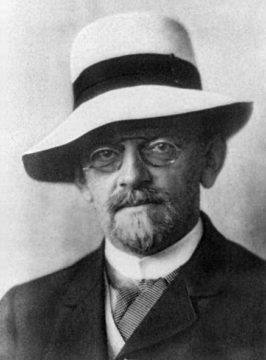
David Hilbert, perhaps the leading mathematician of the early 20th century

The intellectual godfather of the mathematicians was David Hilbert, perhaps the leading mathematician of the first few decades of the twentieth century. In a famous 1900 address at the International Congress of Mathematics in Paris, Hilbert set out 23 open problems in mathematics that he hoped would engage the brightest minds of the next few decades; it is a measure of Hilbert’s perspicacity in picking these problems that some of them are still unsolved and pursued. The second among these problems was to prove the consistency of arithmetic using the kind of axiomatic approach developed by Russell and Whitehead. Hilbert was confident that within a few decades at best, every question in mathematics would have a definite answer that could be built up from the axioms. He famously proclaimed that there would be no ‘ignorabimus’ (a statement whose truth or falsity could never be known) in mathematics. Mathematicians soon began to make themselves busy in carrying out Hilbert’s program.

When Hilbert gave his talk, Kurt Gödel was still six years away from being born. Thirty years later he would drive a wrecking ball into Hilbert’s dream, showing that even this most exact, pristine of all human intellectual endeavors contained truths that are fundamentally undecidable. And he did it in such a final manner that there could be no debate about it. That is what left brilliant men like Einstein and von Neumann with their mouths agape.

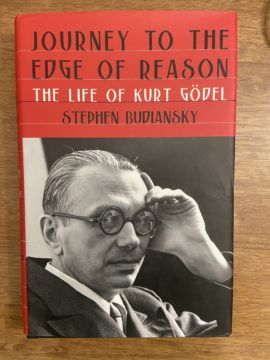
Now we have a biography of Gödel and his times written by veteran science and history writer Stephen Budiansky that is the most evocative and comprehensive biography of the logician written so far for a general audience. The book is really about Gödel and his times rather than his work. There have been some fine books on Gödel until now, including the detailed “Incompleteness” by Rebecca Goldstein, the impressionistic “Gödel: A Life in Logic” by John Casti and most notably, John Dawson’s “Logical Dilemmas” which is perhaps the most complete exploration of the man. But Budiansky’s book is the best one so far that situates Gödel in the magical time that was turn of the century Austria-Hungary, a time that was tragically shattered with a totality approaching anything in mathematics by the onslaught of totalitarianism. Budiansky also sensitively investigates Gödel’s dark side; the same mind that could not tolerate anything that was not precisely defined fell prey to its own exacting standards and unleashed demons that would lead to a life punctuated by paranoid delusions and extreme starvation. When Gödel died in 1978, he weighed 65 pounds.

Gödel’s end was a far cry from his beginning in the glorious years of the Austro-Hungarian empire. The emperor Franz-Joseph, an arch Habsburg, prized order above everything else. The town of Brünn that Gödel was born in was one of the most industrialized towns in the empire, and his father Rudolf was a well-to-do managing director of a textile firm. But it was from his mother Marianne who he was closer to and who was well-versed in music and the arts that Kurt got much of his intellect; throughout his life, Marianne would be a crucial link and lifeline through letters. A brother who was a doctor, Rudi, extended the family. When Gödel was born, the empire was perhaps the foremost fountain of intellect in Europe and possibly the world. In art and philosophy, music and architecture, science and mathematics, Vienna and Budapest led the way. Names like Freud, Wittgenstein, Klimt and Zweig trickled out of the fin de siècle city in a steady stream. They exemplified Vienna and Eastern Europe’s cafe culture, with places like the Café Reichsrat and Café Josephinum becoming battlegrounds of fervent intellectual debate on the deepest questions of epistemology, fueled with marathon shouting matches lasting into the night, strong black coffee topped with whipped cream and scribbles on the marble tabletops.

It was in this heady intellectually milieu that Gödel grew up. He was an outstanding student at the Realgymnasium and showed a meticulous attention to detail that was to be both his biggest strength and his ruin. He was also often the poster child for the head-in-the-clouds intellectual, and throughout his life, as brilliant as his mathematical acumen was, he often remained oblivious to the state of politics around him. A fondness with what many would consider childish preoccupations like children’s toys and kitschy household objects would punctuate his otherwise fanatical commitment to the most abstract reaches of human thought.

Under the facade of Vienna’s intellectual beehive lay a rotten foundation of class and religious inequality, bitterly growing nationalism and, most fatally, anti-Semitism. Viennese Jews had been liberated by Franz Joseph in 1867, and centuries of bottled up ambition and talent in the face of their persecution found a release that led to unprecedented success not just in the practical arts like medicine and law but also in the most abstract realms of mathematics and philosophy. This success bred resentment among Vienna’s growing middle class gentiles. The collective philosophical talent of both Jews and  non-Jews culminated in the creation of the famous Vienna Circle and their philosophy of logical positivism. Logical positivism asked to reject anything that could not be rigorously scientifically verified and the philosophers sought to outdo their fellow scientists and place metaphysics on a solid scientific foundation. The philosophers Hans Hahn who was Gödel’s PhD advisor at the University of Vienna and Moritz Schlick were the leaders of the movement; their patron saints were the mysterious, penetrating Ludwig Wittgenstein and Bertrand Russell. Wittgenstein deigned to speak to the circle only once and remained a distant figure, while the philosopher of science Karl Popper tried to become an official member but was spurned.

Into this milieu entered Kurt Gödel, only 24 years old. He became a regular member of the Vienna Circle but spoke up rarely, preferring to instead listen and occasionally interject with a penetrating comment. But even then Gödel’s predilections ran counter to the circle’s. While the circle emphasized the existence only of propositions that could be verified by grounding in the real world, Kurt became a staunch Platonist whose belief that mathematical objects existed in a world of their own without any human intervention only became deeper during his life. For Gödel, numbers, sets and mathematical axioms were as real as planets, bacteria and rocks, simply waiting to be discovered and existing independent of human effort. A large part of this existence stemmed from the sheer beauty of mathematical structures that Gödel and his colleagues were uncovering: how could such beautiful objects exist only under the pre-condition of discovery by ordinary human minds?

By 1930 the Platonist Gödel was ready to drop his bombshell in the world of mathematics and logic. In September 1930, a big conference was going to be organized in Königsberg. German mathematics had been harmed because of Germany’s instigation of the Great War, and Hilbert’s decency and reputation played a big role in resurrecting it. Just before the conference Gödel met with his friend Rudolf Carnap, a founding member of the Vienna Circle in the Cafe Reichsrat. There, perhaps scribbling a bit on the marble table, he told Carnap that he had just showed that Hilbert and Russell’s program to prove the completeness and consistency of mathematics was was fatally flawed. A few days later Gödel delivered his talk at the conference. As often happens with great scientific discoveries, few people understood the significance of what had just happened. The one exception was John von Neumann, a child prodigy and polymath who was known for jumping ten steps ahead of people’s arguments and extending them in ways that their creators could not imagine. Von Neumann buttonholed Gödel, fully understood his result, and then a week later extended it to a startling new domain, only to find through a polite note from Gödel that the former had already done it.

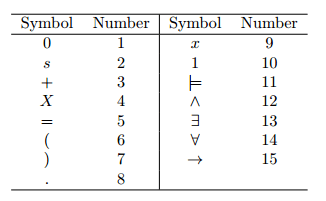
So what had Gödel done? Budiansky’s treatment of Gödel’s proof is light, and I would recommend the 1950s classic “Gödel’s Proof” by Ernest Nagel and James Newman for a semi-popular treatment. Even today Gödel’s seminal paper is comprehensible in its entirety only to specialists in the field. But in a nutshell, what Gödel had found using an ingenious bit of self-referential mapping between numbers and mathematical statements  was that any consistent mathematical system that could support the basic axioms of arithmetic as described in Russell and Whitehead’s work would always contain statements that were unprovable. This ingenious scheme included a way of encoding mathematical statements as numbers, allowing numbers to “talk about themselves”. What was worse and even more fascinating was that the axiomatic system of arithmetic would contain statements that were true, but whose truth could not be proven using the axioms of the system – Gödel thus showed that there would always be a statement G in this system which would, like the old Liar’s Paradox, say, “G is unprovable”. If G is true it then becomes unprovable by definition, but if G is false, then it would be provable, thus contradicting itself. Thus, the system would always contain ‘truths’ that are undecidable within the framework of the system. And lest one thought that you could then just expand the system and prove those truths within that new system, Gödel infuriatingly showed that the new system would contain its own unprovable truths, and ad infinitum. This is called the First Incompleteness Theorem.

An example of Gödel’s ingenious technique to transform mathematical symbols – and therefore statements – into numbers. (Source: Math stack exchange)

The Second Incompleteness showed that such a system cannot prove its own consistency, leading to another paradox and in effect saying that any formal system that is interesting enough to prove its own consistency can do so only if it’s inconsistent. This was an even more damning conclusion. Far from getting rid of the paradoxes that Russell and Whitehead believed would be clarified if only one understood the axioms and the deductions from them well enough, Gödel showed that such paradoxes are as foundational a feature of mathematical systems as anything else. As far as Hilbert was concerned, he had uncovered a rotten foundation underlying mathematics that doomed Hilbert’s program forever.

Ironically, just a day after Gödel’s talk, Hilbert gave a speech reinforcing his belief that there would be no ‘ignorabimus’ in mathematics and ending with a famous refrain: “Wir müssen wissen – wir werden wissen.” (“We must know – we will know.”). As sometimes happens when a great mind declares a truth in a scientific discipline with such finality, reactions can range from disbelief and denial to acceptance. Hilbert himself recognized the significance of Gödel’s results but held out hope that they wouldn’t be as far-reaching as they were thought to be. Von Neumann on the other hand is on record saying that after he heard of the incompleteness theorems, he decided to abandon his own productive work in set theory and the foundations of logic and move on to other topics. Gödel’s work had a seismic impact on that of many other thinkers. His proof that a system made up of purely mechanical, axiomatic procedures would contain undecidable propositions inspired Alan Turing’s own answer in the negative to the question of whether a mechanical computer could decide the truth value of an arbitrary proposition in a finite number of steps. Most notably, Gödel’s ingenious scheme of having numbers represent both themselves as well as instructions to specify operations on themselves is, without him ever knowing it, the basis of digital computing.

Thus by the time he was 24 years old, Gödel had established himself as a logician of the first rank and immortalized his name in history. In the next few years his friends and colleagues spread his gospel around the world, most notably in the United States. The noted mathematician Karl Menger was a close friend and was spending a semester in Iowa, sending Gödel periodic letters describing life in America (“Americans as a rule do not go for walks, they think that dashing around in their cars on Sundays is sufficient recreation.”). Not only did Menger give talks about Gödel’s results in the United States, but he performed a crucial service. Helped by a largesse from the brother-sister pair of Louis and Caroline Bamberger who sold their clothing business to Macy’s, the educator Abraham Flexner had established an institute in Princeton dedicated to pure thought, with no administrative and teaching duties. To populate this heavenly tank Flexner had bagged the biggest fish of them all – Albert Einstein. Along with Oswald Veblen, von Neumann and a few others, Einstein became one of the first faculty members at what came to be called the “Institute for Advanced Study”, although given the exorbitant money that Flexner dangled in front of his faculty in addition to the unique work environment, it quickly came to be christened the “Institute for Advanced Salaries”. Menger recommended that Flexner hire Gödel on a temporary basis. He would visit a few more times before permanently relocating in 1940.

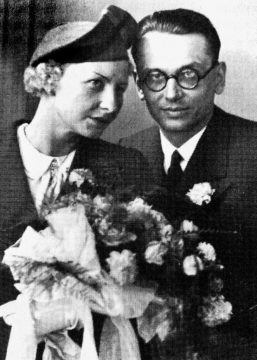
Kurt and Adele at their wedding (Source: Institute for Advanced Study)

By this time, both the personal currents of life and the larger currents of history would steer Gödel’s destiny. In 1927 he had married Adele Porkert, an older woman who lived across from his street. Adele had worked as a nightclub dancer and was a masseuse, qualifications which neither Gödel’s colleagues nor his family considered worthy of his stature. But Adele was to be a true mother to Kurt until her own death. Her role became clear when Gödel started suffering from a kind of psychotic paranoia that would mark him as indelibly as his genius. Starting in the early 1930s, he spent time in sanatoriums, convinced that an apparently weak heart from a bout of rheumatic fever which afflicted him as a child would kill him. More ominously, he started suspecting the sanatorium staff of conspiring to poison him or inject him with lethal substances. He drastically lost weight, and Adele had to feed him food that she had prepared herself to convince him to eat it. In retrospect it is clear that the ultra-logical Gödel also suffered from what we now call obsessive compulsive disorder. He obsessed over his bodily functions, interpreting ordinary signs as signs of trouble – his letters to his mother from America are generously interspersed with accounts of the health of his bowels. Unsurprisingly, this obsession led to a detailed keeping of diaries recording his thoughts and real and perceived symptoms, along with miscellaneous hospital, travel and grocery receipts. It is to Budiansky’s credit that he has combed through these sources to reveal to us the vivid portrait of a methodical, detail-oriented stickler whose very commitment to logic and details would prove to be his undoing.

Political events were also clearly not evolving favorably by the time Gödel first made his way to America. Austrian anti-Semitism had already had a long history, and German-speaking Austrians were fanatically enthusiastic about embracing their former compatriot and army corporal Adolf Hitler. Hitler triumphantly marched into Austria to ecstatic, waving crowds in March 1938 during the Anschluss. But even while Gödel had been proving his famous theorems, the writing had been on the wall. The University of Vienna had been a venue for anti-Semitic demonstrations for a long time, and the Vienna Circle with its Jewish members and commitment to abstract thought and “Jewish science” like relativity was a brightly painted target. In 1936, Johann Nelböck, a mentally troubled former student of Moritz Schlick shot and killed Schlick on the steps of the university, seething under the illusion that Schlick was having an affair with a female student he was obsessed with. Supported by the Nazis and seen as a martyr to the cause of eradicating the foreign element from the body of the Teutonic intellect, Nelböck was sentenced to ten years in prison, only to be promptly released by right-wing authorities in 1938 after the Anschluss. After Schlick’s murder the Vienna Circle effectively dissolved, and with it a glorious intellectual age whose quick demise remains a reminder of how quickly totalitarianism can destroy what takes decades or even centuries to build. After Jewish professors were all dismissed throughout Germany and Austria, Hilbert was asked by the new Nazi minister of education what mathematics was like at the University of Göttingen where he taught. “There is no mathematics anymore at Göttingen”, Hilbert retorted.

Gödel, as involved as he was with the search for mathematical truth, was not finely attuned to what was happening to politics in the country. Two days before Hitler’s takeover of Austria, Menger received a letter about mundane matters of conferences and mathematics from his friend which, as he put it, “may well represent a record for unconcern on the threshold of world-shaking events.” But even Gödel could not ignore what was happening to his colleagues at the university, and after some unpleasant episodes including one in which he was bullied on the streets by Nazi thugs and Adele fended off their taunts with her umbrella, the couple decided to emigrate to America for good. Bureaucratic snafus regarding Gödel’s visa and his new status as a German citizen led to intervention from the director of the Institute for Advanced Study at von Neumann’s goading: that is when von Neumann wrote the remarkable letter urging him to do everything he could to enable Gödel’s emigration, saying that Gödel was absolutely irreplaceable. Because German passengers crossing the Atlantic had to face the dual hazards of Nazi U-boats and potential arrest as enemy aliens by British authorities, Kurt and Adele took the long, scenic route, going through Eastern Europe through Moscow and then taking the Trans-Siberian railroad to Vladivostok, before finally boarding a steamer for San Francisco. Gödel would never leave the Eastern Seaboard of the United States again during his lifetime.

Kurt and Adele arrived in Princeton, a place puckishly described by recent resident Albert Einstein as “a quaint, ceremonial village, full of demigods on stilts”. Gödel had never known Einstein before coming to America, and yet it was Einstein who, along with the Austrian economist Oskar Morgenstern, provided him with the friendship of his Viennese colleagues which he so missed. Einstein and Gödel made for an unlikely pair: the former gregarious, generous, earthy and shabbily dressed, always eyeing the world through a sense of humor; the latter often withdrawn, hyper-logical, critical and unable to lighten up. And yet these exterior differences hid a deep and genuine friendship that went beyond their common background in German culture. Their families often visited each other, and Adele once knitted a woolen vest for Einstein. Animatedly conversing in German during their walks home together, Einstein communed with few others at the institute. It was Einstein who accompanied Gödel and Morgenstern to Gödel’s citizenship ceremony. At the ceremony the overtly pedantic and meticulous Gödel who had studied exhaustively for the citizenship test above and beyond the standard requirements, told the judge that he had found a flaw in the Constitution that would allow the United States to turn into a dictatorship. Einstein and Morgenstern hastily shut him up from saying anything further and the ceremony progressed smoothly.

But the real reason Einstein so admired Gödel was likely because he shared Gödel’s unshakeable belief in the purity of the mathematical constructs governing the universe. Einstein who was not formally religious nevertheless always harbored a deep belief that the laws of physics exist independently of human beings’ abilities to identify and tamper with them – that was one reason he was so uneasy with the then standard interpretation of quantum mechanics which seemed to say that there was no reality independent of observers. Gödel outdid him and went one step further, believing that even numbers and mathematical theorems exist independently of the human mind. It was this almost spiritual and religious belief in the objective nature of mathematical reality that perhaps formed the most intimate bond between the era’s greatest theoretical physicist and its greatest logician. It also helped that Gödel got interested in Einstein’s general theory of relativity, once playing with the equations and startling Einstein by concluding that the theory allowed for the existence of closed timelike curves – in other words, a universe without past and future, without time. For Gödel’s Platonic mind, this kind of result based purely on mathematics and without any physical basis was exactly the kind of absolute mathematical truth he believed in.

Oskar Morgenstern’s friendship with Gödel was even deeper, in part because he outlasted Einstein until Gödel’s own death. Morgenstern who combined worldly wisdom with brilliance in economics had made a name for himself by writing “Theory of Games and Economic Behavior” with von Neumann which established the field of game theory. Morgenstern worried about Gödel’s work, about Gödel’s health and Gödel’s marriage. One of the main sources of Gödel’s life is Morgenstern’s copious, often heartbreaking notes on Gödel’s worries and mental deterioration in his last years. He saw that Adele, while devoted to Kurt, was not a good fit in snobbish Princeton. A young Freeman Dyson vividly described an uncomfortable scene at a party where a very drunk Adele grabbed him and forced him to dance for twenty minutes while Kurt miserably stood by; Dyson could only imagine the horror of their lives. But Adele stayed utterly loyal to Kurt, feeding him, entertaining his paranoid health issues and generally taking good care of him.

After coming to the institute Gödel contributed one significant piece of work that added to the already hallowed place in mathematical history he enjoyed. In his famous 1900 address, the problem Hilbert had put at the top of his list was the so-called Continuum Hypothesis. The hypothesis deals with one of the most startling and deepest aspects of mathematics – a comparison of different kinds of infinity. The fact that there are in fact different kinds of infinity was discovered by Georg Cantor and came as a bombshell. Cantor showed that the “first” kind of infinity, called a countable infinity, was represented by the set of natural numbers. But there was another kind of much larger infinity, an uncountable infinity, represented by the real numbers. It may seem absurd to say that one infinity is larger or smaller than another, but using ingenious arguments Cantor showed that the real numbers cannot have a one-to-one mapping with the natural numbers and are much bigger. The Continuum Hypothesis asked if there is a third kind of infinity between that of the natural numbers and the real numbers.

The problem is still unsolved, but Gödel made a significant dent by showing that the contradiction of the hypothesis could not be proved by standard set theory. This is not the same as showing that the hypothesis is true, but it does result in one strike in favor of it. A bigger advance came in 1963 when mathematician Paul Cohen showed that the hypothesis is independent of standard set theory; that is, either the hypothesis or its negation can be added to standard set theory without destroying its consistency and axioms. For all of Gödel’s scathing remarks and frequent silence about other mathematicians’ work, he was profusely generous toward Cohen when Cohen sent him his proof of the independence of the Continuum Hypothesis, a problem that Gödel himself had tried and failed to solve for more than twenty years.

Mathematician John von Neumann was one of Gödel’s biggest supporters (Source: Totally History)

Gödel’s peculiar obsessions and pedantry made him a difficult colleague, and his promotion of to full professor was held up until 1953 because the faculty feared he would be challenging to deal with when it came to the obligatory administrative matters that full professors had to busy themselves with. Once again von Neumann came to his friend’s rescue, asking, “If Gödel cannot call himself Professor, how can the rest of us?” But even after Gödel got promoted his insecurities did not leave him, and he kept on feeling a mixture of self-pity and suspicions of conspiracy on the part of the institute to demote or fire him. He could nonetheless be a very loyal friend and colleague, testifying against having Oppenheimer removed as director for instance after Oppenheimer’s enemy Lewis Strauss tried to oust him after his infamous security hearing. Especially in his later years, young mathematicians like Martin Davis and Hao Wang observed a Gödel who was friendly, curious and funny.

After Einstein’s death in 1955 and von Neumann’s excruciatingly painful death in 1957, Gödel began to increasingly rely on Adele and Morgenstern (as a measure of how startlingly original his mind remained, in March, 1956, as von Neumann was dying, Gödel sent him a letter that is supposed to contain the first statement of a famous problem in computer science, the P=NP hypothesis). His exalted mind often delighted in the simplest of objects, including trinkets and cheap children’s toys bought from convenience stores. The fear that his colleagues had about his obsession evolved, if anything, in the opposite direction: he would meticulously labor over member applications, exhaustively analyzing them and offering suggestions on points others had missed.

But the spark of genius that had lit the mathematical world on fire seemed to have gone missing. In his last few years, Gödel became obsessed with not just believing that there was a conspiracy against him but also one against a hero of his, the 18th century mathematician and polymath Gottfried Wilhelm Leibniz. He became convinced that there was a plot to keep Leibniz’s work hidden from the world. Beginning in the 1970s, he began to see a psychiatrist whose detailed notes Budiansky opens the book with: “Believes he has been declared incompetent and that one day they will realize he is free and take him away…fear of destitution, loss of position at institute because he hasn’t done anything for past year…brought out delusional ideas, including that brother is the evil person behind plot to destroy him…believes he wants to take his wife, house and position at the institute.” Clearly, having his mother and brother Rudi visit him in America, while welcomed initially, had also turned into a plot to take over his world. It didn’t help that by this time Gödel’s work had been popularized enough that he received the Einstein Prize from Einstein himself , the National Medal of Science from President Gerald Ford and that crowning sign of fame – letters from all over the world from fans and crackpots.

There was little that anyone could do to help. In 1977 Morgenstern himself received a diagnosis of terminal cancer and became paralyzed. His tragic last notes and letters indicate the struggle he was facing as Gödel increasingly came to rely on him, phoning him two or three times every day to communicate his latest worries, even as he himself was facing his own mortality. The last straw was when Adele fell sick and had to spend several months in a hospital. After Morgenstern, she had been his last link to the sane world, and in spite of neighbors and colleagues trying to help out, he stopped eating, convinced that he was being poisoned through his food and, unlike in Vienna in the 1930s, not having Adele around to feed him with tender, loving care. When Adele came back the end was already there, and Gödel entered the hospital for the last time. The cause of death was “malnutrition”, although most people believed that slow suicide was the more likely explanation.

How do we deal with the legacy of someone like Gödel? Philosophically,  Gödel’s theorems had such a shattering impact on our thinking because, along with two other groundbreaking ideas of 20th century science – Heisenberg’s Uncertainty Principle and quantum indeterminacy – they revealed that human beings’ ability to divine knowledge of the universe had fundamental limitations. But while Heisenberg and the quantum pioneers found limits to understanding rooted in the physical world, Gödel found these limits even in the rarefied world of pure ideas. Nonetheless, mathematics continued to thrive within the boundaries of his theorems, gathering Fields Medals and revolutionizing new fields like algebraic topology and category theory. The deeper significance of Gödel’s work therefore, as he explained in a lecture, is that it’s hard to avoid a connection between them and a Platonic world of numbers and ideas existing independent of our efforts. This is because if human beings are fundamentally incapable of finding out all the results of axiomatic systems, it means there will always be some results outside the grasp of even our most exalted intellects. In our limitations lies mathematics’s freedom.

But that also says something about human minds and points to a debate still raging – whether the mind itself is some kind of Turing machine. The implication of Gödel’s proof is that if the mind is indeed a machine, it will be subject to the incompleteness theorems and there will always be truths beyond our grasp. If on the other hand, the mind is not a machine, it frees it up from being described through purely mechanistic means. Both choices point to a human mind and a world it inhabits that are “decidedly opposed to materialistic philosophy”. Beyond this possible truth is another one that is purely psychological. We can either feel morose in the face of the fundamental limits to knowledge that Gödel revealed, or we can revel, as the historian George Dyson put it, to “celebrate his proof that even the most rigid numerical bureaucracy contains the tools by which higher truth will always be able to effect an escape.”Gödel offers us an invitation to an open world, a world without end.

But what about the paradoxes of the man himself, someone devoted to the highest reaches of rational thought in the most logical of all fields of inquiry, and still one who seemed to have had an almost mystical belief in the spiritual certainty of mathematics and often gave in to the worst impulses of irrationality? I think a clue comes from Gödel’s obsession with Leibniz in his last few years. Leibniz was convinced that this is the best of all possible worlds, because that is the only thing a just God could have created. Like his fellow philosophers and mathematicians, Leibniz was religious and saw no contradictions between science and faith, between teasing out the truths of the world rationally and believing in a hereafter. A few years before his mother Marianne’s death in 1961, Kurt wrote to her in a letter his belief that a God probably exists: “For what kind of sense would there be in bringing forth a creature (man), who has such a broad range of possibilities of his own development and of relationships, and then not allow him to achieve 1/1000 of it?” Like his fellow philosopher Leibniz, Kurt Gödel could perfectly reconcile the rational and the transcendental. In doing this, he proved himself to be much more at home in the 18th century than the 20th. Perhaps that vision of a reconciliation between rational thought and seemingly irrational human frailty and belief will be, even more than his seminal mathematical discoveries, his enduring legacy.

Bridging the gaps: Einstein on education

This is my latest column for 3 Quarks Daily.

The crossing of disciplinary boundaries in science has brought with it a peculiar and ironic contradiction. On one hand, fields like computational biology, medical informatics and nuclear astrophysics have encouraged cross-pollination between disciplines and required the biologist to learn programming, the computer scientist to learn biology and the doctor to know statistics. On the other hand, increasing specialization has actually shored up the silos between these territories because each territory has become so dense with its own facts and ideas.

We are now supposed to be generalists, but we are generalists only in a collective sense. In an organization like a biotechnology company for instance, while the organization itself chugs along on the track of interdisciplinary understanding across departments like chemistry, biophysics and clinical investigations, the effort required for understanding all the nuts and bolts of each discipline has meant that individual scientists now have neither the time nor the inclination to actually drill down into whatever their colleagues are doing. They appreciate the importance of various fields of inquiry, but only as reservoirs into which they pipe their results, which then get piped into other reservoirs. In a metaphor evoked in a different context - the collective alienation that technology has brought upon us - by the philosopher Sherry Turkle, we are ‘alone together’.

The need to bridge disciplinary boundaries without getting tangled in the web of your own specialization has raised new challenges for education. How do we train the men and women who will stake out new frontiers tomorrow in the study of the brain, the early universe, gender studies or artificial intelligence? As old-fashioned as it sounds, to me the solution seems to go back to the age-old tradition of a classical liberal education which lays emphasis more on general thinking and skills rather than merely the acquisition of diverse specialized knowledge and techniques. In my ideal scenario, this education would emphasize a good grounding in mathematics, philosophy (including philosophy of science), basic computational thinking and statistics and literature as primary goals, with an appreciation of the rudiments of evolution and psychology or neuroscience as preferred secondary goals.

This kind of thinking was on my mind as I happened to read a piece on education and training written by a man who was generally known to have thought-provoking ideas on a variety of subjects. If there was one distinguishing characteristic in Albert Einstein, it was the quality of rebellion. In his early days Einstein rebelled against the rigid education and rules of the German Gymnasium system. In his young and middle years he rebelled against the traditional scientific wisdom of the day, leading to his revolutionary contributions to relativity and quantum theory. In his old age he rebelled against both an increasingly jingoistic world as well as against the mainstream scientific establishment.

Not surprisingly, then, Einstein had some original and bold thoughts on what an education should be like. He held forth on some of these in an address on October 15, 1931 delivered at the State University of New York at Albany. 1931 was a good year to discuss these issues. The US stock market had crashed two years before, leading to the Great Depression and mass unemployment. And while Hitler had not become chancellor and dictator yet, he would do so only two years later; the rise of fascism in Europe was already evident.

Some of these issues must have been on Einstein’s mind as he first emphasized what he had already learnt from his own bitter Gymnasium experience, the erosion of individuality in the face of a system of mass education, similar to what was happening to the erosion of individuality in the face of authoritarian ideas.

“Sometimes one sees in the school simply the instrument for transferring a certain maximum quantity of knowledge to the growing generation. But that’s not right. Knowledge is dead; the school, however, serves the living. It should develop in the young individuals those equalities and capabilities which are of value for the welfare of the commonwealth. But that does not mean that individuality should be destroyed and the individual becomes a mere tool of the community, like a bee or an ant. For a community of standardized individuals without personal originality and personal aims would be a poor community without possibilities for development. On the contrary, the aim must be the training of independently thinking and acting individuals, who, however, see in the service of the community their highest life problem…To me the worst thing seems to be for a school principally to work with methods of fear, force, and artificial authority. Such treatment destroys the sound sentiments, the sincerity, and the self-confidence of the pupil. It produces the submissive subject. It is not so hard to keep the school free from the worst of all evils. Give into the power of the teacher the fewest possible coercive measures, so that the only source of the pupil’s respect for the teacher is the human and intellectual qualities of the latter.”

Einstein also talks about what we can learn from Darwin’s theory. In 1931 eugenics was still quite popular, and Darwin’s ideas were seen even by many social progressives as essentially advocating the ruthless culling of ‘inferior’ individuals and the perpetuation of superior ones. Where Einstein came from, this kind of thinking was on flagrant display right on the doorstep, even if it hadn’t already morphed into the unspeakable horror that it did a decade later. Einstein clearly rejects this warlike philosophy and encourages cooperation over competition. Both cooperation and competition are important for human progress, but the times clearly demanded that one not forget the former.

“Darwin’s theory of the struggle for existence and the selectivity connected with it has by many people been cited as authorization of the encouragement of the spirit of competition. Some people also in such a way have tried to prove pseudo-scientifically the necessity of the destructive economic struggle of competition between individuals. But this is wrong, because man owes his strength in the struggle for existence to the fact that he is a socially living animal. As little as a battle between single ants of an ant hill is essential for survival, just so little is this the case with the individual members of a human community…Therefore, one should guard against preaching to the young man success in the customary sense as the aim of life. For a successful man is he who receives a great deal from his fellow men, usually incomparably more than corresponds to his service to them. The value of a man, however, should be seen in what he gives and not what he is able to receive.”

In other words, with malice toward none, with charity toward all.

And what about the teachers themselves? What kinds of characters need to populate the kind of school which imparts a liberal and charitable education? Certainly not the benevolent dictators that filled up German schools in Einstein’s time or which still hold court in many schools across the world which emphasize personal authority over actual teaching.

“What can be done that this spirit be gained in the school? For this there is just as little a universal remedy as there is for an individual to remain well. But there are certain necessary conditions which can be met. First, teachers should grow up in such schools. Second, the teacher should be given extensive liberty in the selection of the material to be taught and the methods of teaching employed by him. For it is true also of him that pleasure in the shaping of his work is killed by force and exterior pressure.”

If Einstein’s words have indeed been accurately transcribed, it is interesting to hear him use the words “grow up” rather than just “grow” applied to teachers. I have myself come across stentorian autocrats who inadvertently reminded students that their charges were in fact the adults in the room. They definitely need to grow up. Flexibility in the selection of the teaching material is a different matter. To do this it’s not just important to offer as many electives as possible, but it’s more important to give teachers a wide berth within their own classes rather than constantly being required to subscribe to a strictly defined curriculum. Some of the best teachers I had were ones who spent most of their time on material other than what was required. They might wax philosophical about the bigger picture, they might tell us stories from the history of science, and one of them even took us out for walks where the topics of discussion consisted of everything except what he was ‘supposed’ to teach. It is this kind of flexibility in teaching that imparts the most enriching experience, but it’s important for the institution to support it.
What about the distinction between natural science and the humanities? Germany already had a fine tradition in imparting a classical education steeped in Latin and Greek, mathematics and natural science, so not surprisingly Einstein was on the right side of the debate when it came to acquiring a balanced education.

“If a young man has trained his muscles and physical endurance by gymnastics and walking, then he will later be fitted for every physical work. This is also analogous to the training of the mental and the exercising of the mental and manual skill. Thus the wit was not wrong who defined education in this way: “Education is that which remains, if one has forgotten everything he has learned in school.” For this reason I am not at all anxious to take sides in the struggle between the followers of the classical philologic-historical education and the education more devoted to natural science.”

The icing on this cake really is Einstein’s views on the emphasis on general ability rather than specialized knowledge, a distinction which is more important than ever in our age of narrow specialization.

“I want to oppose the idea that the school has to teach directly that special knowledge and those accomplishments which one has to use later directly in life. The demands of life are much too manifold to let such a specialized training in school appear possible. Apart from that, it seems to me, moreover, objectionable to treat the individual like a dead tool. The school should always have as its aim that the young man leave it as a harmonious personality, not as a specialist. This in my opinion is true in a certain sense even for technical schools, whose students will devote themselves to a quite definite profession. The development of general ability for independent thinking and judgement should always be placed foremost, not the acquisition of special knowledge. If a person masters the fundamentals of his subject and has learned to think and work independently, he will surely find his way and besides will better be able to adapt himself to progress and changes than the person whose training principally consists in the acquiring the detailed knowledge.”

One might argue that it’s the failure to let young people leave college as ‘harmonious personalities’ rather than problem-solvers that leads to a nation of technocrats and operational specialists of the kind that got the United States in the morass of Vietnam, for instance. A purely problem-solving outlook might enable a young person to get a job sooner and solve narrowly defined problems, but it will not lead them to look at the big picture and truly contribute to a productive and progressive society.

I find Einstein’s words relevant today because the world of 2018 in some sense resembles the world of 1931. Just like it did because of the Great Depression then, mass unemployment because of artificial intelligence and automation is a problem looming on the short horizon. Just like it had in 1931, authoritarian thinking seems to have taken root in many of the world’s governments. The specialization of disciplines has led colleges and universities to increasingly specialize their own curricula, so that it is now possible for many students to get through college without acquiring even the rudiments of a liberal arts education. C. P. Snow’s ‘Two Cultures’ paradoxically have become more entrenched, even as the Internet presumably promised to break down barriers between them. Meanwhile, political dialogue and people's very world-views across the political spectrum have gotten so polarized on college campuses that certain ideas are now being rejected as biased, not based on their own merits but on some of their human associations.


These problems are all challenging and require serious thinking and intervention. There are no easy solutions to them, but based on Einstein’s words, our best bet would be to inculcate a generation of men and women and institutional structures that promote flexible thinking, dialogue and cooperation, and an open mind. We owe at least that much to ourselves as a supposedly enlightened species.