Field of Science

Showing posts with label astronomy. Show all posts

A long time ago, in a galaxy far, far away


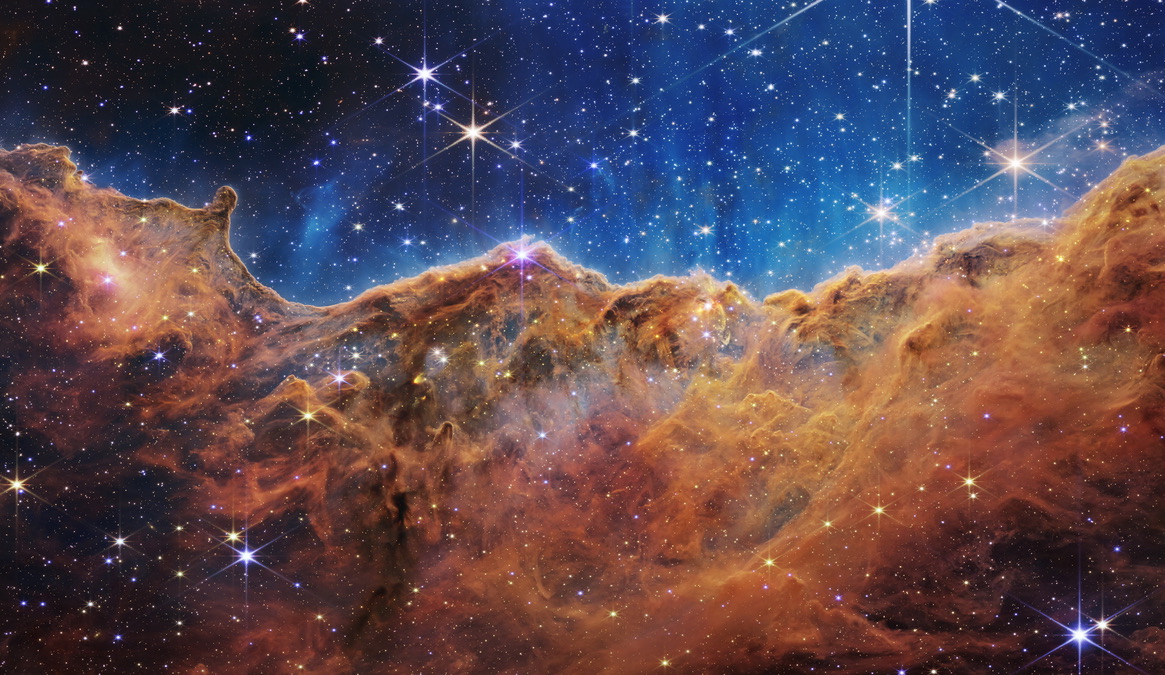
For a brief period earlier this week, social media and the world at large seemed to stop squabbling about politics and culture and united in a moment of wonder as the James Webb Space Telescope (JWST) released its first stunning images of the cosmos. These "extreme deep field" images represent the farthest and the oldest that we have been able to see in the universe, surpassing even the amazing images captured by the Hubble Space Telescope that we have become so familiar with. We will soon see these photographs decorating the walls of classrooms and hospitals everywhere.

The scale of the JWST images is breathtaking. Each dot represents a galaxy or nebula from far, far away. Each galaxy or nebula is home to billions of stars in various stages of life and death. The curved light in the image comes from a classic prediction of Einstein's general theory of relativity called gravitational lensing - the bending of light by gravity that makes spacetime curvature act like a lens. 

Some of the stars in these distant galaxies and nebulae are being nurtured in stellar nurseries; others are in their end stages and might be turning into neutron stars, supernovae or black holes. And since galaxies have been moving away from us because of the expansion of the universe, the farther out we see, the older the galaxy is. This makes the image a gigantic hodgepodge of older and newer photographs, ranging from objects that go as far back as 100 million years after the Big Bang to very close (on a cosmological timescale) objects like Stephan's Quintet and the Carina Nebula that are only a few tens of thousands of light years away.

It is a significant and poignant fact that we are seeing objects not as they are but as they were. The Carina Nebula is 8,500 light years away, so we are seeing it as it looked like 8,500 years ago, during the Neolithic Age when humanity had just taken to farming and agriculture. On the oldest timescale, objects that are billions of light years away look the way did during the universe's childhood. The fact that we are seeing old photographs or stars, galaxies and nebulae gives the photo a poignant quality. For a younger audience who has always grown up with Facebook, imagine seeing a hodgepodge of images of people from Facebook over the last fifteen years presented to you: some people are alive and some people no longer so, some people look very different from what they did when their photo was last taken. It would be a poignant feeling. But the JWST image also fills me with joy. Looking at the vast expanse, the universe feels not like a cold, inhospitable place but like a living thing that's pulsating with old and young blood. We are a privileged part of this universe.

There's little doubt that one of the biggest questions stimulated by these images would be whether we can detect any signatures of life on one of the many planets orbiting some of the stars in those galaxies. By now we have discovered thousands of extrasolar planets around the universe, so there's no doubt that there will be many more in the regions the JWST is capturing. The analysis of the telescope data already indicates a steamy atmosphere containing water on a planet about 1,150 light years away. Detecting elements like nitrogen, carbon, sulfur and phosphorus is a good start to hypothesizing about the presence of life, but much more would be needed to clarify whether these elements arise from an inanimate process or a living one. It may seem impossible that a landscape as gargantuan as this one is completely barren of life, but given the improbability of especially intelligent life arising through a series of accidents, we may have to search very wide and long.

I was gratified as my twitter timeline - otherwise mostly a cesspool of arguments and ad hominem attacks punctuated by all-too-rare tweets of insight - was completely flooded with the first images taken by the JWST. The images proved that humanity is still capable of coming together and focusing on a singular achievement of science and technology, how so ever briefly. Most of all, they prove both that science is indeed bigger than all of us and that we can comprehend it if we put our minds and hands together. It's up to us to decide whether we distract ourselves and blow ourselves up with our petty disputes or explore the universe as revealed by JWST and other feats of human ingenuity in all its glory.

Image credits: NASA, ESA, CSA and STScl

Subrahmanyan Chandrasekhar: A study in fortitude and rigor

It's Subrahmanyan Chandrasekhar's birthday today. "Chandra", as he was fondly known to friends and colleagues, was one of the twentieth century's most important astrophysicists. In addition he was probably its most rigorous and mathematical, applying hard and baroque mathematics to problems ranging from hydrodynamics to collapsing stars. His Nobel Prize came in 1983, and it should have come earlier. Chandra's life provides a good example of quiet rebellion against a traditional scientific establishment, and it's for this reason that it deserves wide study.

By all accounts Chandra was marked to be a great scientist from his birth. Born in the city of Lahore (now in Pakistan) to a respected civil servant, he quickly outpaced his fellow students in his study of advanced mathematics and physics. In the 1920s when he was attending college in the progressive city of Madras (now Chennai) he met the renowned physicist Arnold Sommerfeld when Sommerfeld was visiting Madras, and was both shocked and fascinated to hear Sommerfeld tell him that quantum theory had rendered outdated much of the physics he had learnt. That however was a deficiency that Chandra could remedy. As the famous story goes, at the mere age of nineteen, on a long voyage from India to England to attend graduate school at the University of Cambridge, he did the calculation that was to enshrine his name in history. That analysis which used tools from relativity and quantum theory that were far beyond the grasp of any other nineteen year old physics student, finally led to the establishment of the so-called 'Chandrasekhar limit', a limit for the mass a white dwarf can sustain before it collapses under the weight of its own gravity. 

A few years later Chandra had a famous showdown with Arthur Eddington, the doyen of English astronomers and one of the most famous scientists in the world. It was Eddington who had confirmed Einstein's famous prediction of starlight bending in 1919, and by 1935 when he went up against Chandrasekhar, he was renowned for both his physical theories and his popular writing. The showdown came in a seminar when Chandra put forward his carefully calculated contention that white dwarfs cannot be stable beyond a certain mass. What happened beyond that mass even Chandra did not know, but like his brilliant contemporary and friend Paul Dirac, he was brave enough to trust the mathematics. Eddington however saw Chandra's theorizing leading to a pathological physical reality. He could not conceive of a star keeping on collapsing, and he simply stated without proof that there must be some law of nature that prevented this. It was the classic case of the bastion of conservatism going up against the brash new kid on the block, although Chandra was no brash Richard Feynman cheekily rocking the establishment: he was simply courageous enough to quietly follow the numbers wherever they led.

Characteristically, Chandra did not contradict Eddington any further. He realized that he was the underdog and wisely conceded defeat...for the moment. He then waited a full five decades before a host of other brilliant theoreticians and experimentalists validated his seminal insight. It was Chandra's discovery of limiting masses for stars that finally led Robert Oppenheimer in 1939 to postulate the existence of black holes. In twentieth century physics, Oppenheimer and Chandra's papers on gravitational collapse bracket two very different personalities. Chandra waited quietly after his confrontation with Eddington, while Oppenheimer curiously simply forgot about his own groundbreaking contribution and remained indifferent to it for the rest of his life. After the war, John Wheeler, Dennis Sciama and Yakov Zeldovich put the theory of black holes on a firm footing. Their students Stephen Hawking, Roger Penrose, Kip Thorne and others blazed new pathways that continue to spawn deep insights. But it all started with Chandra.

Chandra who had spent the 1930s in England finally emigrated to the United States in the 1940s, accepting an invitation at the Yerkes Observatory of the University of Chicago. He made this country his own, and like his fellow immigrants Hans Bethe and Enrico Fermi, did much to raise its standing in the world of science. His father who expected him to return to India was deeply pained, but Chandra was convinced that he could have a better life in America, one unfettered by hero worship and the trappings of fame and enriched by friends and freedom to pursue his ideas and opinions. At the same time, although he settled in the US, he retained his love for India and visited often. 

Chandra's invaluable knowledge of hydrodynamics could have been important on the Manhattan Project at Los Alamos. Oppenheimer did invite him, but the delay in his security clearance which probably resulted from a mix of bureaucracy and naive racism kept him from making what would undoubtedly have been key contributions to the complex problems of implosion. Instead of Los Alamos, Chandra spent the war years at the Aberdeen Proving Ground working on ballistics and trajectories. However, he did contribute a bit to the bomb project by analyzing the operation of the calutrons at Oak Ridge, Tennessee.

At Yerkes and Chicago Chandra became famous for being a formidable teacher and top-notch researcher. He became friends with most of the leading physicists of the time, and wrote papers with his fellow Chicago physicist Enrico Fermi. Carl Sagan said that he learnt what mathematical elegance was from Chandra when he was a student there. The future Nobel Laureates C D Yang and T D Lee were taught by Chandra; he considered them so promising that he thought nothing of driving two hours to teach a class of two. In addition Chandra took the previously neglected 'Astrophysical Journal' to new heights. By all accounts he was a strict and fair editor; there are stories of him rejecting phone calls if they came a minute after the official working hours of the journal.

Chandra's mastery of astrophysics was total and incredibly diverse, and the sheer range of his understanding combined with his command of the mathematical tools was probably unmatched by any other scientist from the field. His style was unique. Every decade he used to research an important topic. After spending ten fruitful years exploring it and making important contributions, he would then write an exhaustive treatise that would serve as the standard reference on the subject. He would then move on and conquer another realm for another decade. In this way Chandra mastered and explained stellar structure, radiative transfer, hydrodynamic and hydromagnetic stability, gravitational waves and black holes. Each one of these topics would have been enough to keep a physicist busy for his or her entire career, but Chandra powerfully crisscrossed the entire landscape.

His last great technical treatise was titled "The Mathematical Theory of Black Holes". The volume is so densely mathematical that according to Chandra's own admission, he had to literally invent new symbols when he ran out of the common mathematical, Greek and Roman ones. After putting the finishing touches on this formidable tome, Chandra perhaps wisely decided to spend the rest of his years on more popular topics. Even when exploring these his characteristic rigor and exhaustive approach were apparent. His last book was a detailed and yet accessible analysis of all of Newton's theorems in his great "Principia". After examining his own modern and Newton's supposedly archaic approaches, Chandra concluded that Newton's were still better.

As rigorous and hard an astrophysicist as he was, Chandra was also remarkably well read and cultured. His remarkable wife Lalitha kept him grounded and optimistic. His knowledge of music, art and literature was extensive and this immersion contributed to the memorable clarity of his lectures. He compiled his views on an integrated approach to science, art and the humanities in a set of lectures titled "Truth and Beauty: Aesthetics and Motivations in Science" which is well worth reading. It would not be an exaggeration to say that Chandra embodied both qualities in his more than six decades of amazing contributions to science. As just one example of tributes to him, NASA's flagship x-ray observatory which is allowing us to probe hidden features of the cosmos is named Chandra.


Chandrasekhar remains a study in rigor and fortitude. In these troubled times, it's also worth noting that he was one of those select immigrants who made the United States great. When he and his wife Lalitha became American citizens in 1953 - much to the chagrin of his father and family in India who still expected them to return - Lalitha responded to his father with a sobering letter in which she extolled the democratic tradition in the US and Chandra's and her growing fondness for what made the country unique. In a paragraph that is perhaps relevant to this year's election, Lalitha said that she did not think it was right to sit by idly doing nothing while the pall of McCarthyism descended on the country; she felt that she and Chandra had to participate in the country's democratic process, and they could only do this by becoming citizens. 

One can only hope that this country absorbs more intellects like Chandra and his wife and proudly proclaims them as its own.

"The Hunt for Vulcan": Theory, experiment, and the origin of scientific revolutions

Joseph Urbain La Verrier: The force of his personality
and his spectacular prediction of Neptune solidified
faith in the existence of Vulcan
In his book "The Hunt for Vulcan", MIT science writing professor Thomas Levenson tackles one of the most central questions in all of science - what do you do when a fact of nature disagrees with your theory? In this particular case the fact of nature was an anomaly in the orbit of Mercury around the sun. The theory was Newton's successful theory of gravitation which had reigned supreme for two hundred years in explaining the motion of everything from rocks to the moon. Levenson’s book looks at this question through the lens of an important case study. His writing is clear, often elegant and impressionistic, and he does a good job driving home the nature of science as a human activity with all its human triumphs and follies.

The physical entity invoked to explain the anomalies in Mercury's orbit - a small planet close to the sun which would usually be too small and intensely illuminated by the sun to be seen - was called Vulcan. The idea was that Vulcan's gravitational tug on Mercury would cause its orbit to stray from the expected path. The hypothesis had much merit to it since it was similar theorizing about the anomalies in the predicted orbit of Uranus that had resulted in the discovery of Neptune. The man who proposed the theories of both Neptune and Vulcan was Joseph Urbain Le Verrier, the most important French astronomer of his day and one of the most important of the 19th century. The successful prediction of Neptune and its dazzlingly swift observational validation was a resounding tribute to both Le Verrier’s acumen and to Newton’s understanding of the universe. Not surprisingly Le Verrier's prediction of Vulcan was taken seriously.

The book recounts how partly because of past successes of Newton's theories and partly because of the force of Le Verrier’s personality astronomers spent the next one hundred years unsuccessfully looking for Vulcan. Spectators included a host of well-known astronomers and amateurs, including Thomas Edison. The search was peppered by expeditions to exotic places like Rhodesia and Wyoming. Occasionally the newspapers would ridicule Vulcan-chasers, but none could disprove its evidence conclusively. This fact raises an important point: As far as scientific theories go Vulcan was a good theory since it was testable, but because its existence really strained the limits of astronomical technique as it existed during the time, it did not really satisfy the criteria for being a cleanly falsifiable theory. This led to the Vulcan hypothesis having enough wiggle room for people to get away with explaining away the lack of observation as bad technique or faulty equipment.

As Levenson describes in the latter half of the book, the culmination of the hunt for Vulcan came in the early half of the twentieth century with Einstein’s theory of relativity which did away with Vulcan for good. Levenson spends a good deal of time on Einstein's background and his mathematical preparation; there's a lucid description of the special theory of relativity. Vulcan was almost an afterthought in Einstein's intellectual development, but when he realized that his own theory could explain Mercury's anomalous orbit as an effect of the curvature of spacetime, the realization left him feeling like "something had snapped inside him". When finished his general theory of relativity demonstrated one of the most fascinating features of scientific discoveries – sometimes tiny anomalies in observation point not just to the reworking of an existing theory but a complete overhaul of our understanding of nature. In this case the dramatic change was an appreciation of gravity not as a force but as a curvature of spacetime itself.


It is also instructive to apply lessons from Vulcan to my own fields of drug discovery and biochemistry. Often when a drug does not work it seems convenient to invoke the existence of hitherto unobserved entities (specific proteins, artifacts, side products from organic reactions etc.) to explain the anomalies or failures. Vulcan tells us that while it is prudent to look for these entities experimentally, it's also worth giving a thought to how their existence might be explained by tweaks - or in rare cases significant overhauls - of existing theories of biological signaling or drug action. This might especially be true in case of neurological disorders like Alzheimer's disease where the causes are ill-understood and the underlying theories (the amyloid hypothesis for instance) are constantly being subjected to revision.

Levenson’s book is a tribute to how science actually works as opposed to how it's thought to work. It's also a good instruction manual for how science works when experiment disagrees with theory. In such cases the theory can then be slightly amended, radically amended or replaced. In Vulcan’s case Newtonian gravity was not really replaced, but the amendment required was so drastic that it led to a new epoch in our view of our cosmos. The story of Vulcan is a story for our scientific times.