Field of Science

The discovery of gravitational waves is the perfect opportunity for the Nobel Prize committee to change its rules

Peter Higgs and Francois Englert certainly deserved the Nobel
Prize, but without the hard work done at the LHC their work
would have stayed on the blackboard
Even before LIGO announced the discovery of gravitational waves speculation had abounded about who would win the Nobel Prize for the finding. Gravitational waves are definitely Nobel-worthy so there is no doubt that someone would be recognized. The question as usual is who.

For me the answer is clear. It should be all of LIGO. A few years ago in an article for the BBC, I quipped that since the nature of science over the last twenty years has fundamentally changed from an individual endeavor to a largely collaborative one, the original rules of Alfred Nobel’s honor have become rather archaic. As I said then and will say now,
"When the Nobel Prize was set up by Alfred Nobel 113 years ago, science was done very differently. It was done mostly by individuals, there was very little international collaboration and it was done very cheaply. 
"But it has radically changed. A lot of cutting edge science, a lot of work on the most important problems in science is a team effort. It is done by large interdisciplinary teams."
If the committee keeps on continuing to follow the rules which they established since the prize's inception, they will increasingly be out of step with important mainstream science. Whether it’s physics (LIGO, Kepler, LHC) or biology (ENCODE, Brain Map), it’s pretty clear now that much of the most important science is done by large groups around the world working together. This trend is likely to only grow bigger.

The Nobel committee already ignored the collaborative nature of research when they awarded the 2013 physics prize to Peter Higgs and Francois Englert, both of whom undoubtedly deserved the honor. What was left out was the large team of very capable experimentalists working at the LHC; without them Englert and Higgs’s dream would have stayed a dream. There are perfectly reasonable grounds to recognize both the ATLAS and the CMS experimental groups who actually found the Higgs boson, and the time is still very much ripe to take that step. This is also not the first time that discoveries in particle physics have failed to recognize organizations like Fermilab, CERN and Brookhaven National Laboratory which made them possible.

This year’s discovery by LIGO is similarly prompting calls to recognize a few select individuals. The names most commonly cited seem to be those of Kip Thorne, Ron Drever and Rai Weiss. All three of them have been shepherding the LIGO project through tough scientific and political challenges right from the beginning and all three of them deserve the honor. And yet hewing to the 3-person rule – a rule that isn’t even enshrined in Alfred Nobel’s will – and ignoring essentially the entire LIGO team of experimental physicists, engineers, statisticians and other personnel who built and serviced the detectors, spent hours looking at the data and then carefully and rigorously analyzed it will be a great disservice to their hard work and dedication.

It’s not like the rules of the prize have not been amended before; after all the economics prize did not exist in Nobel’s will and the peace prize has been routinely awarded to organizations and not just individuals. The LHC discovery of the Higgs boson and the LIGO discovery of gravitational waves is a resounding cry for the arbiters of the prize to take an extra short step and do the right thing. 

The time has come for the Nobel Prize to step into the twenty-first century. 

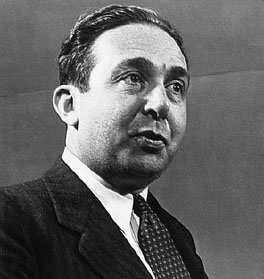
Why the world needs more Leo Szilards

Here's to the crazy ones, the misfits, the rebels, the troublemakers, the round pegs in the square holes... the ones who see things differently -- they're not fond of rules... You can quote them, disagree with them, glorify or vilify them, but the only thing you can't do is ignore them because they change things... they push the human race forward, and while some may see them as the crazy ones, we see genius, because the ones who are crazy enough to think that they can change the world, are the ones who do. - Steve Jobs

The body of men and women who built the atomic bomb was vast, diverse, talented and multitudinous. Every conceivable kind of professional - from theoretical physics to plumber - worked on the Manhattan Project for three years over an enterprise that spread across the country and equaled the US automobile industry in its marshaling of resources like metals and electricity.

The project may have been the product of this sprawling hive mind, but one man saw both the essence and the implications of the bomb, in both science and politics, long before anyone else. Stepping off the curb at a traffic light across from the British Museum in London in 1933, Leo Szilard saw the true nature and the consequences of the chain reaction six years before reality breathed heft and energy into its abstract soul. In one sense though, this remarkable propensity for seeing into the future was business as usual for the Hungarian scientist. Born into a Europe that was rapidly crumbling in the face of onslaughts of fascism even as it was being elevated by revolutionary discoveries in science, Szilard grasped early in his youth both a world split apart by totalitarian regimes and the necessity of international cooperation engendered by the rapidly developing abilities of humankind to destroy itself with science. During his later years Szilard once told an audience, "Physics and politics were my two great interests". Throughout his life he would try to forge the essential partnership between the two which he thought was necessary to save the human species from annihilation.

It's Leo Szilard's birthday today. A couple of years ago historian Bill Lanouette brought out a new revised edition of his authoritative, sensitive and sparkling biography of Szilard. It is essential reading for those who want to understand the nature of science, both as an abstract flight into the deep secrets of nature and a practical tool that can be wielded for humanity's salvation and destruction. As I read the book and pondered Szilard's life I realized that the twentieth century Hungarian would have been right at home in the twenty-first. More than anything else, what makes Szilard remarkable is how prophetically his visions have played out since his death in 1962, all the way to the year 2016. But Szilard was also the quintessential example of a multifaceted individual. If you look at the essential events of the man's life you can see several Szilards, each of whom holds great relevance for the modern world.

There's of course Leo Szilard the brilliant physicist. Where he came from precocious ability was commonplace. Szilard belonged to the crop of men known as the "Martians" - scientists whose intellectual powers were off scale - who played key roles in European and American science during the mid-twentieth century. On a strict scientific basis Szilard was perhaps not as accomplished as his fellow Martians John von Neumann and Eugene Wigner but that is probably because he found a higher calling in his life. However he certainly did not lack originality. As a graduate student in Berlin - where he hobnobbed with the likes of Einstein and von Laue - Szilard came up with a novel way to consolidate the two microscopic and macroscopic aspects of the science of heat, now called statistical mechanics and thermodynamics. He also wrote a paper connecting entropy and energy to information, predating Claude Shannon's seminal creation of information theory by three decades. In another prescient paper he set forth the principle of the cyclotron, a device which was to secure a Nobel Prize for its recognized inventor - physicist Ernest Lawrence - more than a decade later.

Later during the 1930s, after he was done campaigning on behalf of expelled Jewish scientists and saw visions of neutrons branching out and releasing prodigious amounts of energy, Szilard performed some of the earliest experiments in the United States demonstrating fission. And while he famously disdained getting his hands dirty, he played a key role in helping Enrico Fermi set up the world's first nuclear reactor. When Fermi was building the reactor his experiments were plagued by graphite moderator containing impurities of boron which absorbed neutrons and slowed down the reaction; with his background in engineering and his business connections, Szilard found a chemical engineering firm which supplied high purity graphite. Interestingly, the Germans encountered the same problem but instead of getting around it they got dissuaded and decided to use heavy water as a moderator instead. This led to them depending on the heavy water facility at Vemork in Norway; that facility was destroyed by the Allies in 1943, consigning the German atomic bomb effort to a certain end.

Szilard as scientist also drives home the importance of interdisciplinary research, a fact which hardly deserves explication in today's scientific world where researchers from one discipline routinely team up with those from others and cross interdisciplinary boundaries with impunity. After the war Szilard became truly interdisciplinary when he left physics for biology and inspired some of the earliest founders of molecular biology, including Jacques Monod, James Watson and Max Delbruck. His reason for leaving physics for biology should be taken to heart by young researchers - he said that while physics was a relatively mature science, biology was a young science where even low hanging fruits were ripe for the picking.

Szilard was not only a notable theoretical scientist but he also had another strong streak, one which has helped so many scientists put their supposedly rarefied knowledge to practical use - that of scientific entrepreneur. His early training had been in chemical engineering, and during his days in Berlin he famously patented an electromagnetic refrigerator with his friend and colleague Albert Einstein; by alerting Einstein to the tragic accidents caused by leakage in mechanical refrigerators, he helped the former technically savvy patent clerk put his knowledge of engineering to good use (as another indication of how underappreciated Szilard remains, the Wikipedia entry on the device is called the "Einstein refrigerator"). Szilard was also finely attuned to the patent system, filing a patent for the nuclear chain reaction with the British Admiralty in 1934 before anyone had an inkling what element would make it work, as well as a later patent for a nuclear reactor with Fermi.

He also excelled at what we today called networking. Szilard's networking abilities were evident in his connections with prominent financiers and bankers who he constantly tried to conscript in supporting his scientific and political adventures; in attaining his goals he would not hesitate to write any letter, ring any doorbell, ask for any amount of money, travel to any land and generally try to use all means at his disposal to secure support from the right authorities. In his case the "right authorities" ranged, at various times in his life, from top scientists to bankers to a Secretary of State (James Byrnes), a President of the United States (FDR) and a Premier of the Soviet Union (Nikita Khrushchev). Interestingly Szilard also became an early confidant of financier (and future Oppenheimer nemesis) Lewis Strauss who he convinced to fund and support his projects; later when the vindictive Strauss turned against Oppenheimer Szilard repudiated his advances.

I am convinced that had Szilard been alive today, his abilities to jump across disciplinary boundaries, his taste for exploiting the practical benefits of his knowledge and his savvy public relations skills would have made him feel as much at home in the world of Boston or San Francisco venture capitalism as in the ivory tower.

If Szilard had accomplished his scientific milestones and nothing more he would already have been a notable name in twentieth century science. But more than almost any other scientist of his time Szilard was also imbued with an intense desire to engage himself politically - "save the world" as he put it - from an early age. Among other scientists of his time, only Niels Bohr came closest to exhibiting the same kind of genuine and passionate concern for the social consequences of science that Szilard did. This was Leo Szilard the political activist. Even in his teens, when the Great War had not even broken out, he could see how the geopolitical landscape of Europe would change, how Russia would "lose" even if it won the war. When Hitler came to power in 1933 and others were not yet taking him seriously Szilard was one of the few scientists who foresaw the horrific legacy that this madman would bequeath Europe. This realization was what prompted him to help Jewish scientists find jobs in the UK, at about the same time that he also had his prophetic vision at the traffic light.

It was during the war that Szilard's striking role as conscientious political advocate became clear. He famously alerted Einstein to the implications of fission - at this point in time (July 1939) Szilard and his fellow Hungarian expatriates were probably the only scientists who clearly saw the danger - and helped Einstein draft the now iconic letter to President Roosevelt. Einstein's name remains attached to the letter, Szilard's is often sidelined; a recent article about the letter from the Institute for Advanced study on my Facebook mentioned the former but not the latter. Without Szilard the bomb would have certainly been built, but the letter may never have been written and the beginnings of fission research in the US may have been delayed. When he was invited to join the Manhattan Project Szilard snubbed the invitation, declaring that anyone who went to Los Alamos would go crazy. He did remain connected to the project through the Met Lab in Chicago, however.

In the process he drove Manhattan Project security up the wall through his rejection of compartmentalization; throughout his life Szilard had been - in the words of the biologist Jacques Monod - "as generous with his ideas as a Maori chief with his wives" and he favored open and honest scientific inquiry; this aspect of Szilard’s scientific philosophy would have been acutely appreciated by many modern scientists who favor open-access publication and collaborative, crowdsourced science. At one point General Groves who was the head of the project even wrote a letter to Secretary of War Henry Stimson asking the secretary to consider incarcerating Szilard; Stimson who was a wise and humane man - he later took ancient and sacred Kyoto off Groves's atomic bomb target list - refused.

Szilard's day in the sun came when he circulated a petition directed toward the president and signed by 70 scientists advocating a demonstration of the bomb to the Japanese and an attempt at cooperation in the field of atomic energy with the Soviets. This was activist Leo Szilard at his best. Groves was livid, Oppenheimer - who by now had tasted power and was an establishment man - was deeply hesitant and the petition was stashed away in a safe until after the war. Szilard's disappointment that his advice was not heeded turned to even bigger concern after the war when he witnessed the arms race between the two superpowers.

In 1949 he wrote a remarkable fictitious story titled 'My Trial As A War Criminal' in which he imagined what would have happened had the United States lost the war to the Soviets; Szilard's point was that in participating in the creation of nuclear weapons, American scientists were no less or more complicit than their Russian counterparts. Szilard's take on the matter raised valuable questions about the moral responsibility of scientists, an issue that we are grappling with even today. The story played a small part in inspiring Soviet physicist Andrei Sakharov in his campaign for nuclear disarmament. Szilard also helped organize the Pugwash Conferences for disarmament, gave talks around the world on nuclear weapons, and met with Nikita Khrushchev in Manhattan in 1960; the result of this amiable meeting was both the gift of a Schick razor to Khrushchev and, more importantly, Khrushchev agreeing with Szilard's suggestion that a telephone hot-line be installed between Moscow and Washington for emergencies. The significance of this hot line was acutely highlighted by the 1962 Cuban missile crisis. Sadly Szilard's later two attempts at meeting with Khrushchev failed.

After playing a key role in the founding of the Salk Institute in California, Szilard died peacefully in his sleep in 1964, hoping that the genie whose face he had seen at the traffic light in 1933 would treat human beings with kindness.
Since Szilard the common and deep roots that underlie the tree of science and politics have become far clearer.

Today we need scientists like Szilard to stand up for science every time a scientific issue such as climate change or evolution collides with politics. When Szilard pushed scientists to get involved in politics it may have looked like an anomaly, but today we are struggling with very similar issues. As in many of his other actions, Szilard's motto for the interaction of science with politics was one of accommodation. He was always an ardent believer in the common goals that human beings seek, irrespective of the divergent beliefs that they may hold. He was also an exemplar of combining thought with action, projecting an ideal meld of the idealist and the realist. Whether he was balancing thermodynamic thoughts with refrigeration concerns or following up political idealism with letters to prominent politicians, he taught us all how to both think and do. As interdisciplinary scientist, as astute technological inventor, as conscientious political activist, as a troublemaker of the best kind, Leo Szilard leaves us with an outstanding role model and an enduring legacy. It is up to us to fill his shoes. 

This is a revised version of a past post.

Does the discovery of gravitational waves foretell the "end of physics"?

Tomorrow at 10:30 AM Eastern Time the gravitational wave observatory LIGO will have a big announcement to make. LIGO will tell us whether it has finally observed gravitational waves (Update: The discovery has been confirmed). The finding will be the culmination of a two decade old experiment that in turn builds upon a hundred year old prediction. Gravitational waves are a logical prediction of Einstein's general theory of relativity which tells us that accelerating masses will generate "ripples" in the curvature of spacetime just like frolicking children on a rubber sheet generate waves in the material. These ripples will propagate through space and be detectable in the form of gravitational waves. Along with electromagnetic radiation, gravitational waves will give us another window through which we can "listen" to the universe.

The biggest gravitational waves would logically be detected from intense gravitational fields involving the acceleration of truly massive objects, and there are few gravitational fields that are more intense than those generated by the collision of two black holes; waves from these are the ones that are supposed to be announced by the LIGO collaboration tomorrow. 

The technology, dedication and attention to detail that has been involved in the detection of these waves is quite amazing and is a testament to the power of tool-driven science. The theory itself has been around for over a hundred years, but the experimental setup allowing us to validate it consists of a panoply of old and new tools. The biggest experimental achievement in detecting these waves is the construction of laser interferometers which split a laser beam and send the two resulting beams to a distance of 4 kilometers from where they are reflected back; fittingly enough, it was interferometry that put the stake in the heart of the luminiferous ether at the turn of the 19th century and paved the way for Einstein. The idea is that when a gravitational wave arrives at this source, there will be an asymmetric compression of one beam and expansion of the other (illustrated well in this BBC article) which should be manifested in the different times at which they arrive back at the detector. This difference in length should be detectable by ultra-sensitive electronics. 

But the magnitude of this difference is astonishingly tiny; as this article puts it, a gravitational wave from a source 4 light years away will cause a perturbation of no more than a thousandth of the width of an atomic nucleus. Recognizing this perturbation is trying to drill down to the very limits of what human beings can achieve with their inventions, and it's a truly noteworthy achievement. What we also need to appreciate is that the detection will be the work of several fields of science. Physics, certainly, but also chemistry and materials science, electronics, mechanical and civil engineering and a boatload of mathematics and statistics. All these fields needed to have matured before gravitational waves could be discovered.

Gravitational wave detection is certainly going to be an exciting moment for science and it would be the well-deserved culmination of countless hours of toil and creativity. And yet this discovery fills me with a certain amount of nostalgia and sadness. One of the reasons is John Horgan's "The End of Science", a book which continues to stick out from the science literature like a sore thumb. The book is rightly controversial, and most working scientists disagree with its proclamations of the demise of various fields of science as highly premature. Yet the book has a more subtle message which seems to ring true, and the many scientific stalwarts in it who validated Horgan's thinking through interviews certainly don't help dismiss its message.

Here's the problem: While the detection of gravitational waves will be a fitting testament to both experimental and theoretical science and the dedication of countless scientists over the years, in one sense it would be utterly unsurprising. That's because it is the logical prediction of a theory that has been around for a hundred years. In fact it's not even the first or most important prediction of this theory, nor would it be the first time that experiment and engineering have been able to probe physical phenomena predicted by this theory to an incredible degree of accuracy (that honor in my opinion goes to gravity probe B). If the true progress of science is measured by the number of novel and original phenomena it unearths, then what would have been really surprising is if LIGO conclusively failed to detect gravitational waves.

Einstein put the finishing touches on his general theory of relativity in 1915 with the publication of his so-called field equations. Since then, starting with Arthur Eddington's pioneering detection of the bending of starlight in 1919, one experiment after another has spectacularly validated the predictions of the theory. Relativity has been probed at a vast range of scales, from right here outside earth to the innards of galaxies and black holes to the large-scale structure of the entire known universe. A Wikipedia article lists at least ten different tests which confirmed the basic features of the framework: frame dragging, redshift, the equivalence principle...the whole works. Even gravitational waves were indirectly detected from a pulsar, and the scientists who did the work won the Nobel Prize.

Thus, in some sense the direct detection of these waves comes not at the forefront but at the tail end of a century of amazing experimental work; the real star here is the theory itself which was truly a watershed. If science grows best at its edges, then gravitational waves are at its dead center; general relativity would have been alive and well even if they hadn't been detected. Would their detection be a technical tour de force, a tribute to the hard work of brilliant physicists and engineers? Absolutely. Would it be a novel discovery, a discovery like relativity itself or fission or Mendelian genetics that overturned or revolutionized science? Sadly no.

The reason I kept thinking of Horgan's book is because some sources are already calling the putative finding one of the most important discoveries in physics of the last few decades. Let me not mince words here: if that is indeed the case, then physics is in bad shape. To see why it's worth looking at the history of physics and going back to say, 1950. If as a chronicler of science in 1950 you were to list the most important discoveries in physics of the last few decades, that list would include special and general relativity, the discovery of the neutron, the atomic nucleus and fission, the whole edifice of quantum mechanics (including the uncertainty principle) as well as pioneering experimental achievements like the Lamb shift and the laser. 

In contrast, listing the important achievements in physics of the last few decades in 2016 is a depressing task. There have been no fundamental revolutions in theoretical physics since the evolution of the standard model. Experimentally there have been a few important discoveries like the Hall effect and high temperature superconductors, but nothing comparable to Rutherford's discovery of the nucleus. Even the discovery of the Higgs boson - a supreme achievement of engineering and collaboration if there ever was one - was vindication of a prediction from the 1960s. It is hard to escape the feeling that physics's main job these days seems to be experimentally verifying everything that people conjectured forty years ago; the cynical view would have us say that gravitational waves might be one of the last hurrahs of reductionist physics. The only truly unexpected, startling and revolutionary discovery in physics of the last three decades has been the finding that the expansion of the universe is accelerating. In fact that's a good benchmark for comparing discoveries. Unlike the accelerating universe which was wholly unexpected, the discovery of gravitational waves would be completely expected.

The fact that tomorrow's expected announcement would be treated as one of the greatest physics discoveries of our lifetimes should give us pause and should make us think about the history and future of the science. At the same time, there is one reason it should make us feel optimistic; if gravitational waves have indeed been detected, there's no telling what else they would say about our universe. The one truth about science is that the most important discoveries are the ones which we cannot predict. If gravitational waves are utterly predictable, then we can at least hope that what they will tell us about our fascinating universe will be utterly unpredictable and new. That is something all of us can look forward to.

Billionaires and science prizes: "Fund the science, not the prizes"

Physicist Lawrence Krauss has a good piece decrying recent billion-dollar science prizes like the Breakthrough Prize which billionaires like Mark Zuckerberg are giving out to leading scientists in Oscar-style extravaganzas, and I have to say I largely agree with his criticism. Quite aside from the simple fact that gunning for any prize is terrible motivation for doing science, I have always been skeptical about how much of a difference exactly these prizes make in terms of public appreciation of science, let alone in terms of getting young people interested in science.

As Krauss puts it, it's not just a simple question of whether these recognitions are "good" or "bad" for science (they're probably not bad per se); it's a question of whether the cost to benefit ratio is worth it and whether there are simply better ways in which a billionaire can spend his or her billion dollars on science. I also tend to agree with his cynical-sounding but valid point that the most palpable impact of these prizes is probably to raise the public profile of the benefactors themselves rather than the recipients. Nor are the prizes, as glittering as they seem, the ultimate honors; as Krauss accurately observes, all the prize winners would almost certainly trade their awards for a Nobel Prize if they had a chance. Simply put, money can't really buy you prestige.

Krauss's recommendation for what to do instead with all that money is simple: instead of putting a billion dollars into a prize for an individual or specific discovery, fund actual science instead. One of the reasons is simply the magnitude of what could be done: a simple calculation leads to the rather alarming conclusion that a billion dollars would fund about two hundred and seventy postdocs for a year. In fact, as any academic who is cash-strapped and constantly jousting for a dwindling percentage of NIH or NSF grants knows, even a million dollars could serve as a healthy injection of funds into a moribund project. Here's Krauss on how spreading the wealth around could do a great deal of good, especially in fields in which the government is increasingly stepping back.
"But a larger problem is that these prizes are not an efficient use of funds. Instead of funding science prizes, these billionaires should try funding the science itself. Take particle physics—one of the main specialties in which Breakthrough Prizes have been awarded. In that field, government funding has been cut back significantly, and budgets have been flat or declining for years. The $27 million awarded by Yuri Milner, in 2012, would have funded perhaps two hundred and seventy new postdoctoral fellowships that year, or a smaller number of postdoctoral fellowships combined with endowed faculty positions. That could more than double the current number of young researchers in the field. With a larger group of young, talented, and ambitious scientists finding gainful employment, the likelihood of jumpstarting some new and exciting research would be significant. (The benefit to young scientists, meanwhile, would be far greater than that created by giving more money to older scientists whose work has, in all likelihood, already been recognized and well supported.)"
Krauss's words remind me of a past blog post in which I had commented favorably on private funding of actual science and had cited very successful endeavors like the Broad Institute and the Kavli Institute as well as scientific projects funded by people like Larry Ellison and Paul Allen. It seems quite clear to me that these people have done a lot more good for science than what they would have had they put their billions into annual prizes given out by Hollywood celebrities in rock concert-like events with performances by actual rock stars. This is exactly what Krauss gets to at the end of his piece:
"My advice to would-be billionaire prize-makers is simple: set up independent foundations from which good young people and the institutions they are part of can receive support. This will allow more scientists to pursue careers that might otherwise be cut short due to the current, and unfortunate, lack of public funding. If you want glitz, spend your money on yachts; if you want to have an immediate impact as a force for good, then help the poor. But if you want to help the scientific enterprise, prizes aren’t the way to do it."

What math can teach us about drug discovery and biology (and all of science, really)

Columbia University mathematical physicist (and slayer of string theory myths) Peter Woit recently gave an interesting talk at Rutgers in which he made an appeal for theoretical physicists working on string theory to 'reform' by learning from mathematicians. Woit thinks the physicists have lost their way in their drive toward empirically unsupportable and mathematically dubious claims. He says that unlike physics, mathematics is alive and robust, and unlike the physicists' barren exploits in the realm of fundamental physics, mathematicians have been proving many important fundamental theorems in the last few years (Fermat's last theorem, the Poincare conjecture, the twin prime conjecture etc.)

Woit's main point seems to be that mathematics has very clear protocols and boundaries for achieving its goals, and these kinds of guidelines would serve as useful pointers to physicists who seem to have abandoned rigor and logic in certain highly speculative areas. On one of his slides Woit had a listing of the steps mathematicians adopt as reality checks, and it struck me that one could apply the same lessons to a lot of the modeling - molecular as well as statistical - that goes on in drug discovery. In fact one could apply these lessons to much of empirical science as a whole. Here's the slide:


The first point about being very clear about your assumptions is spot on. My graduate school advisor Jim Snyder always used to emphasize this point; often when I breathlessly extolled the virtues of a fine paper with impressive graphics and methodology published in Science or Nature, he would calmly quip, "Looks interesting...but there's an assumption here...". The point was that no matter how elegant a study might be and no matter how impressive the technical manipulations in it might seem, if it's built on a foundation of flawed assumptions the whole structure can collapse.

As we have often seen in molecular modeling for instance, it's not hard at all to present fancy-looking computer models based on dubious assumptions. We don't have to look too far to realize this; a lot of docking and molecular dynamics is predicated on the assumption of an accurate force field. The even more basic assumption there is that we can accurately model the complicated intermolecular forces causing a small molecule to bind to a protein of interest. As we have found out over the years, both those assumptions can be suspect and they can turn the whole process into a crapshoot. No amount of computing power, beautiful graphics or elegant software can turn conjecture into reality if the basic assumptions underlying these things are questionable or inaccurate.

Woit's second point is also very valid. The chain of logic extending from one argument to another can often break down in complex, multilevel fields like chemistry and biology. We see this in drug discovery all the time. For instance, much of pre-clinical drug discovery depends on the accuracy of assays that are supposed to mimic the conditions inside a diseased human being. In reality this is almost never true; assays reveal themselves under conditions of high dilution in simple test tubes, diseases under chaotic regimes of intense molecular crowding inside complicated bodies. Extrapolating from one assay to another is a constant and daily headache for drug hunters, and extrapolating from assays to mice or human models is usually a great step into the unknown. Thus Woit's caveat to constant double-check the logical progression from one step to another - from one assay to another to mice to monkeys to humans - is absolutely critical before you declare that a dug molecule is actually working.

Lastly, one can never underestimate the staggering relevance of the third admonition - to separate what's known from what's murky, ill-defined and simply dark. Casually striding over the boundaries of these two domains has gotten scientists into a lot of trouble. Especially in a highly complicated endeavor like biology where emergent chaos play havoc on reductionist elan, mistaking what's unknown for what's known will ensure that you're in for some very rude shocks, and will likely consign your project to a swift end. At every step in a project involving complex biological or physical systems, it is imperative to make sure you clearly understand the known knowns, known unknowns and the unknown unknowns.

In 1931 the 25 year old Kurt Gödel taught us that even in that most exalted realm of mathematics which we are talking about, what we can know is fundamentally limited. It's a lesson which we should take very seriously to heart in the far more uncertain world of empirical science in general and biology in particular, otherwise we may very well end up taking it to our grave.

The virtualization of drug discovery is not the actualization of drug discovery

Automation in biology and drug development can design, execute, explore and analyze, but can it ask the right questions?
From Forbes comes this piece about VC firm Andreessen Horowitz and former Stanford biology/computer science professor Vijay Pande (who has recently joined the firm as a partner) who are trying to get the most out of the "hacking drug discovery" paradigm. 

The piece talks about the "virtualization" of several key aspects of biology and drug discovery which would involve using software and smart automation to perform experiments. The areas that Horowitz and Pande are focusing on in particular involve cloud-based experiments, machine learning and lab automation. This is not the first time that Bay Area software entrepreneurs and scientists are taking notice of drug discovery. Peter Thiel who has had some interesting thoughts on drug development has already funded Emerald Cloud Labs (ECL), a venture that uses 15,000 sq ft of lab space packed with robots and automation to perform experiments that you can design and initiate with the click of a button on your laptop.

I am all for new approaches to drug discovery and especially ones that promise to make it more efficient, but as the piece notes, the optimism about applying software to drug development is rightly tempered by a recognition of the inherent messiness of biology and the vast gaps of ignorance that riddle our knowledge of the interaction between small molecules and living organisms. The article quotes several industry experts on the challenges that any kind of software-based drug development platform would face. Here's Mark Murcko for instance:

“Can you solve the biology problem with the latest technology out on the cloud? I have not seen that.Every day, every company I work with is struggling with target validation, biomarkers and patient selection. Questions come up such as “‘I have a hit from a screen and I do not know what it does’ and  ‘Which of these two targets (out of ten in total) do I pick for my next drug discovery project?’” Murcko said. All of this, Murcko said, gets into biology that is “half-right and half-wrong. For example, ‘I have to extrapolate from mouse data.’ Or ‘It is human genetic data but it’s from the germ line [e.g. from sperm or egg cells or their immediate progeny].’”  So the data do not necessarily teach you what will happen if you shut down 80% of the activity of the same target in a 50-year-old patient."

And he's right. The kinds of questions that most people in drug discovery tackle are very messy and often quantitatively ill-defined. They deal with emergent biological organization and non-linear dose-response. It's one thing to be able to speed up the acquisition of data in such experiments; another to interpret that data or even to ask the right questions in the first place. Although I am all for automation and cloud-based analysis, these experiments by themselves are not going to speed up the fundamental challenges involved in getting to a new drug, nor are they going to account for unexpected events. One of the other experts quoted in the article, Nagesh Mahanthappa, puts this issue into perspective:

“You can automate an assay and be in love with the output. But if you bother to look you can find out that you have been grossly misled…These days, so much equipment is automated or semi-automated. They give you results in thirty minutes. But the results often sound like this: ‘The molecule inhibited signaling.’ You have to remember to ask in that case, are you sure that the molecule did not just kill all the cells? Or that the cells were not washed off the plates during a washing step?”

Consider Emerald Cloud Labs for instance; their website lists dozens of experiments ranging from flow cytometry to fluorescence microscopy which you can remotely ask a robot to perform. Key biostructural techniques like crystallography and NMR spectroscopy are coming online by the end of the year. It's great that you can cheaply outsource such techniques from the comfort of your living room. But the problem as anyone who has worked in the field knows is that both the course and the output of these experiments are far from standard. No assay development project is the same as another, even for well known targets, and assays and biophysical characterization of every target and class of small molecule demands its own tweaking, idiosyncrasies and unexpected glitches. There is no doubt that a facility like Emerald Cloud Labs will speed up plain vanilla type experiments, but there is also little doubt in my mind that the automation that such a facility promises will be severely hampered by the project specific human-intervention that will be constantly demanded by the vagaries of drug discovery.

Some of the thinking in that article exemplifies what Derek Lowe has called the "Andy Grove fallacy", the belief that bringing computational thinking to biology will help us rapidly sort the wheat from the chaff and get to the right answer fast. It's the kind of thinking that a lot of Silicon Valley entrepreneurs who are steeped in the high success rate of software ventures are bringing to bear on the intricacies of biology. Unfortunately as I mentioned before the problem here is not speed or efficiency per se, it's asking the right questions in the first place. Very little of our ability to develop new drugs is constrained by speed; much of it is constrained by plain ignorance. You can hack together a car app given enough manpower, money and time because the goal is usually quite clear and the process highly deterministic. That's not the case with the emergent world of biology. There's not much point in doing something fast if you don't know whether that's the right thing to do. Blazing automation will help only if you are asking the right question and know how to interpret the answer.

All this being said, I am glad that people like Thiel, Andreessen, Horowitz and Pande are putting their own money into such investments and walking the talk. The real benefit of such ventures would be to push the boundaries of our thinking regarding the application of data science to biology, and even the ignorance that they would discover would be enlightening. At the very least, increased speed and automation would allow us to make mistakes faster and learn what doesn't work. And as anyone who has worked in the time and money-constrained world of pharma knows, that's as good an asset to have as any other.

Update: Derek's take.

What do we need? A Jarvis for molecular modeling. When do we need him? Yesterday.

"Jarvis, is this model statistically validated or am I just
making stuff up?"
One of the major and somewhat underappreciated characters in the Iron Man franchise of movies is Jarvis, Tony Stark’s loyal AI system and indispensable assistant. Jarvis in fact may be the principal character in Iron Man apart from Iron Man himself, since he has saved Tony Stark's life more than once. For our purposes though, Jarvis’s key function is in reducing Iron man’s ideas to practice. In the first Iron Man movie, after Tony Stark cobbles together a primitive iron man suit from a bunch of scraps in a cave, it’s Jarvis who helps him turn his newfound ideas into something far more sophisticated. Jarvis has two key capabilities that help him help Stark. One is a superior natural language processing capability that allows him to understand exactly what his creator wants. The other is access to a vast repository of data regarding specs, blueprints, system hybrids and other paraphernalia which he can summon on demand.

What I find most interesting though is Jarvis’s highly interactive nature. He seems to anticipate much of Tony Stark’s thinking, asking questions like “Are you sure you don’t want to use carbon nanotubes instead of titanium, Sir?” or “Do you want me to pull up [system X] which is similar to [system Y] that you are trying to build?”. This interactive capability not only speeds up the progress of projects that Stark is working on, but it also opens up new avenues that he himself may not have thought about.

Why was I thinking about Jarvis? Here’s the thing: I thought about Jarvis when I realized how woefully, drastically uninteractive all of our molecular modeling software is. This criticism does not apply to a specific program or set of tools; it permeates the entire panoply of structure and ligand based drug design tools employed by computational and medicinal chemists. One can debate the pros and cons of specific algorithms for molecular dynamics or docking or QSAR, but I think the one thing we should be able to agree on is that none of these tools anticipate our needs or talk to us even in simple ways. In the sense of being interactive, our modeling software is as primitive as transportation was in the eighteenth century; it sits there, listless and passive, waiting for us to push the buttons and pull the levers.

This is an odd state of affairs. Today we expect most of our electronic devices and software to interact with us; Microsoft Office had in fact implemented their primitive version of Jarvis – the unfortunate and doomed ‘Clippy’ – in Windows back in the 90s. Clippy did not stay around forever, but in principle he was asking the right questions (“It seems you are writing a letter”). What we need is a more sophisticated form of Clippy for our modeling software.

What would a Jarvis or advanced Clippy for modeling look like? For one thing, it would be able to look at a protein or ligand of interest and immediately have at hand a list of similar systems drawn from the academic, industrial and patent literature. Its speed and efficiency assumes ready – instant in fact – access to databases like the PDB, GVK and ChemBL. This task by itself shouldn’t be a problem since it only involves an upfront investment of effort. Once this data has been acquired, our hypothetical Jarvis should then be able to identify the tasks we are embarking on and suggest enhancements, automation or modifications to those tasks. For instance, we may want to identify or probe binding sites in a protein which we want to inhibit. In that case, once we start to run a program like Schrodinger’s SiteMap which accomplishes this, Jarvis should immediately be able to chime in, identify what we are doing, and then retrieve homologous proteins with similar binding sites. It should similarly be able to parse a ligand on the screen and identify similar ligands depending on what we are doing with it. For instance if we were docking that ligand, it would draw up a list of shape-based binding pocket pharmacophores which are similar to the ones in our protein, telling us what the probability of our ligand inhibiting those other proteins might be. This would give us some idea of the protein off-target interactions which our ligand might be expected to have. All this would be displayed as attractively as the graphics in Tony Stark’s basement lab.

In the ligand-based design sphere, a Jarvis for modeling would be especially useful in building QSAR models. One of the biggest pitfalls of QSAR - and in fact of all of computational chemistry - is the existence of spurious or artifactual correlations with biological activity. There are innumerable case studies where people have correlated biological activity of molecules with any number or combination of chemically impenetrable and mathematically dense parameters without first checking whether the activity correlates equally well or better with very simple parameters such as molecular weight, hydrophobicity (logP) or polar surface area. A Jarvis for modeling would make sure that whenever you start building any kind of a QSAR or similar model, he calculates and flashes in front of you a few simple correlations that allow you to make sure that you are not missing simple relationships; only once you are sure that the simple correlations don’t hold up would it make sense to grab a non-linear combination of your favorite ten-dimensional topological index and a parameter from a relativistic quantum chemical calculation. Visualization of this data in a clean, comprehensive and attractive format would again be a key attribute of such a Jarvis.

The desirability of having a Jarvis for molecular modeling dovetails with similar general thoughts I have had about the lack of sophistication in modeling software. I always find it odd that we expect a lot of interactive sophistication in our iPhones and our Samsung watches, and yet we somehow seem to be content in dealing with software for molecular modeling that simply waits for us to push buttons. Generally speaking we don’t apply the same standards to molecular modeling software which we apply to our smartphones, tablets and other devices. We take Siri and Cortana for granted, and yet we don’t demand Siris, Cortanas and Jarvisis in our docking programs. It would be a while before an entity as intelligent as Jarvis is able to help us do better modeling, but that does not mean we don’t start trying right now. I think that demanding this kind of sophistication from scientists, developers and vendors will do a lot of good for the entire community. It’s high time we did.

Book review: Andrea Wulf's "The Invention of Nature: Alexander von Humboldt's New World"

If I ask my learned friends to make a list of the top ten scientists in history, Alexander von Humboldt probably won't figure on the list; he probably wouldn't have figured on my own. And yet when he was alive, for a while Humboldt was the most famous scientist in the world. Thousands thronged to hear him speak, and the most distinguished personalities of the age visited him at his home in Paris and Berlin. He was a polymath in the true sense, excelling in science, philosophy, writing and adventure. He also laid the foundations for modern environmentalism and inspired scores of later writers and naturalists, including Charles Darwin, Henry David Thoreau, George Perkins Marsh and John Muir. Dozens of streets, mountains, forests, universities and scholarships around the world are named after him.
Andrea Wulf has written an excellent biography of this remarkable mind which secures Humboldt’s place both as a brilliant scientist and explorer and as one of the founding fathers of modern environmentalism. It would not be off the mark to say that he paved the way for Darwin and natural selection. He was born in Prussia in 1769, when Europe was starting to crackle with reform and intellectual ferment. Humboldt inherited a large sum of money from a strict, authoritarian mother who wanted him to enter the law and civil service. But Humboldt was smitten by nature and exploration from a very young age and wanted nothing more than to travel to the far, wild reaches of the planet. His brother Wilhelm on the other hand took to law and diplomacy like a fish and held a succession of important ambassadorial posts in France and Italy; throughout their lives the brothers along with Wilhelm’s wife Caroline were to be close, in spite of their occasional disagreements. In his young days Humboldt’s scientific temper was molded by a short career as a mining inspector. This career gave him a chance to travel throughout Europe and appreciate some of the finer details of geology and the chemistry of minerals.
Humboldt's early intellect was shaped in part by his own burning curiosity for reading and nature and in part by a formative friendship with Goethe; the two often visited each other and spent long evenings debating everything from science to poetry. Until Humboldt met Goethe he was a strict rationalist, but Goethe taught him that a true appreciation of nature comes when its scientific study is infused with a sense of wonder and feeling about its workings. The heady mix of Romanticism and Enlightenment thinking that pervaded Humboldt’s discussions with Goethe primed Humboldt for a novel appreciation of nature.
Armed with these twin pillars of natural philosophy, Humboldt set off in 1799 on what would turn out to be the most important trip of his career. He decided to traverse as much of South America and especially Venezuela as he could. His goal, just like Darwin's twenty-five years later, was to study the native flora and fauna, including the mighty river systems of the South and the indigenous tribes. Humboldt was accompanied by a French botanist named Aime Bonpland who shared his enthusiasm for adventure and science. And what adventures they had. They climbed mountains in freezing weather and hailstorms, navigated rivers and forests filled with dangerous snakes, crocodiles, scorpions and spiders and came face to face with ferocious tribes who had never seen a European before. The duo’s hardiness – some would call it foolhardiness – in the face of extreme weather and dangerous conditions alternately evokes a sense of bravery and stupidity. The most vivid experience they had which really stood out for me was when they trotted in horses in a pool filled with electric eels so that the dangerous creatures would be roiled up to the surface by the horses’ hooves, ready for capture and study.
Humboldt’s South American adventures took five years and planted seeds for two key ideas which laid the foundations for similar thinking by many of the world’s most important scientists, humanists and writers. Traversing diverse environments like mountains, rivers, oceans and rain forests, Humboldt was struck by the similarity in flora and fauna that he observed; many of the plant species at higher altitudes for instance were similar to ones he had seen in Europe. At the same time he also observed how crucial the dependence of life in these environments was on climatic conditions. These observations led Humboldt to conceive of life as a seamless whole whose parts are critically dependent on each other; perturb one part and you risk perturbing the whole. Without giving it a name Humboldt had discovered the biosphere. This was a profound insight in an age when the environment was considered as a limitless resource that was ripe for man’s taking. The sensitive dependence of various parts of life on each other was a novel idea at the time, and it became the precursor for much thinking on ecology, biology and climate change that we take for granted; it underlies for instance James Lovelock’s idea of Gaia, of seeing the earth as a living and breathing organism with interdependent parts.
Humboldt also acquired a lifelong disdain for colonialism and slavery during his American sojourn. By the time he arrived in Venezuela the Spanish had already established a sizable stronghold in much of the continent. Humboldt was struck by the plight of both the natives and the lowly status of the Spaniards who were born in the exploited countries. He also appreciated the wealth of knowledge that infused the way of life of the indigenous tribes and their ancient civilization; a way of life that was slowly being eroded by the Conquistadors. Humboldt got a further opportunity to shape his thinking on these issues when he made his way to Philadelphia and Washington DC in his way back home. His goal was to meet Thomas Jefferson. Jefferson had already heard of Humboldt’s observations, and he thought Humboldt’s notes on South America and Mexico would be especially helpful to him as the United States sought to expand its territories in the South and the West. The two men struck up a warm, cordial relationship. The president and the scientist-explorer had much in common; they were both polymaths and leading intellects whose thinking was permeated by an appreciation of nature and exploration. Humboldt stayed at Monticello and admired Jefferson’s experiments in agriculture and architecture. He also found much to admire in the forward-looking and spirited Americans. But he also openly criticized slavery in the United States and made the obvious observation that the founding ideals of the country were in stark contrast to its exploitation of other human beings. These discussions made Jefferson uneasy but it did not affect the intellectual relationship that the two men enjoyed.
Humboldt arrived back in Paris to thousands of spectators; stories of his adventures and his vivid writings had already made him famous. Paris with its museums and intellectuals was the place to be, and Humboldt developed friendships with several leading French scientists including the chemist Gay-Lussac and the paleontologist Georges Cuvier. But he also watched with dismay as, after what seemed to be a bloody but successful people’s revolution, Napoleon turned France into an empire-building state and semi-dictatorship. At the same time Napoleon did have some appreciation of science, so Humboldt could still work relatively unfettered in France. Humboldt’s most interesting friendship in France was with the South American revolutionary Simon Bolivar who was spending a short period in the world’s cultural capital after the death of his young wife, immersing himself in wine, women and song to recover from the grief. After meeting Humboldt, Bolivar had a renewed sense of urgency regarding the freedom of South Americans from the Spanish, and when he returned he started his incredibly resilient and successful campaigns for Latin American independence.
While Humboldt thrived in France and wrote bestselling books on South America’s flora and fauna, his restless mind could not stop thinking of other places to explore. He set his sights on India and the Himalayas, and his determined sadly unsuccessful search is one of the great what-could-have-beens of the times. The culprit was the East India Company which had established a stronghold in India and whose express permission was needed to travel to the country. When Humboldt visited London – mobbed by famous scientists and crowds as usual – he tried to pull all the scientific and diplomatic strings which he could to secure passage to India. But the thorn in the East India Company’s side was his vocal criticism of colonialism, of which India was Britain’s self-proclaimed “jewel in the crown”; the Company would never agree to let this upstart intellectual who threatened to create a publicity nightmare for them enter India. Humboldt continued to try to get to India for the rest of his life, and one can only wonder what kind of perspicacious observations he would have unearthed had he been able to make the trip.
If not India, Humboldt’s next choice was Russia which was still under the yoke of the Tsars. By this time Humboldt’s inheritance was gone and he was being funded by a stipend from the German King; it was a stipend that Humboldt grumbled about since it often involved accompanying the king on menial trips and small talk with court ministers. Humboldt was therefore gratified to secure funds from the Russian monarch. He was then 59 but still in his element. Accompanied by a few assistants and fellow scientists, Humboldt covered almost 10,000 miles in less than a month. The journey was again dangerous, and at one point involved barreling through a region stricken with an epidemic of anthrax. The official mandate of the trip was a mining exploration, but Humboldt often violated this mandate and strayed several thousand miles off the chosen route to perform his own experiments on the native flora and fauna. The result was again a view of the unity of life spread across diverse geographical and biological environments.
Humboldt finally came home to Berlin after what turned out to be his last international trip. But his restless spirit was not done yet. He spent the next thirty years corresponding with leading lights like Darwin, Jefferson and Louis Agassiz. The crowning achievement of those years was a vast, multivolume, audaciously ambitious compendium of earth’s biosphere and the universe called “Cosmos”. Predating Carl Sagan’s Cosmos by a hundred and fifty years, Humboldt’s “Cosmos” sought to put all physical and biological phenomena on the same footing. Here was Humboldt the polymath at his best. In Cosmos Humboldt put together everything he knew about geology, anatomy, geography, paleontology, ecology and humanity to create a unified view of life. The volumes were lavishly illustrated with Humboldt’s own drawings as well as those from scores of correspondents. They were works not just of science but of literature, stamped with the influence of Goethe and the age of Romanticism. The volume of letters that Humboldt received from both scientists and fans during this time reached into the thousands. “Cosmos” was Humboldt’s last great work, and he died in 1859 at the ripe age of eighty-nine years, in his last years becoming one of the most famous people in the world. He was feted in all the world’s major capitals, and celebrations of his life lasted many days and drew crowds of thousands.
The last part of the book charts the influence of this remarkable intellect on some of the best-known and most influential naturalists and writers of the nineteenth and twentieth century. Darwin found commonalities in his own observations of similarities among species and Humboldt’s work in Venezuela. Humboldt also had a great influence on Henry David Thoreau who took inspiration from Humboldt’s sensitive appreciation of nature in writing his famous ‘Walden’; Thoreau’s words exemplify the kind of poetry that Humboldt learnt from Goethe. The American naturalist George Perkins Marsh was also quite taken by Humboldt’s observations on the destructive influence of human activity on the environment, and especially on deforestation. Marsh’s “Man and Nature” anticipated Rachel Carson’s “Silent Spring”; Marsh today is regarded as America’s first serious environmentalist. Finally, John Muir whose wanderlust took him on foot from his home in Indiana to first Florida and then to Yosemite became America’s foremost influence on the founding of its national parks. Muir, Thoreau and Marsh all had heavily marked copies of Humboldt’s works on their shelves, and all extensively referenced Humboldt in their writings.
What all of these naturalists and a horde of other successive writers gained from Humboldt was an appreciation of the unity of life, the seamless interdependence of its various parts on each other, and its great fragility and sensitivity to human intervention. As we debate climate change and greenhouse gas emissions, as we discuss nature’s depiction in art and poetry, as we pick up a snowflake and wonder at its multifaceted aspects of geometry and beauty, we are all walking in Alexander von Humboldt’s shoes.

George Whitesides: "Chemists - we change the way you live or die"

I don't know if I have highlighted this eminently readable quote from a review on the future of chemistry by the always interesting George Whitesides before, but it's quite memorable, not just because it dramatically illustrates how chemistry contributes to our world but also because it accurately does so.

Whitesides is talking about an old and thorny problem: how to pitch the wonders of chemistry to a public which often thinks that while physics is about the universe and biology is about life, chemistry is about glue and vitamins. How do we convince people not just of the practical utility of chemistry but also about its vast reach as the "central science". Whitesides's advice is to try out the line at the end of the following exchange on your next trans-Atlantic flight fellow passenger.


To me, the beauty of that statement is not just that it encompasses the ubiquitous and deep role that chemistry plays in human life and death but that it also satisfies a key constraint from the philosophy of chemistry: that of representing the discipline at the right emergent level. What I mean is that it would be trivial to say that the statement "We change the way you live or die" could encapsulate physics and biology even better; after all there would not be life or death without evolution, and even less so without the second law of thermodynamics. 

Yet not only does chemistry serve as the major workhorse for both evolution and the Second Law but it also contributes to life and death at a very direct level, as opposed to an abstract if very general one. The ATP, glucose and water molecules coursing through your body can put a chokehold on your very ability to live right away if their number dwindled. So can the molecules in your food supply or your environment. They are life-giving and life-depriving in a very real sense unlike the laws of physics and biology which, although they may be more generally encompassing, don't describe the system at the right explanatory level.

It is the combination of pleasing philosophical applicability and damning practical applicability that make that quote feel as satisfying to me as a Bruce Willis quote on living and dying from "Die Hard".

Book review: Simon Winchester's "Pacific" - A "behemoth of eye-watering complexity"

I am always game for anything written by the prolific polymath Simon Winchester. His specialty is to dig up stories of entire geographic regions and/or the fascinating individuals who populate them. In the past he has written about the making of the Oxford dictionary ("The Professor and the Madman") and about the brilliant Joseph Needham who revealed China to the West ("The Man Who Loved China"). He has also written about the history of the Atlantic Ocean, and now he turns his sprawling attention to the Pacific.

The Pacific, writes Winchester, "is a behemoth of eye-watering complexity". Its size beggars belief - its sixty-five million square miles can hold all the world's continents and still leave room for more - and its fringes and its heart contain some of the most important stories of science, history, geography and human civilization. How does one tackle an entity of such enormous scope and complexity?

Winchester's tack is a neat one. What he does is tell us the story of the Pacific in ten diverse chapters. The subtitle of the book, "Silicon Chips and Surfboards, Coral Reefs and Atom Bombs, Brutal Dictators, Fading Empires, and the Coming Collision of the World's Superpowers" gives us a flavor of the myriad topics he takes on. The beginning of every chapter portrays a major event related to that chapter, which then becomes a springboard for a much broader theme. Here are some of the chapters that I found particularly interesting.

The first chapter starts with a history of the hydrogen bomb tests in the countless tiny islands of the South Pacific which the US brazenly set off in the late 40s and early 50s. This series of tests leads to the real story, which is the sordid history and tragic exploitation of the native Pacific islanders populating these tiny islands: the Marshall Islands (including Bikini atoll where the first hydrogen bomb was detonated), the Solomon Islands (where John F. Kennedy almost died after his PT boat was sunk by a Japanese destroyer during World War 2) and the Marianas (which were the sites of some of the most ferocious battles of the war). The islanders essentially became pawns in the Cold War, and their constant uprooting and exploitation is a reminder of how forgotten people can almost be erased from history in the struggle between superpowers.

Another chapter talks about how surfing took root in Hawaii and how, due to the efforts of a select few westerners - including writers Jack London - came to California and spawned a whole culture. There's also a chapter on the founding of Sony and the key role that Masaru Ibuka played in it (Akio Morita's role is usually better known). Winchester characteristically digs up amusing facts; for instance I did not know that Sony's transistor radios became big in the US after a highly publicized heist in which hundreds of them were stolen from a warehouse - while others were left untouched.

A lot of the book is about the coming of age of Asian powers. One of the most interesting chapters is about the 1968 capture of the NSA spy ship USS Pueblo and its sailors by North Korea. That story provides a springboard into the exploration of the bizarre regime of North Korea and its highly repressive and otherworldly culture. Particularly illuminating is a brief history of the Korean War in which the boundary between the North and South was decided arbitrarily and literally on a whim by an American Colonel named Boneskull. And there's a description of one of the strangest places on the planet - the DMZ between the two countries where bears, exotic birds and other animals have thrived as in no other place on the planet. The capstone of the chapter is a bizarre dinner which the author has in the Swiss embassy which was formed to oversee the truce in 1952: a dinner that takes place with speakers in the background constantly blaring propaganda inviting South Koreans to live in the promised land under the beneficence of the Dear Leader.

Just like the Pacific has been an enormous stage for geopolitical affairs, so is it also a great cauldron of geography and biology. One chapter tells us how - through its marshaling of El Nino and La Nina - the Pacific's heaving currents and underwater geography essentially control the entire world's climate. The same chapter also explores how ocean acidification caused by climate change is resulting in the destruction of the Great Barrier Reef's magnificent corals through a phenomenon called coral bleaching. Since I was at the reef only a few days back this chapter hit home. Perhaps the most elemental role played by the Pacific is illustrated through a chapter detailing the discovery of tremendous hot chimney like structures called black smokers which can generate life-giving nutrients in the absence of sunlight and which can sustain entire ecosystems of fascinating and bizarre creatures deep down on the ocean floor. The discovery of these smokers has revolutionized our understanding of the origin of life.

Another chapter in the book talks about Australia and its amusing politics, especially the incident in the 70s when the Prime Minister Gough Whitlam was fired by none other than the Queen of England (technically her representative). Much of that chapter is about Australia's mixed legacy of alternately welcoming and shunning immigrants and also about the building of an iconic Australian symbol - Sydney's Opera House (which I have always found a bit underwhelming). Since I visited Australia just a few days ago I can attest to many of the things Winchester says about it. It's a beautiful country with very friendly people, but its nature is perhaps summarized by a remark made by one of Winchester's Australian friends: "Australia is a great country to live in, but it's not a great country yet".

The last part of the book deals with an entity on the geopolitical stage which is undoubtedly going to loom large in the very near future - China. This is illustrated by one chapter which deals with the ceding of former colonial possessions in the Pacific to their rightful owners by former colonial powers. This is actually an inspiring chapter since it illustrates the waning years of imperialism. However one cannot but feel a bittersweet twinge of regret as Britain handed Hong Kong over to China. Britain had forcibly possessed Hong Kong from China during the Opium Wars of the 19th century, but it's also clear that in some sense China's governance of the island might be less benign than Britain's. China's assertive demands to take charge of Hong Kong in 1997, even as Britain had to meekly concede it, is illustrative of the power that that country has started to wield in the region. Winchester's ambivalence toward the trappings of this power are made clear in the last chapter when he talks about how China is gradually but surely expanding its military power by quietly building bases in the South China sea. While the West's withdrawal from the Pacific is a welcome sign of the end of centuries long imperialism in the region, China's authoritarian power and global plans make the peaceful future of the entire region uncertain.

It was quite timely that I visited Australia right when I read this book. Through Winchester's narrative my appreciation of the key role that this mighty ocean has played in the fortunes of men, in the downfall of empires and in the sustenance of our planet - its very reach and its captivating romance - was enhanced. As I stood on the shores of Trinity Beach in Cairns (photo below) and contemplated the roiling waves, the billowing winds, the graceful palm trees and the beautiful but deadly jellyfish that lurked in the depths, my mind went back to the islanders on the Marshall Islands who, guided only by the stars and the wind, would have arrived on their tiny atolls tens of thousands of years ago and called them home. The same story of arrival and expulsion has played out over and over again in the Pacific. Which one of these tales prevails in the future is up to us.