Field of Science

Showing posts with label history of physics. Show all posts

Simple, atypical but neat estimation of energy released in fission

Simple but neat atypical calculation of energy released in fission (from Glasstone and Sesonske, “Nuclear Reactor Engineering”). It’s a nice illustration of guesstimating based on empirical data.

"The amount of energy released when a nucleus undergoes fission can be calculated by determining the net decrease in mass, from the known isotopic masses, and utilizing the Einstein mass-energy relationship. A simple, but instructive although less accurate, alternative procedure is the following. Disregarding the neutrons involved, since they have a negligible effect on the present calculation, the fission reaction may be represented (approximately) by

Uranium-235 -› Fission product A + Fission product B + Energy.

In uranium-235, the mean binding energy per nucleon is about 7.6 Mev, so that it is possible to write
92 p + 143 n -> Uranium-235 + (235 X 7.6) Mev

where p and n represent protons and neutrons, respectively.

The mass numbers of the two fission product nuclei are mostly in the range of roughly 95 to 140, where the binding energy per nucleon is, as in tin-120, for example, about 8.5 Mev; hence,
92 p + 143 n -› Fission products A and B + (235 X 8.5) Mev

Upon subtracting the two binding energy expressions, the result is

Uranium-235 -> Fission products + 210 Mev."

How Niels Bohr predicted Rydberg atoms


In Niels Bohr's original 1913 formulation of the quantum atom, the Bohr radius r was proportional to n^2, n being the principal quantum number. Highly excited states would correspond to very large values of n and Bohr predicted these "giant" atoms would exist. Since the volume scales as r^3 or n^6, for n=33 you should see a "hydrogenic" atom a billion times larger than a ground state hydrogen atom. However, no spectral lines corresponding to such atoms were observed. So was Bohr's theory wrong?

No! Bohr pointed out that unlike physicists, *astronomers* had observed faint spectral lines in the spectra or stars and nebulae, consistent with his theory. Because of the large proportion of gas and low density, he predicted such highly excited states would exist.

Because of the extremely low densities, these excited states could live for as long as 1 second - a lifetime for an atom. In 1957, astronomers looking for electron-proton recombination in the interstellar medium serendipitously observed spectra from hydrogen atoms for n=110! In the 1970s, after Bohr's death, the advent of tunable dye lasers finally made it possible to observe these excited states in the lab. Because of their long lifetimes and huge electric dipole moments, these atoms have potential applications in quantum computing.


These "atoms" are called Rydberg atoms because Johannes Rydberg had hypothesized about these large-quantum-number states in the 19th century. But Bohr provided a physical basis and an explanation, so they should really be called Rydberg-Bohr atoms at the least. Today, Rydberg atoms have diverse applications ranging from lasers to quantum computing to plasma physics to radio receivers for military applications. But it all goes back - almost as an afterthought - to Bohr's original pioneering 1913 paper and should be recognized as such.

Book review: "The Apocalypse Factory: Plutonium and the Making of the Atomic Age", by Steve Olson

In the history of the Manhattan Project, Los Alamos has always been the star, and Hanford and Oak Ridge where plutonium and uranium respectively were created have been supporting actors. Steve Olson's goal is to resurrect Hanford as the most important site in retrospect. Its product, plutonium, is now the element of choice in the vast majority of the world's nuclear arsenals. And the product of that creation has created an environmental catastrophe beyond reason.

Olson has written a lively and thought-provoking book about the "devil's element" and the global catastrophe and promise it has bred. Olson's account especially shines in the first half as he describes Glenn Seaborg, Joseph Kennedy and Arthur Wahl discovering plutonium-239 at Berkeley in February, 1942. Very quickly plutonium's promise became clear - unlike uranium whose rare fissionable isotope (uranium-235) it would take herculean efforts to separate from its more copious cousin (uranium-238), plutonium, being a different element from uranium, could be separated using relatively simple chemical means from its parent uranium-238. It was also clear that plutonium could be more efficiently fissioned than uranium and so less of it was needed to build bombs; if this elementary fact of nature had not been true, enough plutonium would never have been produced in time for the bomb that destroyed Nagasaki, and the world's nuclear arsenals might have looked very different. As it turned out, while the Hiroshima bomb needed about 140 pounds (63 kilograms) of uranium, the Nagasaki bomb needed only about 13 pounds (6 kilograms) of plutonium. It is still stupendous and terrifying to think that an amount of plutonium that can be carried as a cube that's about 3 inches on one side can destroy an entire city.
The first hulking reactor at Hanford (Reactor B) went up soon under the watchful eyes of Enrico Fermi, Eugene Wigner and the DuPont company; the first batch of plutonium from Hanford was produced at the beginning of 1945. Olson's book has amusing accounts of the differences in philosophy between the DuPont engineers and the physicists; the engineers thought the physicists considered everything too simple, the physicists thought the engineers made everything too complex. Of special note was Crawfort Greenewalt, a bright young engineer who had married into the DuPont family and who orchestrated DuPont's building of the reactor. Somehow peace was brokered and the warring functions worked well during the rest of the war. The plutonium in the Nagasaki bomb came from Hanford, its high spontaneous fission rate necessitating a revolutionary new design - implosion - used in that bomb and pretty much all its successors.
Olson's account of the Nagasaki mission is gripping. The poor city was the third choice after Hiroshima. Kokura which was the second choice turned out to have significant cloud cover. So did Nagasaki, but at that point the 'Bockscar', the B-29 bomber that was delivering the bomb, made a last-minute decision to bomb in spite of lack of the visual bombing requirement which had been mandated. After the war, even Manhattan Project chief General Leslie Groves who never publicly regretted the bombings said privately that he did not think Nagasaki was necessary.
As the Cold War heated up, the Hanford site became the principal site of production of plutonium for the tens of thousand of nuclear weapons that were to fill the missiles, bombers and submarines of the United States, a number that was many fold that necessary to bring about the destruction of the entire planet in a nuclear exchange between the two superpowers. The reactors were powered down in the 60s and early 70s, only to be powered up again during the hawkish administration of Ronald Reagan. There was another kind of destruction wrought during their operation. In their haste to make plutonium: billions of gallons and pounds of toxic radioactive and chemical sludge and waste were stored in makeshift steel tanks underground; some of this effluent was released into the mighty Columbia River. The scientists and engineers and politicians who made Hanford did not quite understand the profoundly difficult long-term problem for humanity that these long-lived radioactive materials would face. Even today, the Hanford site is often referred to as the most contaminated site in the world, and it is estimated that it could take up to $640 billion to clean up the site.
With plutonium also came jobs and families and hospitals and schools. Olson who grew up in the area talks about the complicated relationship people whose fathers and grandfathers and grandmothers worked on the reactors have with the site. On one hand, they are proud that their work contributed to the end of World War 2 and preserved America's edge and possibly survival during the Cold War; on the other hand, they worry about the bad reputation that the site has gotten as the principal protagonist in creating weapons of mass destruction. Most of all, they worry about the potential cancers that they think the contaminated site might have caused. As Olson documents, studies have found tenuous links at best between the radiation at the site and the rate of cancers, but it's hard to convince people who believe that any amount of radiation must be bad.
Today the Hanford site is part of the Manhattan Project National Historical Park that encompasses Oak Ridge and Los Alamos (I have been wanting to go on a tour for a long time). The B reactor no longer produces the devil's element. Instead it is a mute testament to humankind's discovery of the means of its own destruction. That nuclear weapons have never been used in anger since August, 1945 might elevate it in the future to an importance that we cannot yet gauge.

Rutherford on tools and theories (and machine learning)

Ernest Rutherford was the consummate master of experiment, disdaining theoreticians for playing around with their symbols while he and his fellow experimentalists discovered the secrets of the universe. He was said to have used theory and mathematics only twice - once when he discovered the law of radioactive decay and again when he used the theory of scattering to interpret his seminal discovery of the atomic nucleus. But that's where his tinkering with formulae stopped.

Time and time again Rutherford used relatively simple equipment and tools to pull off seemingly miraculous feats. He had already won the Nobel Prize for chemistry by the time he discovered the nucleus - a rare and curious case of a scientist making their most important discovery after they won a Nobel prize. The nucleus clearly deserved another Nobel, but so did his fulfillment of the dreams of the alchemists when he transmuted nitrogen to oxygen by artificial disintegration of the nitrogen atom in 1919. These achievements justified every bit Rutherford's stature as perhaps one of two men who were the greatest experimental physicists in modern history, the other being Michael Faraday. But they also justified the primacy of tools in engineering scientific revolutions.

However, Rutherford was shrewd and wise enough to recognize the importance of theory - he famously mentored Niels Bohr, presumably because "Bohr was different; he was a football player." And he was on good terms with both Einstein and Eddington, the doyens of relativity theory in Europe. So it's perhaps not surprising that he pointed out an observation about the discovery of radioactivity attesting to the important of theoretical ideas that's quite interesting.

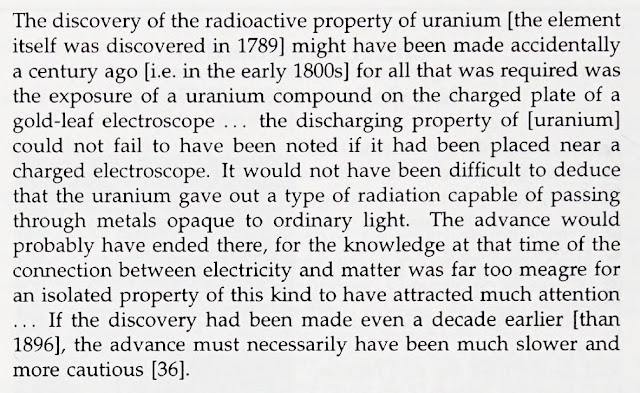
As everyone knows, radioactivity in uranium was discovered by Henri Becquerel in 1896, then taken to great heights by the Curies. But as Rutherford points out in a revealing paragraph (Brown, Pais and Pippard, "Twentieth Century Physics", Vol. 1; 1995), it could potentially have been discovered a hundred years earlier. More accurately, it could have been experimentally discovered a hundred years earlier.


Rutherford's basic point is that unless there's an existing theoretical framework for interpreting an experiment - providing the connective tissue, in some sense - the experiment remains merely an observation. Depending only on experiments to automatically uncover correlations and new facts about the world is therefore tantamount to hanging on to a tenuous, risky and uncertain thread that might lead you in the right direction only occasionally, by pure chance. In some ways Rutherford here is echoing Karl Popper's refrain when Popper said that even unbiased observations are "theory laden"; in the absence of the right theory, there's nothing to ground them.

It strikes me that Rutherford's caveat applies well to machine learning. One goal of machine learning - at least as believed by its most enthusiastic proponents - is to find patterns in the data, whether the data is dips and rises in the stock market or signals from biochemical networks, by blindly letting the algorithms discover correlations. But simply letting the algorithm loose on data would be like letting gold leaf electroscopes and other experimental apparatus loose on uranium. Even if they find some correlations, these won't mean much in the absence of a good intellectual framework connecting them to basic facts. You could find a correlation between two biological responses, for instance, but in the absence of a holistic understanding of how the components responsible for these responses fit within the larger framework of the cell and the organism, the correlations would stay just that - correlations without a deeper understanding.

What's needed to get to that understanding is machine learning plus theory, whether it's a theory of the mind for neuroscience or a theory of physics for modeling the physical world. It's why efforts that try to supplement machine learning by embedding knowledge of the laws of physics or biology in the algorithms are likely to work, while efforts blindly using machine learning to try to discover truths about natural and artificial systems using correlations alone would be like Rutherford's fictitious uranium salts from 1806 giving off mysterious radiation that's detected without interpretation, posing a question waiting for an explanation.

Steven Weinberg (1933-2021)

I was quite saddened to hear about the passing of Steven Weinberg, perhaps the dominant living figure from the golden age of particle physics. I was especially saddened since he seemed to be doing fine, as indicated by a lecture he gave at the Texas Science Festival this March. I think many of us thought that he was going to be around for at least a few more years. 

Weinberg was one of a select few individuals who transformed our understanding of elementary particles and cemented the creation of the Standard Model (he coined the name), in his case by unifying the electromagnetic and weak forces; for this he shared the 1979 Nobel Prize in physics with Abdus Salam and Sheldon Lee Glashow. His 1967 paper which heralded the unification, "A Model of Leptons", was only 3 pages long and remains one of the most highly cited articles in physics history.

But what made Weinberg special was that he was not only one of the most brilliant theoretical physicists of the 20th century but also a pedagogical master with few peers. His many technical textbooks, especially his 3-volume "Quantum Theory of Fields", have educated a generation of physicists; meanwhile, his essays in the New York Times Book Review and other avenues and collections of articles published as popular books have educated the lay public about the mysteries of physics. But in his popular books Weinberg also revealed himself to be a real Renaissance Man, writing not just about physics but about religion, politics, philosophy, history including the history of science, opera and literature. He was also known for his political advocacy of science. Among scientists of his generation, only Freeman Dyson had that kind of range.

There have been some great tributes to him, and I would point especially to the ones by Scott Aaronson and Robert McNees, both of whom interacted with Weinberg as colleagues. The tribute by Scott especially shows the kind of independent streak that Weinberg had, never content to go with the mainstream and always seeking orthogonal viewpoints and original thoughts. In that he very much reminded me of Dyson; the two were in fact friends and served together on the government advisory group JASON, and my conversation with Weinberg which I describe below ended with him asking me to give my regards to Freeman, who I was meeting in a few weeks.

I had the good fortune of interacting with Steve on two occasions, both rewarding. The first time I had the opportunity to be with him on a Canadian television panel on the challenges of Big Science. You can see the discussion here:

https://www.tvo.org/video/the-challenge-of-big-science

The next time was a few years later when I contacted him about a project and asked whether he had some thoughts to share about it. Steve didn't know me personally (although he did remember the Big Science panel) and was even then very busy with writing and other projects. In addition, the project wasn't something close to his immediate interests, so I was surprised when not only did he respond right away but asked me to call him at 10 AM on a Sunday and spoke generously for more than an hour. I still have the recording.

Steve was a great physicist, a gentleman and a Renaissance Man, a true original. We are unlikely to see the likes of him for a long time. 

One of the reasons I feel particularly wistful with his passing is because he was among the last of the creators of modern particle physics. He worked in an enormously fruitful time in which theory went hand in hand with experiment. This is different from the last twenty years in which fundamental physics and especially string theory have been struggling to make experimental connections. In cosmology however, there have been very exciting developments, and Weinberg who devoted his last few decades to the topic was certainly very interested in these. Hopefully fundamental physics can become as involved with the productive interplay of theory and experiment as cosmology and condensed matter physics are, and hopefully we can again resurrect the golden era of science in which Steven Weinberg played such a commanding role.

Chandra and Johnny come close to discovering black holes

This is from Jagdish Mehra and Helmut Rechenberg's monumental "The Historical Development of Quantum Mechanics, Vol. 6, Part 2". With Chandrasekhar's facility with astrophysics and von Neumann's with mathematics, there is little doubt in my mind that they would have succeeded.


As it happened, it was Oppenheimer and his student Hartland Snyder who wrote the decisive paper describing black holes in 1939. 


The timing was bad, though; on the same day that the paper came out in the Physical Review, Germany attacked Poland and started World War 2. Far more consequential was another paper published on the same day in the same issue - John Wheeler and Niels Bohr's liquid drop model of nuclear fission.

Book review: Quantum mechanics and quantum mechanics. David Kaiser's "Quantum Legacies: Dispatches from an Uncertain World"

David Kaiser is a remarkable man. He has two PhDs from Harvard, one in physics and one in the history of science, and is a professor in the Science, Technology and Society department at MIT. He has written excellent books on the history of particle physics and the quirky personalities inhabiting this world. On top of it all he is a genuinely nice guy - he once wrote me a long email out of the blue, complimenting me on a review of his book "How the Hippies Saved Physics". And while his primary focus is the history and philosophy of physics, Kaiser still seems to find time for doing research in quantum entanglement.

What makes Kaiser unique is the attention he gives to what we can call the sociological aspects of physics, things like the physics job market, portrayals of physicists in the humanities, parallel threads of science and history, and perhaps most uniquely, the publications of physics - both the bread-and-butter textbooks that students use and the popular physics books written for laymen. It's this careful analysis of physics's sociological aspects that makes "Quantum Legacies" a delightful read, tread as it does on some of the under-explored aspects of physics. There are chapters on quantum indeterminacy and entanglement and the lives of Schrödinger, Einstein and Dirac, a nice chapter on computing and von Neumann's computer and interesting essays on the Large Hadron Collider and the tragic Superconducting Supercollider which was shelved in 1993 and the Higgs boson. All these are worth reading. But the real gem in the book as far as I am concerned is a collection of three chapters on physics publishing; this is the kind of material that you won't find in other books on the history and philosophy of physics.

The first chapter is about a book that fascinated me to no end while I was growing up - Fritjof Capra's "The Tao of Physics" which explored parallels between quantum physics and Eastern mysticism. This book along with the downright dubious "aliens-visited-earth" literature by the Danish writer Erich von Daniken dotted my bedroom for a while until I grew up and discovered in particular that Daniken was peddling nonsense. But Capra isn't that easy to dismiss, especially as Kaiser tells us, his book hit the market at a perfect time in 1975 when physicists had become disillusioned by the Vietnam War, the public had become disillusioned by physicists, and both groups of people had become smitten with the countercultural movement, Woodstock and Ravi Shankar. There could be no better time for a book exploring the ins and outs of both the bizarre world of quantum mechanics and the mystical world of Buddhism and the "Dance of Shiva" to become popular. Kaiser describes how Capra's book set the tone for many similar ones, and while most of the parallels described in it are fanciful, it did get the public interested in both quantum physics and Eastern philosophy - no small feat. Capra's own personal story, one in which he comes to the United States from Vienna, has a hard time making ends meet and goes back and then decides to first write a textbook and then a more unique popular book based on his experiences in California and advice from famed physicist Victor Weisskopf, is also quite interesting.

The second interesting chapter is about a textbook, albeit a highly idiosyncratic one, that is a household name to students of general relativity - a 1200 page doorstop of a tome by Kip Thorne, Charles Misner and John Wheeler, all legendary physicists. "MTW" as the textbook became known was a kind of landmark event in physics publishing. The textbook was the first major book to introduce advanced undergraduate and graduate students to fascinating concepts like time dilation, spacetime curvature and black holes. The joke about its size was that not only was the book *about* gravity but that it also *generated* gravity. But everything about the book was highly unconventional and quirky, including the typeface, the non-linear narrative and most importantly, serious and advanced mathematical calculations interspersed with boxes containing cartoons, physicist biographies and outrageous speculations about wormholes and time travel. Most people didn't know what to make of it, and perhaps the best review came from the Indian-American astrophysicist Subrahmanyan Chandrasekhar who said, "The book espouses almost a missionary zeal in preaching its message. I (probably for historical reasons) am allergic to missionaries." Nonetheless, "MTW" occupies a pride of place in the history of physics textbooks, and a comparable one on sagging student shelves where it's probably more seen than read.

The last chapter and perhaps the one I found most interesting is about the content of traditional quantum mechanics textbook, which is really a history of the quantum mechanics textbook in general. The first quantum mechanics textbooks in the United States came out in the 1940s and 50s. Many of them came out of the first modern school of theoretical physics in the country founded by J. Robert Oppenheimer at the University of California, Berkeley. Two of Oppenheimer's students, David Bohm and Leonard Schiff, set the opposing tones for two different kinds of textbooks (I remember working through a bit of Schiff's book as an undergraduate). After the war Schiff taught at Stanford, Bohm at Princeton.

Bohm was old school and believed in teaching quantum mechanics as a subject fraught with fascinating paradoxes and philosophical speculations. His approach was very close in spirit to the raging debates of the original scientist-philosophers who had founded the revolutionary paradigm - Niels Bohr, Albert Einstein, Erwin Schrödinger and Werner Heisenberg in particular. Bohm of course had a very eventful life in which he was accused on being a Communist and hounded out of the country, after which he settled in England and became known for carrying out and publishing a set of philosophical dialogues with Indian philosopher J. D. Krishnamurthy. His textbook is still in print and is worth reading, but it's worth noting that the Schrödinger equation is not even introduced until several chapters into the volume.

Schiff's book was different and was a practical textbook that taught students how to solve problems, mirroring a philosophy called "shut up and calculate" that was then taking root in American higher physics education. The Schrödinger equation was introduced on page 6. What Kaiser fascinatingly demonstrates, often through analysis of the original lecture notes from Bohm and Schiff's classes, is that this attitude reflected both a mushrooming of physics students as well as a higher demand for physicists engendered by the Cold War and the military-industrial complex. Not surprisingly, when you had to turn out large numbers of competent physicists with jobs waiting for them in the nation's laboratories and universities, you had little time or patience to teach them the philosophical intricacies of the field. Shut up, calculate, and get out there and beat the Soviets became the mantra of the American physics establishment.

Fascinatingly, Kaiser finds out that the philosophical trends and the practical ones in physics textbook publishing wax and wane with the times; when the job market was good and enrollment was high, the practical school prevailed and textbooks accordingly reflected its preferences, and when the pickings were slim, the job market was tight and enrollment drastically dropped, philosophical questions started making a comeback on tests and in textbooks. Especially after 1970 when the job market tanked, the Vietnam War disillusioned many aspiring physicists and the countercultural movement took off, philosophical speculations took off as well and combined with Fritjof Capra's "The Tao of Physics". Perhaps the ultimate rejection of philosophy among physicists might be said to have come during the second job slump in the early 90s, when many physicists left the world of particles and fields for the world of parties and heels on Wall Street.

Physics publishing, the physics market, the lives of physicists and physics theories have a strange and unpredictable entanglement of their own, one which even Einstein and Bohr might not have anticipated. Kaiser's book explores these well and brings a unique perspective to some of the most interesting aspects of a science that has governed men's lives, their education and their wallets.

Big discoveries from little things


That's physicist Albert Michelson, at the University of Chicago in 1894, saying that fundamental physics was essentially finished. In the fifty years after Michelson's talk, physics discovered the following: special and general relativity, quantum theory, nuclear fission and the expansion of the universe. And it was just getting warmed up. The famously acerbic Wolfgang Pauli would have probably called Michelson's prediction as "not even wrong".

Michelson clearly was woefully wrong in saying that the main task of physics would henceforth simply be more accurate measurements. And yet it would be wrong to take him to task for a clearly mistaken view, for at least two reasons. Firstly, physics in 1894 explained an enormous range of phenomena. From Newtonian mechanics that explained everything from apples falling down to the motion of planets to thermodynamics which explained everything from the increase in disorder in physical systems to the practical workings of steam engines, physics clearly had proved itself to be a spectacularly successful science, so there was good reason to think that most of the fundamentals had been worked out. 

Secondly, the kinds of things physics was being unable to explain then could be seen as little more than annoying anomalies and exceptions; the behavior of glowing blackbodies, the slight anomaly in the motion of mercury around the Sun, the absence of the luminiferous ether. In fact, Michelson himself would perform an experiment just three years later, in 1887, that would lead to a very important negative result: the lack of detection of the ether that had been predicted as a medium for the propagation of light and other electromagnetic radiation which Maxwell had worked out.

Neither Michelson nor anyone else could have seen the profound new worlds hidden in these seemingly mundane anomalies. Problems with blackbody radiation led to the birth of Planck's quantum theory, and problems with the ether and with the anomalous orbit of Mercury led to Einstein's special and general theories of relativity. And at least in one sense Michelson's highlighting of more and more accurate measurements was spot on: the difference between the perihelion of Mercury predicted by Newton's theory of gravity and what was actually measured was tiny - Newton's prediction was off only by a millionth of one percent (which meant that Mercury would arrive at its perihelion only half a second later than what Newton predicted), but that little deviation hid a stunningly different and new view of nature that took Einstein's genius to uncover.

Rather than mocking Michelson's 1894 statement as a foolish failure of prediction or the product of tunnel vision, it's more important therefore to recognize what it implies. Firstly, it's clear that nobody and not just Michelson could have known how different the future of physics would be, giving currency to Niels Bohr's statement that prediction is difficult, especially about the future. But more importantly, it's enlightening to realize how seemingly mundane experimental anomalies can lead to completely new ways of looking at the world. 

In my view, the fifty years that followed Michelson's statement, although now rightly regarded as a triumph of theoretical physics, should be viewed as an even greater triumph of experimental physics. Both the old quantum theory invented by Planck and the new quantum theory invented by Heisenberg and others arose from small, anomalous observations in seemingly obscure and minor areas of physics. So did relativity. Without the exceedingly accurate measurement of the error in the predicted vs measured anomaly of Mercury's orbit, who knows how long it would have taken general relativity to come along.

The development of physics following Michelson's statement gives one hope that the biggest discoveries in science will continue to be hidden in some of the smallest discrepancies in experiment. This is especially true of biology where we are now in a position to detect very small differences in protein and gene expression. Experimentalists should keep on looking for minor anomalies in their observations; flies in the ointment; nagging little differences in numbers that should be explained by the existing theoretical framework but are not. Sometimes it will be nothing, often it will simply be a result of statistical error or random noise, but occasionally, just occasionally, it could be a glimpse of the crack of light from a door that opens on to a whole new world.

The birth of a new theory: Richard Feynman and his adversaries


Leading physicists discuss their field's most pressing problems
at Shelter Island in April 1947; including, among others, Julian
Schwinger, Richard Feynman and J. Robert Oppenheimer
This post was written on occasion of Richard Feynman's 100th birthday on May 11th and was first published on the website 3 Quarks Daily. It's the second in a pair of articles about two landmark meetings in postwar American physics.
A new theory seldom comes into the world like a fully formed, beautiful infant, ready to be coddled and embraced by its parents, grandparents and relatives. Rather, most new theories make their mark kicking and screaming while their fathers and grandfathers try to disown, ignore or sometimes even hurt them before accepting them as equivalent to their own creations. Ranging from Darwin’s theory of evolution by natural selection to Wegener’s theory of continental drift, new ideas in science have faced scientific, political and religious resistance. There are few better examples of this jagged, haphazard, bruised birth of a new theory as the scientific renaissance that burst forth in a mountain resort during the spring of 1948.
April 2, 1948. Twenty-eight of the country’s top physicists met at the Pocono Manor Hotel near the Delaware Water Gap in Pennsylvania. Kept apart from their first love of fundamental research in physics by the war, they were eager to regroup and rethink the problems which had plagued the heights of their profession before they were called away for war duty to Los Alamos, Cambridge and Chicago.
The listing of participants provides a rare snapshot of one of those hallowed transitions in the history of science, a passing of the torch. Both the old and the new guards were there. The old guard was represented, among others, by Niels Bohr, Paul Dirac and Eugene Wigner – the men who had formulated and then shaped the material world in its quantum mechanical image during the 1920s and 30s. The new guard was represented by Richard Feynman, John Wheeler and Julian Schwinger – the swashbuckling young theorists who wanted to take quantum theory to new heights, even if it meant challenging the old wisdom. J. Robert Oppenheimer who led the conference represented a prophet of the middle ground; a guide joining old hands with new. In retrospect, a clash of worldviews seems almost inevitable.
The problem that was at the forefront of everyone’s attention was the plague of infinities. The infinities had started showing up just a few years after the quantum revolution had burst upon the world. Within a short span of five years or so, between 1925 and 1930, a handful of theorists in their twenties and thirties including Dirac, Werner Heisenberg, Erwin Schrödinger, Max Born and Wolfgang Pauli had completely reworked the foundations of our physical picture of the world. Niels Bohr who along with Albert Einstein and Max Born had kicked off the revolution a decade before was their avuncular godfather; Einstein himself was a reluctant pioneer. The father of quantum mechanics, Max Planck, had showed that energy came only in discrete packets; now these new frontiersmen extended the concept to every physical entity in the universe. The work done by the quantum pioneers revealed a world steeped in probabilities rather than certainties, a world where you could not know the values of even simple parameters like a particle’s position and momentum to infinite precision, a world where particles and waves blurred themselves into each other in a mirage of probability amplitudes and wavefunctions. It was this fundamental ambiguity about what you could know about subatomic entities that led to Einstein’s famous remark about God playing dice.
And yet the theory was accuracy exemplified. Whatever its mathematical and philosophical ambiguities, it kept on providing astonishingly accurate answers to both old and new problems in disparate branches of physics. Whether it was a matter of calculating the frequency of radiation emitted by electrons transitioning in an atom or the resistance of metals to electrical current, quantum theory gave you the right answers, marching in perfect lockstep with numbers from experiment. It seemed to work for virtually every problem you threw it at. Except one.
That puzzle was the interaction between light and matter. It turned up in the simplest of situations, such as calculating the energy of an electron in an atom, and was recognized by the father of quantum field theory, Paul Dirac. Quantum field theory is the most comprehensive description of the world of subatomic particles, and in its simplest sense involves subjecting both particles and the electromagnetic fields which surround them to the rules of quantization. But even a cursory glimpse at the issue made the intractability clear: the energy of a charge in an electromagnetic field – called the ‘self energy’ – is given by the ratio of the strength of the field at various points and the distances between the charge and these points. One calculates the total self-energy by summing up the values at every point. The difficulty is obvious when you think about it: at distances close to zero, you divide by an increasingly smaller number, blowing up the value precipitously. Exactly at the location of the charge, where the distance is zero, the energy becomes infinite; the writers Robert Crease and Charles Mann have described it as a plane being blown to smithereens in its own wake. Clearly this is an absurd result since every energy value which you measure in a real world laboratory is finite.
Starting in about 1930, this problem of infinite self-energy was tackled by many of the most brilliant theoreticians of their time without resolution: Oppenheimer, Heisenberg, the acerbic Wolfgang Pauli and his mild-mannered assistant Victor Weisskopf all described the problem and tried to resolve it in various ways. If anything the picture got even worse; instead of just one infinity, other infinities started rearing their ugly heads like the heads of the mythical Hydra. One of these infinities was pointed out by Dirac. It turns out that during its transition in an atom, an electron can briefly spit out a photon and reabsorb it; this seemingly ex nihilo act of creation is allowed by quantum mechanics as long as it’s done in an exceedingly small amount of time. The problem is that the energy between the electron and this so-called ‘virtual’ photon can be apportioned again in an infinite numbers of ways. If you sum up all these ways you again get the dreaded explosion of infinity.
There seemed to be no end to attempts to exorcising these infinities. Then war intervened, the community of American physicists was drawn up for work on radar and the bomb, and the community of European physicists, many of whom had already fled from Hitler and Mussolini and were scattered across at least two continents, joined them. There the matter of the infinities rested until 1947, when an extraordinary conference of physicists was organized at a small inn off the coast of Long Island near New York City. The Shelter Island conference later went down in history as the conference that kicked off the postwar rejuvenation of particle physics, but in April 1947 it still represented the first stirrings of a revolution. The conference was again chaired by Oppenheimer and included a mix of the old and young guards.
The attention of the participants at Shelter Island was focused on one number of singular importance. Sometimes it takes hard experiment to cut the theoretical Gordian knot. While the theorists had struggled with infinities even before the war, they were galvanized by the experiments of Willis Lamb and his colleague Robert Retherford. Lamb was one of those rare breeds of scientist who are comfortable with both theory and experiment. Combining highly skilled techniques in microwave spectroscopy developed during wartime work on radar with a good understanding of the problems with infinities plaguing quantum field theory, Lamb and Retherford discovered a slight difference in energy between two states of the hydrogen atom at a place where the original Dirac theory predicted no difference. In science revolutions are sometimes engineered by the slightest and most mundane-looking discrepancies in the behavior of matter – Arthur Eddington’s measurement of a tiny shift in the position of the stars predicted by Einstein’s general theory of relativity comes to mind – and the Lamb Shift is as good an example as any of this pivot point in scientific history.
The Lamb Shift is also a telling example of what happens when multiple ideas are in the air, vying with each other for publicity and survival. In the conference Weisskopf had already presented a calculation that could potentially explain the shift, and so had one of the members of the old guard, Hendrik Kramers, who had been Niels Bohr’s assistant. But neither of these efforts got rid of the infinities. It took Hans Bethe with his absolutely mastery of synthesizing different ideas to take the Lamb Shift to its logical conclusion. Nobody surpassed Bethe in his knowledge of multiple branches of physics and his ability to calculate real world answers using the right combination of mathematical techniques and approximations. During a train journey back from Shelter Island, Bethe had the stroke of insight to attempt a calculation of the Lamb Shift using a non-relativistic approximation that ignored effects due to Einstein’s special theory of relativity. In addition, he introduced a physically sensible cutoff for the infinities to get a finite answer. Everyone knew that a correct quantum field would have to include special relativity, so it took some courage on Bethe’s part to attempt a non-relativistic calculation. Strikingly, the result was very close to experiment; 1040 MHz vs 1000 MHz. It still wasn’t the exact answer, but Bethe’s calculation was a shot in the arm, a signal that the theorists’ thinking was on the right track. It was also a fine illustration of how sometimes even a strictly non-realistic, approximate model can guide you in the right direction.
Bethe’s work breathed new life into the work of many others, including Weisskopf and Lamb, both of whom kicked themselves for not thinking about it first. But the biggest impact was on two young members of the group who had already distinguished themselves by their brilliant work during the war – Julian Schwinger and Richard Feynman.
Feynman and Schwinger were two of the earliest products of the American school of theoretical physics. Until the 1930s or so, most American theorists had to go to Europe to learn quantum mechanics at the feet of the masters: Niels Bohr in Copenhagen, Max Born in Göttingen and Arnold Sommerfeld in Munich. In the 30s the center of research started moving to the United States, partly engendered by the exodus of Jewish refugee physicists and partly because of the creation of prominent schools of physics by American physicists themselves. Two of the most prominent schools were Robert Oppenheimer’s at Berkeley and John Archibald Wheeler’s at Princeton. Schwinger came from Oppenheimer’s school; Feynman came from Wheeler’s.
Both Schwinger and Feynman were from New York, but otherwise were very different characters. Feynman was a practical joker who cracked safes, disdained pretension, played the bongos and spoke in colloquial New York City slang. While he had been recognized as a brilliant physicist, he still did not enjoy the star power that Schwinger – a child prodigy who had written his first paper on quantum electrodynamics when he was sixteen – did. Unlike Feynman, the leonine Schwinger wore expensive suits, drove a Cadillac and was the very picture of the distinguished academic. Physicists of the stature of Bethe and Fermi had already paid homage to Schwinger and everyone thought him to be the future. At Shelter Island they had listened to him with reverence; as Oppenheimer put it, “When other physicists do a calculation they want to tell you how they do it; when Schwinger does a calculation he wants to tell you that only he can do it.”
After Shelter Island, the physicists went off to their universities and laboratories, attempting a full calculation of quantum electrodynamics that was relativistic. Schwinger managed to calculate a precise value for the magnetic moment of the electron – a parameter for which comparison between theory and experiment would come to represent the most accurate agreement in all of physics – for the first time in November 1947. Most importantly, the calculation gave a finite answer. One of the elder statesmen of physics, a tough-minded New Yorker named Isidor Rabi, rushed off a note to Bethe: “Schwinger’s calculation is as accurate as yours. God is Great!”.
Feynman was on a completely different track. Working with John Wheeler, he had come up with a novel approach called the path integral approach that included particles traveling backward and forward in time. His bookkeeping technique used a principle familiar from classical mechanics, the principle of least action, that minimized the energy a particle takes in order to travel from A to B. For quantum theory, in Feynman’s hands, one had to consider every single trajectory that the particle would take in order to calculate the most probable one. This so-called 'sum over histories' approach was completely different from anyone else's, although its first trappings had been anticipated by the always prescient Dirac in a paper which Feynman had eagerly read in the Princeton library as a graduate student. Feynman represented his calculations in the form of squiggly and straight lines symbolizing virtual and real particles traveling backward and forward in time. When the Pocono Conference rolled around, he was ready to dazzle his listeners.
Unfortunately Feynman was up against two major obstacles. One was the traditional and hidebound old physics establishment. The other was Julian Schwinger. Schwinger had just given a marathon six-hour talk in which he brought all the formal machinery of mathematical physics to bear on calculating finite answers for electron-photon interactions. His talk was described by some as a virtuoso violin performance, more technique than comprehension. By one account, only Hans Bethe and Enrico Fermi – men who were particularly known for their stamina and powers of concentration – stayed awake and alert enough to follow the entire presentation.
Then Feynman took the podium. Knowing that his listeners would have trouble following the novel derivation of his results, he instead proceeded to simply show them worked out examples. His strategy was understandable, but he was attempting something akin to simply showing worked out examples in a mathematics textbook without showing the underlying theory. For the mandarins of theory who had spent their entire careers trying to take apart and understand all the gory details of how nature worked, this impressionistic-looking display was most unsatisfactory. Immediately they interrupted.
Edward Teller, the Hungarian-born physicist who hadn’t yet achieved the infamous moniker of ‘father of the hydrogen bomb’, thought that Feynman was violating the exclusion principle, a central tenet of physics and chemistry discovered by Wolfgang Pauli that precludes having two electrons with the same energy and spins in the same state. Dirac asked Feynman about a mathematical matrix that carried particle probabilities forward in time. He was wondering about a recondite mathematical property of a matrix called the unitary property that had nonetheless been key in understanding all particle interactions in quantum mechanics. Finally, the elder statesman of physics, the father of them all, Niels Bohr interrupted. Bohr had been impressed at Los Alamos by Feynman’s willingness to brazenly question all authority, including Bohr’s. He now took umbrage at the unfamiliar thicket of squiggles representing particle trajectories. Already in the 1930s, Bohr said in his soft but firm voice, we knew that the classical notion of a trajectory does not make sense in quantum mechanics. Now Feynman seemed to be violating this basic tenet of quantum theory. Bohr strode up to the stage and, standing next to Feynman, speaking in his notorious mumble, delivered a humiliating lecture that seemed to convey Feynman’s lack of understanding of even elementary ideas.
Feynman realized that it was hopeless; Teller was obsessed with a basic fact of quantum mechanics, Dirac was hung up over mathematical formalism, Bohr was still stuck in the 1930s. Clearly his approach was too unconventional and too novel for the old guard. The only way they would listen would be if he laid it all out in an academic paper. History was witnessing the passing of the torch between generations, but for the time being it would have to allow the old generation to win the battle, even if they lost the war. Feynman was undoubtedly on the right track. His new theory had given the right answers for all outstanding problems posed by the new physics. And after his talk, in the next few days, he compared his results with Schwinger’s. These two rivals nonetheless had a healthy respect for each other’s unique approaches, and they realized that were both traversing different trajectories on the mountain of truth.
Within a year Feynman had written up a seminal paper spurred by the disappointment and urgency he witnessed at Pocono. “Space-Time Approach to Quantum Mechanics” would become one of the most important physics papers of the twentieth century. In time, Feynman diagrams would come to dot the pages of the leading physics journals like an art form, much like the native art found on the caves at Lascaux represented its creator’s innermost desires and motivations. And like God bringing, in Schwinger’s words, “computation to the masses”, Feynman would have his own prophet: his colleague Freeman Dyson would unify Schwinger and Feynman’s versions of the promised land and deliver a set of powerful tools that would allow physicists to apply the duo’s techniques to problems in fields ranging from particle physics to astrophysics. And finally, like a voice from the deep, a lonesome letter would come floating to America from the troubled East, where a physicist named Sin-Itiro Tomonaga would have astonishingly worked out Schwinger’s formulation of QED in the isolation and destruction of wartime Japan. In time, QED would provide the most astonishingly accurate between theory and experiment in the history of physics.
But it had all started at Shelter Island and Pocono, where history changed hands and took a new direction, where a thirty year old physicist presented a novel vision; in Dyson’s words, “this wonderful vision of the world as a woven texture of world lines in space and time, with everything moving freely, a unifying principle that would either explain everything or explain nothing.”