Field of Science

Showing posts with label chemistry. Show all posts

Jack Dunitz (1923-2021): Chemist And Writer Extraordinaire

Every once in a while there is a person of consummate achievement in a field, a person who while widely known to workers in that field is virtually unknown outside it and whose achievements should be known much better. One such person in the field of chemistry was Jack Dunitz. Over his long life of 98 years Dunitz inspired chemists across varied branches of chemistry. Many of his papers inspired me when I was in college and graduate school, and if the mark of a good scientific paper is that you find yourself regularly quoting it without even realizing it, then Dunitz’s papers have few rivals.

Two rare qualities in particular made Dunitz stand out: simple thinking that extended across chemistry, and clarity of prose. He was the master of the semi-quantitative argument. Most scientists, especially in this day and age, are specialists who rarely venture outside their narrow areas of expertise. And it is even rarer to find scientists – in any field – who wrote with the clarity that Dunitz did. When he was later asked in an interview what led to his fondness for exceptionally clear prose, his answer was simple: “I was always interested in literature, and therefore in clear expression.” Which is as good a case for coupling scientific with literary training as I can think of.

Dunitz who was born in Glasgow and got his PhD there in 1947 had both the talent and the good fortune to have been trained by three of the best chemists and crystallographers of the 20th century: Linus Pauling, Dorothy Hodgkin and Leopold Ruzicka, all Nobel Laureates. In my personal opinion Dunitz himself could have easily qualified for a kind of lifetime achievement Nobel himself. While being a generalist, Dunitz’s speciality was the science and art of x-ray crystallography, and few could match his acumen in the application of this tool to structural chemistry.

X-ray crystallography was developed by physicists in the first half of the 20th century to peer inside molecules, the way x-rays and MRI peer inside the human body. Just like those two techniques tell us the locations and structures of various organs in our body, x-ray crystallography tells us where the atoms in a molecule are exactly located, what the lengths of the various bonds are and what the stoichiometry – the exact composition of a complex mixture – is. If you had to point out one technique that has truly revolutionized chemistry, laying the entire chemical universe ranging from rocks and minerals to proteins and nucleic acids bare, it is x-ray crystallography. Dozens of Nobel Prizes for figuring out the structures of increasingly complex molecules, starting with table salt and progressing on through DNA, hemoglobin and the entire ribosome – the multi-component assembly that synthesizes proteins in living organisms – have been awarded through the decades.

One such Nobel Prize was given to James Watson and Francis Crick for figuring out the structure of DNA, a feat made possible by the world-class x-ray crystallography on DNA done by Rosalind Franklin and Raymond Gosling. Dunitz who got his PhD in Glasgow and was working in Oxford in 1953 saw history in the making as he and a colleague drove up to Cambridge to see the ball-and-stick model of DNA using metal plates and tubes that Watson and Crick had constructed. In fact after making a suggestion to Pauling who had figured out the fundamental structure of proteins at Caltech, Dunitz might have contributed an immortal alphabet to the language of life:

While my own work at Caltech had nothing to do with protein structure, Pauling used to talk to me occasionally about his models and what one could learn from them. In his lecture, he had talked about spirals. In conversation a few days later, I told him that for me the word “spiral” referred to a curve in a plane. As his polypeptide coils were three-dimensional figures, I suggested they were better described as “helices.” Pauling’s erudition did not stop at the natural sciences. He answered, quite correctly, that the words “spiral” and “helix” are practically synonymous and can be used almost interchangeably, but he thanked me for my suggestion because he preferred “helix” and declared that he would always use it henceforth. Perhaps he felt that by calling his structure a helix there would be less risk of confusion with the various other models that had been proposed earlier. In their 1950 short preliminary communication, Pauling and Corey wrote exclusively about spirals, but in the series of papers published the following year the spiral had already given way to the helix. There was no going back. A few years later we had the DNA double helix, not the DNA double spiral.

After seeing the power of crystallography to crack open the very structure of life, Dunitz spent the rest of his career in that field at the famed ETH in Zurich, capping an incredible 64-year-long career with his death in 2021; his last paper, written when he was 96, was appropriately a critique of certain chemical terminology and titled “Bad Language“.

Dunitz was truly unusual in ranging across the broad spectrum of chemical disciplines. Organic, inorganic and biological chemistry all came within his purview, aided by the powerful interdisciplinary generality of the tool of x-ray crystallography which he wielded with aplomb. Over his long career he published more than 350 scientific papers and penned several foundational books. It would be impossible to review his entire corpus, so I now review three of his papers which made a striking impression on me, which I have cited and read many times over the years, and which I think showcase his striking originality in marshaling simple models and arguments across a variety of fields.
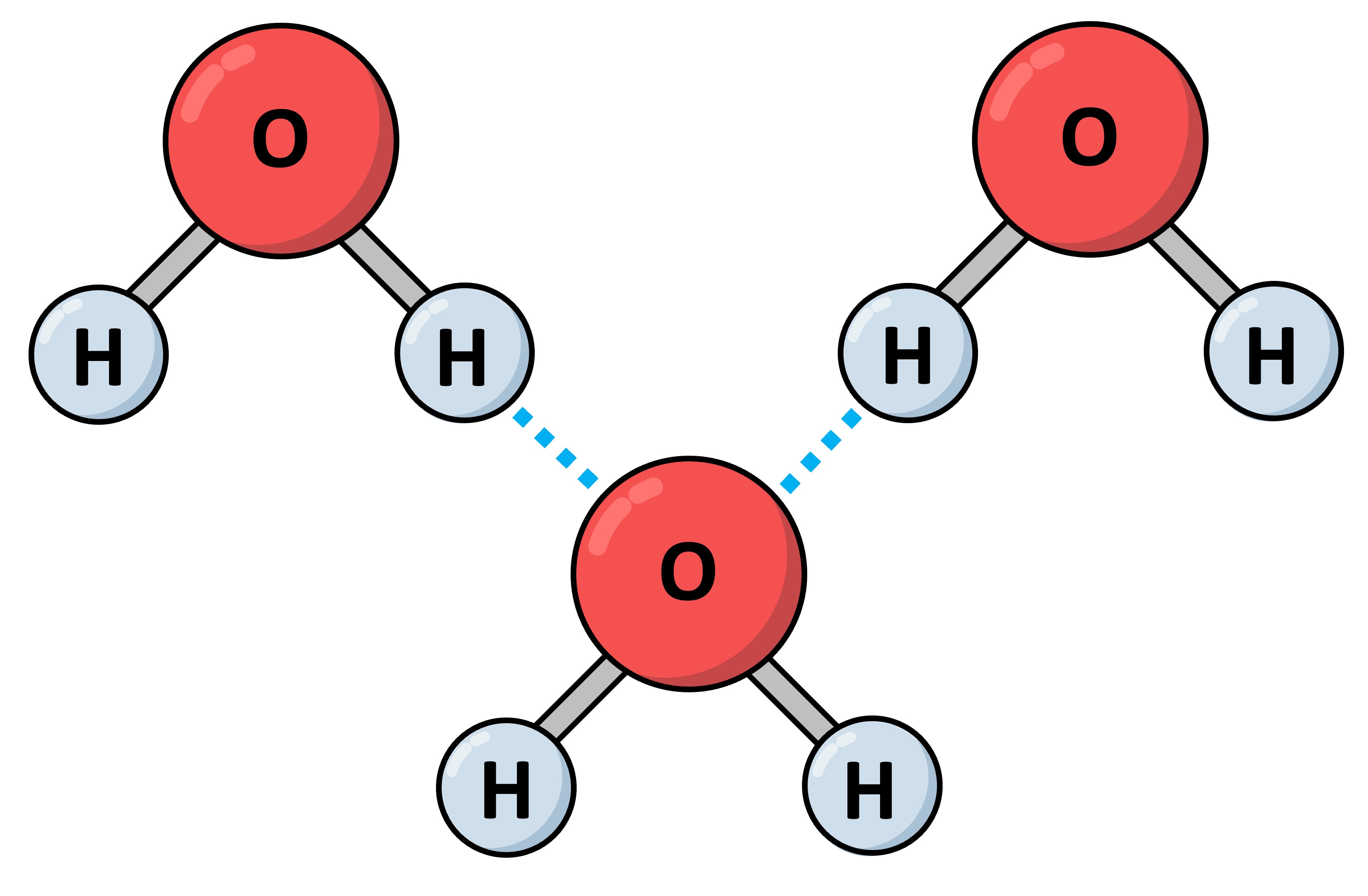
Hydrogen Bonding
Hydrogen bonds in water molecules: the hydrogens of one molecule form fleeting interactions with the oxygens of the other (Image credit: Bioninja)

Perhaps my favorite paper of Dunitz’s is a 1997 paper titled “Organic Fluorine Hardly Ever Accepts Hydrogen Bonds”. Some explication is needed here. Hydrogen bonds are weak, fleeting bonds between hydrogen and other atoms which, while weak, are absolutely critical in keeping all kinds of molecules including proteins and nucleic acids together. In fact, water would not be a liquid without hydrogen bonds and life as we know it would not exist without them. It is their very transient nature that make hydrogen bonds “on-demand” bonds; they can be formed when needed and rapidly dissolved when no longer needed. Linus Pauling, often considered the most important chemist of the 20th century, had underscored the importance of hydrogen bonds in the 1930s in his seminal book, “The Nature of the Chemical Bond”. Typically hydrogen bonds are formed between hydrogen and what are called ‘electronegative’ atoms, ones like oxygen and nitrogen. Electronegative atoms have a particular affinity for electrons, attracting the electron clouds of atoms like hydrogen; the most common hydrogen bonds therefore are ones between oxygen and nitrogen.

There is another element on the periodic table, a most unusual one, which should be even more powerful at forming hydrogen bonds, except that it isn’t. That element is fluorine. Fluorine is in fact the most electronegative element on the periodic table, which is why we would expect it to form hydrogen bonds with furious abandon. But while inorganic fluorine found in compounds like hydrofluoric acid – a diabolically corrosive and dangerous substance – does form these hydrogen bonds, organic fluorine (fluorine bonded to carbon, that is) found in compounds like polytetrafluoroethylene – PTFE or Teflon – does not. In fact it is precisely fluorine’s reluctance to form hydrogen bonds with water in Teflon that makes it such an effective coating for non-stick cookware.

This behavior of fluorine is what the facts indicate, but the facts in this case don’t line up well with chemical theory which expects hydrogen bonding tendencies to increase with electronegativity. Fortunately there is a big database of “solved” crystal structures of organic molecules that includes molecules containing fluorine; it was only waiting for the right person to come along to interpret it. Dunitz’s paper was perhaps the first one to exhaustively analyze this database and then come up with a convincing chemical explanation for the counterintuitive observation that fluorine hardly ever forms hydrogen bonds. He looked at almost 6000 structures with fluorine and determined that hardly a dozen form hydrogen bonds between the fluorine and other hydrogen atoms. The details of why fluorine is reluctant to form hydrogen bonds is beyond the scope of this post (and explained in a further paper by Dunitz), but the qualitative explanation is simple: imagine that an electronegative element like oxygen has “hands” that pull others toward it. The problem with fluorine is that it is so electronegative that it simply keeps its hands to itself.

Even today I keep meeting chemists who, based on what seems like entirely sound chemical logic, expect fluorine to form hydrogen bonds. They recommend that one make drug molecules with fluorine that would enable them to stick better to and form hydrogen bonds with proteins that they want to block, proteins that have gone haywire in cancer, for instance. It is then that I find myself waving Dunitz’s paper – sometimes literally since I still “believe” in paper copies – with the fervent enthusiasm of a preacher.

The second paper from Dunitz that I often highlight shows Dunitz’s masterful application of simple, semi-quantitative arguments to addressing an important question. One of the most important things that scientists want to know when thinking about biological molecules like proteins is how they interact with water. All biological molecules are swimming in a vast sea of water; in fact water not just ubiquitously surrounds these molecules but is also an intimate participant in their behavior. Knowing the thermodynamics of this system – the strength of binding in particular between proteins and other molecules and water – is critical in engineering better drugs and proteins. Two factors are key in quantifying this binding: enthalpy and entropy. Roughly speaking, enthalpy concerns itself with the strength of the interactions between two molecules and entropy concerns itself with how loosely or tightly they bind, whether they stay in place or whether they jiggle around. While enthalpy is often easy to estimate, entropy is not.
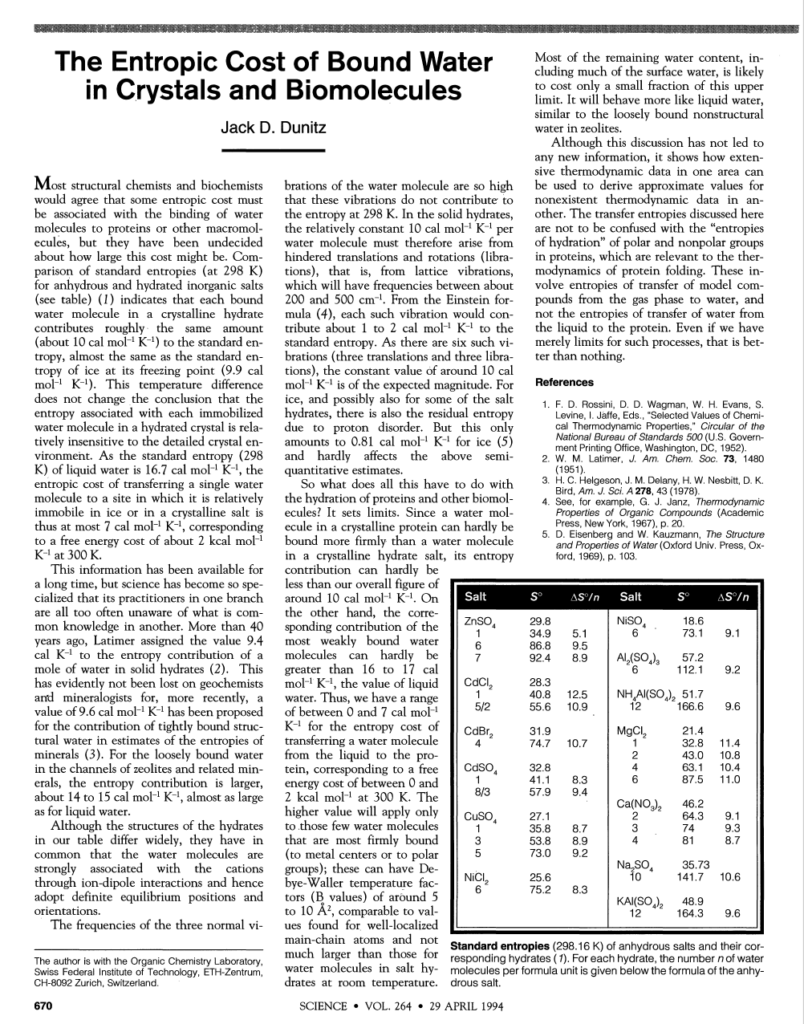
Image credit: Science

In 1994, Dunitz wrote a one-page paper in the journal ‘Science’ titled “The Entropic Cost of Bound Water Molecules in Crystals and Biomolecules” in which, using the simplest of data and arguments, he came up with a reliable number quantifying the entropy of a single water molecule binding to biological molecules. One of his strengths here which is also showcased in the fluorine paper is his ability to look at old data and come up with new explanations. He starts by looking at data on hydrates, simple salts like zinc sulfate which are surrounded by water molecules. He also looks at old data on the thermodynamics of the melting and freezing of ice which would also gives estimates on the entropy of water molecules; he points out something telling which is now a far more serious problem in our specialized world, namely that “this information has been available for a long time, but science has become so specialized that its practitioners in one branch are all too often unaware of what is common knowledge in another.”

How is thermodynamic information on ice, liquid water and hydrate salts relevant to what goes on with proteins? Because, as Dunitz astutely observes, this thermodynamics sets an upper limit on the entropy question for water around proteins: salts bind water molecules most tightly, so surely proteins would bind them more weakly? Using these arguments, Dunitz arrives at a value for the entropy of a bound water molecule which is now commonly used in calculations. The paper demonstrates characteristic Dunitzian strengths which should be widely emulated: scrupulous attention to existing data, including data going back decades, simple back-of-the-envelope calculations, and proof by analogy.

The last paper among Dunitz’s great corpus of works is a paper which exemplifies a particularly fine example of speculative as well as interdisciplinary thinking. It questioned a fact which everyone knows but no one really thinks about: Why is body temperature for animals like humans who can maintain their temperature about 36 degrees celsius, and why is it maintained across such a huge range of organisms? As we know, unless they are sick, homeothermic animals like ourselves are very efficient at regulating body heat. An explanation provided by some previous scientists pointed to the specific heat of water. Specific heat is the amount of heat required to change the temperature of a substance by one degree. Water has a very large specific heat compared to many other substances, which is just one of many of its remarkably unusual properties. But this specific heat happens to reach its lowest value at about 36 degrees celsius, just the optimum temperature mentioned above. The previous explanation said that water at this temperature was least resistant to changes in its temperature and quickly dissipated whatever heat was added to or subtracted from it.

Dunitz and his co-author, Steven Benner, found this argument “appealing, but not correct” in their response, published in the journal Nature in 1986. First, they identify what seems to be an obvious but overlooked problem: the smaller the specific heat, the easier it will be to cause fluctuations in temperature, making it harder for an organism to survive, not easier. They also realize that the previous argument only applies to pure water; water in living organisms is a complex aqueous mixture consisting of water, biomolecules like proteins and salts. So what could be responsible for the precise temperature regulation? Dunitz and Benner don’t pretend to know the answer, but they focus on two of water’s unique properties in particular, its hydrophobicity (or tendency to repel greasy, oil-like substances) and its viscosity. As temperature rises, water becomes less viscous and therefore facilitates chemical reactions in it. However, hydrophobicity also lessens with temperature, which could lead to unwanted mingling between water and greasy substances. Dunitz and Benner speculate that a temperature of 36 degrees is a Goldilocks-like zone, one where the viscosity is low enough for chemical reactions to speedily occur but hydrophobicity is high enough to prevent greasy substances from dissolving too easily.

To me this paper is a superb example of informed speculation, not pretending to solve a problem but offering a tantalizing potential solution and gently but firmly demolishing an existing explanation. It is widely believed that life anywhere in the universe would have to be based on water. Dunitz and Brenner’s analysis of the temperature dependence of water’s unique viscosity and hydrophobicity provides another window on why this substance is so unique for supporting life.

These three papers may serve to exemplify the range of Dunitz’s contributions, and they are but a slice of his vast corpus. In another analysis, he used a purely mathematical argument about the geometry of a pentagon to predict the experimentally-verified geometry of cyclopentane, a molecule with five carbon atoms arranged in a ring. His is a textbook name in many ways, none more so than in the eponymous “Bürgi-Dunitz angle” which describes the angle of attack of a reacting molecule and the precise geometric configuration of the reactants in an important class of organic reactions, one which has yielded great dividends of both academic and industrial interest.
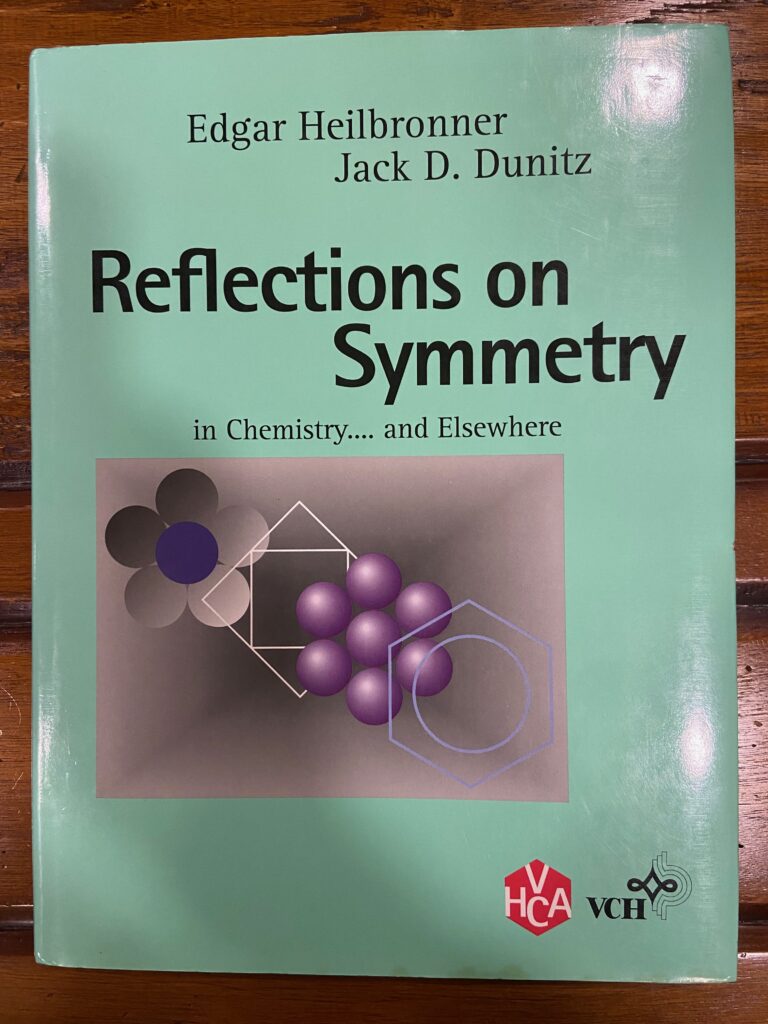
Apart from scientific papers spanning a remarkable variety of topics, Dunitz also wrote books that are considered foundational in the field. Perhaps my favorite book of his is written for laymen. “Reflections on Symmetry: In Chemistry…and Elsewhere“, written with his co-author Edgar Heilbronner, is a marvelous look at symmetry, perhaps the deepest quality of nature. Symmetry is absolutely fundamental not just for chemistry and biology but in the deepest reaches of physics, including quantum mechanics and particle physics. Dunitz and Heilbronner’s book is a romp through aspects of symmetry in fields as disparate as medieval mathematics, Islamic and modern art and of course, chemistry. It is a beautiful book, filled with illustrations and elegant arguments.

Jack Dunitz was one of those scientists who enrich everything they touch, across a wide range of domains, with insight, revelation and beauty. The simplicity and importance of his arguments, humility as a man and fearlessness in tackling disparate problems will be a candle that will keep lighting the minds of aspiring chemists and other scientists for eons to come.


Chemistry is not harder than other sciences...just different.

A well known physicist turned venture capitalist asked on Twitter the other day why people seem to have a harder time understanding chemistry rather than physics or biology. Chemistry is by no means harder to understand than physics or biology, but it occupies a tricky middle ground between rigor and intuition, between deduction and creation, between creativity and understanding. Understanding it can bring great dividends: Robert Oppenheimer once said that “If you want to get someone interested in science teach them a course on elementary chemistry…unlike physics it gets very quickly to the heart of things.”
Chemistry’s path was partly driven by an impulse to understand the physical world, much like the path of physics and astronomy, but somewhat differently from physics and astronomy, to consciously improve the material conditions of life. What passed for medicine, art, architecture, agriculture and commerce in the ancient world was suffused with chemistry. Whether it was indigo dye for royal textiles, mercury or arsenic for medicine, lime for protecting crops or plaster for holding together stones of medieval stone buildings, the world looked to chemistry, whether consciously or not, to feed, transport, clothe and sustain itself. But this foundational practical role that chemistry played also obscured its philosophy.
The philosophy of chemistry developed in the 18th and 19th centuries through the work of Dalton, Lavoisier, Liebig, Kekule, Mendeleev and other thinkers. Much like biologists had spent their time collecting specimens and systematizing their science before someone like Darwin could make a great theoretical leap, chemists had systematized the vast body of observations that natural philosophers had documented and assimilated over the years. But key questions still remained: Why did water freeze at 0 degrees celsius and expand as it cooled? Why were gallium and mercury liquids? Why was lithium relatively stable while its cousin sodium a fiery, unstable beast? Even Mendeleev’s famed periodic table, after answering the how and what, did not answer the why.
It was only with the advent of atomic physics and quantum theory in the 20th century that these questions started to be answered. Niels Bohr’s atomic model led to the idea of the atom as an entity with a central dense nucleus surrounded by fuzzy probabilistic shells of electrons. Concomitant developments by 19th century chemists that had led to the precise measurements of atomic weights and the elucidation of rules that predicted how elements combine with each other intersected with the basic Bohr atom and the science of spectroscopy to illuminate how different elements were built up with different numbers of electrons and protons (the neutron whose discovery explained isotopes came only in 1932).
It was only after Walter Heitler, Fritz London, Gilbert Newton Lewis and especially Linus Pauling explained how the chemical bond was formed that chemistry truly exploded as a self-contained discipline. By showing how different atoms shared electrons in different ways so that they were held together by a variety of forces – weak dispersion forces and strong electrostatic forces for instance – modern chemistry finally started answering those questions about liquid ice and mercury that had been asked for centuries.
But how was the philosophy of chemistry faring compared to the philosophy of science during this period? Not very well. Firstly, philosophers were more naturally drawn first to physics and then to biology as deductive disciplines for laying out their conception of how science was done. Quantum mechanics especially, with its paradoxes and mysteries, became a fertile ground for philosophers to erect their edifice. Biology with evolution and heredity seemed to go to the heart of human existence and also attracted philosophical theorizing. Somehow chemistry slipped through the fingers of the prominent philosophers, partly because it seemed too practical like engineering (although engineering has its own philosophy) and partly because they simply didn’t get it.
Why? Because chemistry largely defies the traditional philosophy of science as laid down not only in physics and biology but in science in general in the centuries since the competing visions of Baconian and Cartesian science molded the way both scientists and philosophers view the natural world. Francis Bacon said, “All depends on keeping the eye fixed on the facts of nature.” Descartes said, “I think, therefore I am.” Science developed along both these lines and it led to the familiar set of ideas about hypothesis testing, observation, experiment and theorizing, and later in the 20th century, to conjectures and refutations, falsification and paradigm shifts. Most people were comfortable dealing with sciences that seem to at least broadly fit these notions from the philosophy of science.
Chemistry does not neatly fit into these categories every time because it’s more akin to the creative arts of architecture and painting. The Nobel Prize winning chemist, writer and poet Roald Hoffmann asks what hypothesis we are exactly generating or falsifying when we are synthesizing a molecule like quinine or indigo, or for that matter what hypothesis we are exactly trying to generate or falsify when we are composing a poem like “J. Alfred Prufrock”. Synthesis of novel substances is really at the heart of chemistry and it has had an incalculable impact of our way of life. There is great science as well as great art in synthesizing a complex molecule through the precise, creative assembly of simple atomic components; there is great beauty as well, of the kind found in constructing the finest cathedrals. 

There is really nothing that a chemist is trying to falsify when she makes a new compound, except to prove that it can actually be made. In addition, chemistry much more than physics is a tool-driven science, and instrumental revolutions like x-ray crystallography and NMR spectroscopy are counter to the more traditional idea-driven revolutions framework by Thomas Kuhn that is popular among science philosophers. Chemistry is thus a slippery eel, easily escaping the grasp of the flowing waters of philosophy. It’s this inability of traditional boxes of philosophy to hold chemistry that often makes it hard for people to appreciate it.
The second aspect of chemistry makes it easier for biologists to appreciate it than physicists. Hoffmann provocatively hits on this aspect when he says, “When I talk about chemistry I have three audiences in mind; fellow academics in the humanities and arts, the man on the street and physicists. Among these three I find it hardest to explain chemistry to physicists, because they think they understand, but they don’t”. The problem here is that chemistry did depend on physics, especially atomic physics and quantum mechanics, to provide some of its key foundations. There is little doubt that explaining the Bohr atom allowed theoretical chemists to then explain the chemical bond. But this success also lulled physicists – and I would say a good number of laymen – into an illusory sense of total explanatory power.
This illusion was reflected in the words of Paul Dirac, as great a theoretical physicist as one can find, when, after setting into place the full laws of quantum mechanics in the late 1920s, he said that “The underlying physical laws necessary for the mathematical theory of a large part of physics and the whole of chemistry are thus completely known, and the difficulty is only that the exact application of these laws leads to equations much too complicated to be soluble. It therefore becomes desirable that approximate practical methods of applying quantum mechanics should be developed, which can lead to an explanation of the main features of complex atomic systems without too much computation.”
Dirac was both presciently, profoundly right in saying this as well as profoundly wrong. Profoundly right because it is indeed true that many simplifying approximations and massive computations have to be brought to bear when quantum mechanics is applied to real chemical systems. Profoundly wrong because while this fact is true in theory, it’s almost irrelevant for real chemical systems. Even if you could hypothetically solve the Schrödinger equation for every single molecule of DNA in the body, that solution would still not tell you why DNA is a double helix, why it replicates semi-conservatively, why it mutates, how these mutations are passed down from parents to children or how the information it encodes is passed from DNA to RNA to protein.
All these are examples of emergent phenomena, unique to chemistry that cannot be completely reduced to physics. One can write down the Schrödinger equation for DNA, but the exact functions of DNA are the consequences of its unique structure combined with evolutionary contingency that selected the replication and transmission of hereditary characteristics as one among many functions of DNA. Contingency and emergence confer a special status on DNA the chemical as opposed to DNA the collection of atoms described by quantum theory. The same theme permeates other parts of chemistry. A good example is the hydrogen bond, a bonding interaction that’s strong enough to hold the molecules of life together but weak enough to allow them to shape-shift between structures performing a variety of functions essential to life. The hydrogen bond is a minimalist feature of chemical and biological systems that’s composed of just three atoms, oxygen or nitrogen and hydrogen being exchanged between them like a tennis ball. One can write a Schrödinger equation for a hydrogen bond and it’s useful in deriving fairly accurate energies for it, but the solution by itself doesn’t inform us how useful hydrogen bonds are, how they differ on different length and time scales and how their distribution of energies leads us to a more refined understanding of biological systems.
There are concepts in chemistry like hydrogen bonding, electronegativity, aromaticity and polarizability that get “frayed at their edges”, in Hoffmann’s words, when one tries to scrutinize them too finely using the scalpel of physics; in that sense they are like the mythical electron that physicists talk about, best-behaved when not observed and left alone. It’s not that physics is useless for understanding these ideas, it’s that they are best understood at the level of chemistry itself as semi-qualitative concepts.
It’s this emergent nature of chemical concepts which still keep one foot rooted in physics, this imprecise and yet immensely useful blend of rigor and qualitative understanding, this inability of traditional philosophy of science to keep chemistry encased within its boxes, that makes chemistry a unique science. It’s not hard to understand. It’s just complicated.
First published on 3 Quarks Daily.

Lessons from Tom Steitz, surveyor of molecular empires (1940-2018)


The ribosome is one of the most important and complicated molecular machines ever devised by evolution. Functioning as the factory and assembler for making proteins from RNA, it is as important as DNA itself and is found in every life form on planet Earth. If we find life on another planet, along with some form of DNA, it is almost certain to contain some kind of ribosome.

Tom Steitz, Venki Ramakrishnan and Ada Yonath won the Nobel Prize for chemistry in 2009 for cracking the structure of the ribosome. I was saddened to hear that Steitz passed away a few days ago. Incidentally, his demise comes after Venki Ramakrishnan published his memoir on his ribosome odyssey, a journey that both starred and owed a lot to Tom Steitz.

Over more than two decades, Steitz, Ramakrishnan, Yonath and others used laborious techniques to carefully obtain more complicated and better structures of this beast of a molecule. And a beast it certainly was; the 40S subunit of a eukaryotic ribosome contains 1900 nucleotides and 33 proteins. While protein crystallography is now routine, solving the structure of a multiprotein assembly like the ribosome is incredibly daunting even now, and is a tribute to both the perseverance and the creativity of these scientists. Crystallography is the ultimate example of marathon running in science, something that at its highest levels can easily take a decade and long hours in the lab. Even before he attacked the ribosome, Steitz had already established a reputation as one of the world's top crystallographers, doing a detailed study of the enzyme hexokinase for instance. Among other findings, his work revealed that the ribosome is composed mainly of RNA rather than proteins; another boost for the RNA world theory for the origins of life.

I have fond memories of Steitz from my time as a postdoc at the University of North Carolina, Chapel Hill. In 2010, a year after he won the prize, he was a visiting lecturer at UNC. Four or five of us had a chance to sign up for a private breakfast with him in a small room at the faculty club. There wasn't a trace of ego in Steitz's interactions with us, but what I remember best was his unending curiosity regarding each of our research projects (not surprisingly, he was particularly interested in some cryo-EM work a colleague of mine was doing). It was clear that Seitz was no prima donna, but a scientist's scientist who was not resting on his laurels but seeking new adventures.

The New York Times has a good obituary of Steitz that showcases many of his qualities. After his PhD he trained at the famed MRC Laboratory of Molecular Biology, an institution started by Watson, Crick, Perutz and others that has produced more than fifteen Nobel Laureates. The article talks about the atmosphere in the institute, where Nobel laureates sat next to graduate students during tea and lunch in the cafeteria and constantly talked science. One thing that struck Steitz was how much time they spent talking about experiments rather than doing them; later he realized that they were basically enforcing a process of ruthless elimination on the experiments by discussing them beforehand, so that they would pursue only the most promising ones. That's a good lesson.

I remember another MRC-related anecdote that Steitz told us during our breakfast eight years ago; he was constantly surprised how the famous scientists at the MRC asked seemingly stupid or simple questions whose answers were not as obvious as we think. For instance, he remembers Max Perutz asking everyone what a eukaryote was; the question led to an unexpectedly fascinating discussion about the molecular differences between eukaryotes and prokaryotes. Steitz emphasized to us how important it is to keep on asking simple questions and setting our egos aside, a lesson that many of us sadly don't imbibe.

Steitz's wife Joan is an equally eminent biologist in her own regard. She was awarded a Lasker Prize this year and has done much to advance RNA science in addition to serving as a role model for women in science. When Steitz was looking for a faculty position he was offered one at Berkeley, but they declined to offer Joan - a protégé of James Watson - one, so Steitz turned down the job, and the couple moved to Yale where both of them acquired prestigious positions.

Tom Steitz was a scientist's scientist and an honorable man who did much to advance progress in molecular biology and the cause of honest, sound science. He will be missed.

The only two equations that you should know

“Chemistry”, declared the Nobel laureate Roger Kornberg in an interview, “is the queen of all sciences. Our best hope of applying physical principles to the world around us is at the level of chemistry. In fact if there is one subject which an educated person should know in the world it is chemistry.” Kornberg won the 2006 Nobel Prize in chemistry for his work on transcription which involved unraveling the more than dozen complicated proteins involved in the copying of DNA into RNA. He would know how important chemistry is in uncovering the details of a ubiquitous life process.
I must therefore inevitably take my cue from Kornberg and ask the following question: What equation would you regard as the most important one in science? For most people the answer to this question would be easy: Einstein’s famous mass-energy formula, E=mc2. Some people may cite Newton’s inverse square law of gravitation. And yet it should be noted that both of these equations are virtually irrelevant for the vast majority of practicing physicists, chemists and biologists. They are familiar to the public mainly because they have been widely publicized and are associated with two very famous scientists. There is no doubt that both Einstein and Newton are supremely important for understanding the universe, but they both suffer from the limitations of reductionist science that preclude the direct application of the principles of physics to the everyday workings of life and matter.
Take Einstein’s formula for instance. About the only importance it has for most physical scientists is the fact that it is responsible for the nuclear processes that have forged the elements in stars and supernova. Chemists deal with reactions that involve not nuclear processes but the redistribution of electrons. Except in certain special cases, Einstein therefore does not figure in chemical or biological processes. Newton’s gravitational formula is equally distant for most chemists' everyday concerns. Chemistry hinges on the attraction and repulsion of charges, processes overwhelmingly governed by the electromagnetic force. This force is stronger than the gravitational force by a factor of 1036, an unimaginably large number. Gravity is thus too weak for chemists and biologists to bother with in their work. The same goes for many physicists who deal with atomic and molecular interactions.
Instead here are two equations which have a far greater and more direct relevance to the work done by most physical and biological scientists. The equations lie at the boundary of physics and chemistry, and both of them are derived from a science whose basic truths are so permanently carved in stone that Einstein thought they would never, ever need to be modified. The man who contributed the most to their conception, Josiah Willard Gibbs, was called "the greatest mind in American science" by Einstein. The science that Gibbs, Helmholtz, Clausius, Boltzmann and others created is thermodynamics, and the equations we are talking about involve its most basic quantities. They apply without exception to every important physical and chemical process you can think of, from the capture of solar energy by plants and solar cells to the combustion of fuel inside trucks and human bodies to the union between sperm and egg.
Two thermodynamic quantities govern molecular behavior, and indeed the behavior of all matter in the universe. One is the enthalpy, usually denoted by the symbol H, and roughly representing the quantity of energy and the strength of interactions and bonds between different atoms and molecules. The other is the entropy, usually denoted by the symbol S, and roughly representing the quality of energy and the disorder in any system. Together the enthalpy and entropy make up the free energy G, which roughly denotes the amount of useful work that can be extracted from any living or non-living system. In practical calculations, what we are concerned with are changes in these quantities rather than their absolute values, so each one of them is prefaced by the symbol ∆, indicating change. The celebrated second law of thermodynamics states that the entropy of a spontaneous process always increases, and it is indeed one of the universal facts of life, but that is not what we are concerned with here.
Think about what happens when two molecules – of any kind – interact with each other. The interaction need not even be an actual reaction, it can simply be the binding of two molecules to one another by strong or weak forces. The process is symbolized by an equilibrium constant Ke, which is simply the ratio of the concentrations of the products of the reaction to the starting materials (reactants). The bigger the equilibrium constant, the more the amount of the products. Ke thus tells us how much of a reaction has been completed and how much reactant has been converted to product. Our first great equation relates this equilibrium constant to the free energy of the interaction through the following formula:
∆G0 = -RT ln Ke
or, in other words
Ke = e-∆G0/RT
Here ln is the natural logarithm to base e, R is a fundamental constant called the gas constant, T is the ambient temperature and ∆Gis the free energy change under so-called 'standard conditions' (a detail which can be ignored by the reader for the sake of this discussion). This equation tells us two major things and one minor thing. The minor thing is that reactions can be driven in particular directions by temperature increases, and exponentially so. But the major things are what's critical here. Firstly, the equation says that the free energy in a spontaneous process with a favorable positive equilibrium constant is always going to be negative; the more negative it is the better. And that is what you find. The free energy change for many of biology's existential reactions like the coupling of biological molecules with ATP (the “energy currency” of the cell), the process of electron transfer mediated by chlorophyll and the oxidation of glucose to provide energy is indeed negative. Life has also worked out ingenious little tricks to couple reactions with positive (unfavorable) ∆G changes to those with negative ∆G0 values to give an overall favorable free energy profile.
The second feature of the equation is a testament to the wonder that is life, and it never ceases to amaze me. It attests to what scientists and philosophers have called “fine-tuning”, the fact that evolution has somehow succeeded in minimizing the error inherent in life’s processes, in carefully reining in the operations of life to within a narrow window. Look again at that expression. It says that ∆G0 is related to Ke not linearly but exponentially. That is a dangerous proposition because it means that even a tiny change in ∆G0 will correspond to a large change in Ke. How tiny? It should be no bigger than 3 kcal/mol.
A brief digression to appreciate how small this value is. Energies in chemistry are usually expressed as kilocalories per mole. A bond between two carbon atoms is about 80 kcal/mol. A bond between two nitrogen atoms is 226 kcal/mol: this is why nitrogen can be converted to ammonia by breaking this bond only at very high temperatures and pressures and in the presence of a catalyst. A hydrogen bond - the "glue" that holds biological molecules like DNA and proteins together - is anywhere between 2 and 10 kcal/mol.
3 kcal/mol is thus a fraction of the typical energy of a bond. It takes just a little jiggling around to overcome this energy barrier. The exponential, highly sensitive dependence of Ke on ∆G0 means that changing ∆G from close to zero to 3 kcal/mol will translate to changing Ke from 1:99.98 in favor of products to 99.98:1 in favor of reactants (remember that Ke is a ratio). This is a simple mathematical truth. Thus, a tiny change in ∆G0 can all but completely shift a chemical reaction from favoring products to favoring reactants. Naturally this will be very bad if the goal of a reaction is to create products that are funneled into the next chemical reaction. Little changes in the free energy can therefore radically alter the flux of matter and energy in life’s workings. But this does not happen. Evolution has fine-tuned life so well that it has remained a game played within a 3 kcal/mol energy window for more than 2.5 billion years. It's so easy for this game to quickly spiral out of hand, but it doesn’t. It doesn’t for the trillions of chemical transactions which trillions of cells execute everyday in every single organism on this planet.
And it doesn’t happen for a reason; because cells would have a very hard time modulating their key chemical reactions if the free energies involved in those reactions had been too large. Life would be quickly put into a death trap if every time it had to react, fight, move or procreate it had to suddenly change free energies for each of its processes by tens of kilocalories per mole. There are lots of bonds broken and formed in biochemical events, of course, and as we saw before, these bond energies can easily amount to dozens of kcals/mol. But the tendency of the reactants or products containing those bonds to accumulate is governed by these tiny changes in free energy which nudge a reaction one way or another. In one sense then, life is optimizing small changes (in free energy of reactions) between two large numbers (bond energies). This is always a balancing act on the edge of a cliff, and life has managed to be successful in it for billions of years. It's one of the great miracles of the universe.
The second equation is also a relationship between free energy, enthalpy and entropy. It's simpler than the first, but no less important:
∆G = ∆H - T∆S
The reason this equation is also crucial to the operation of the universe is because it depicts a fine dance between entropy and enthalpy that dictates whether physical processes will happen. Note that entropy is multiplied by the temperature here and the sign is negative. So if it decreases in a process then ∆S becomes negative and the overall product (T∆S) becomes positive. In that case the change in enthalpy needs to be negative enough to compensate, otherwise the free energy will not be negative and the process won't take place. 
For instance, consider the schoolboy experiment of oil and water not mixing. When oil is put into water, the water molecules have to order themselves around oil molecules, leading their entropy to decrease and become negative. The attraction between water and oil on the other hand is weak, so the change in enthalpy does not compensate for the change in entropy, and oil does not mix. This is called the hydrophobic effect. It's a fundamental effect governing a myriad of critical phenomena; drugs interacting with signaling proteins, detergents interacting with grease, food particles attracting or repelling each other inside saucepans and human bodies. On the other hand, salt and water mix easily; in this case, while the entropy is still unfavorable because of the ordering of water molecules around salt molecules, the enthalpy is overwhelmingly favorable (negative) because the positive and negatively charged sodium and chloride ions strongly attract water.
Because temperature is part of the equation it too plays an important role. For instance consider a phenomenon like a chemical reaction in which the change in entropy is favorable but quite small. We can then imagine that this reaction will be greatly accelerated if T is high, making the product of it and the entropy large. This explains why the free energy of chemical reactions can be made much more favorable at high temperatures (there is a subtlety here, however: making the free energy more favorable is not the same as accelerating the reactions, it's simply making the products more stable. The difference is between thermodynamics and kinetics).
Even the origin of life during which the exact nature of molecular interactions was crucial in deciding which ones would survive, replicate and thrive was critically dependent on enthalpy and entropy. When little oily molecules called micelles repelled water molecules because of the unfavorable entropy and enthalpy described above, they sequestered themselves into tiny bags inside which fragile molecules like DNA and RNA could safely isolate themselves from the surrounding water. These DNA and RNA molecules could then experiment with copying themselves at leisure, not having to worry about being hydrolyzed by water. The ones with higher fitness survived, kickstarting the process which, billions of years later, finally led to this biped typing these words on his computer.
That's really all there is to life. We all thus hum along smoothly, beneficiaries of a 3 kilocalorie energy window and of the intricate dance of entropy and enthalpy, going about our lives even as we are held hostage to the quirks of thermodynamic optimization, walking along an exponential energy precipice.
And all because Ke = e-∆G0/RT

Unifiers and diversifiers in physics, chemistry and biology

On my computer screen right now are two molecules. They are both large rings with about thirty atoms each, a motley mix of carbons, hydrogens, oxygens and nitrogens. In addition they have appendages of three or four atoms dangling off their periphery. There is only one, seemingly minor difference: The appendage in one of the rings has two more carbon atoms than that in the other. If you looked at the two molecules in flat 2D - in the representation most familiar to practicing chemists - you will sense little difference between them.
Yet when I look at the two molecules in 3D - if I look at their spatial representations or conformations - the differences between them are revealed in their full glory. The presence of two extra carbons in one of the compounds causes it to scrunch up, to slightly fold upon itself the way a driver edges close to the steering wheel. This slight difference causes many atoms which are otherwise far apart to come together and form hydrogen bonds, weak interactions that are nonetheless essential in holding biological molecules like DNA and proteins together. These hydrogen bonds can in turn modulate the shape of the molecule and allow it to get past cell membranes better than the other one. A difference of only two carbons - negligible on paper- can thus have profound consequences for the three-dimensional life of these molecules. And this difference in 3D can in turn translate to significant differences in their functions, whether those functions involve capturing solar energy or killing cancer cells.
Chemistry is full of hidden differences and similarities like these. Molecules exist on many different levels, and on each level they manifest unique properties. In one sense they are like human beings. On the surface they may appear similar, but probe deeper and each one is unique. And probing even deeper may then again reveal similarities. They are thus both similar and different all at once. But just like human beings molecules are shy; they won't open up unless you are patient and curious, they may literally fall apart if you are too harsh with them, and they may even turn the other cheek and allow you to study them better if you are gentle and beguiling enough. It is often only through detailed analysis that you can grasp their many-splendored qualities. It is this ever-changing landscape of multifaceted molecular personalities, slowly but surely rewarding the inquisitive and dogged mind, that makes chemistry so thrilling and open-ended. It is why I get a kick out of even mundane research.
When I study the hidden life of molecules I see diversity. And when I see diversity I am reminded of how important it is in all of science. Sadly, the history of science in the twentieth century has led both scientists and the general public to value unity over diversity. The main culprit in this regard has been physics whose quest for unity has become a victim of its own success. Beginning with the unification of mechanics with heat and electricity with magnetism in the nineteenth century, physics achieved a series of spectacular feats when it combined space with time, special relativity with quantum mechanics and the weak force with electromagnetism. One of the greatest unsolved problems in physics today is the combination of quantum mechanics with general relativity. These unification feats are both great intellectual achievements as well as noteworthy goals, but they have led many to believe that unification is the only thing that really matters in physics, and perhaps in all of science. They have also led to the belief that fundamental physics is all that is worth studying. The hype generated by the media in fields like cosmology and string theory and the spate of popular books written by scientist-celebrities in these fields have only made matters worse. All this is in spite of the fact that most of the world's physicists don't study fundamental physics in their daily work.
The obsession with unification has led to an ignorance of the diversity of discoveries in physics. In parallel with the age of the unifiers has existed the universe of diversifiers. While the unifiers have been busy proclaiming discoveries from the rooftops, the diversifiers have been quietly building new instruments and cataloging the reach of physics in less fundamental but equally fascinating fields like solid-state physics and biophysics. They have also gathered the important data which allowed the unifiers to ply their trade. Generally speaking, unifiers tend to be part of idea-driven revolutions while diversifiers tend to be part of tool-driven revolutions. The unifiers would never have seen their ideas validated if the diversifiers had not built tools like telescopes, charged coupled devices and, superconducting materials to test the great theories of physics. And yet, just like unification is idolized at the expense of diversification, ideas in physics have also been lionized at the expense of practical tools. We need to praise the tools of physics as much as the diversifiers who build them.
As a chemist I find it easier to appreciate diversity. Examples of molecules like the ones I cited above abound in chemistry. In addition chemistry is too complex to be reduced to a simple set of unifying principles, and most chemical discoveries are still made by scientists looking at special cases rather than those searching for general laws. It's also a great example of a tool-driven revolution, with new instrumental technologies like x-ray diffraction and nuclear magnetic resonance (NMR) completely revolutionizing the science during the twentieth century. There were of course unifiers in chemistry too - the chemists who discovered the general laws of chemical bonding are the most prominent example - but these unifiers have never been elevated to a status seen among physicists. Diversifiers who play in the mud of chemical phenomena and find chemical gems are still more important than ones who might proclaim general theories. There will always be the example of an unusual protein structure, a fleeting molecule whose existence defies our theories or or a new polymer with amazing ductility that will keep chemists occupied. And this will likely be the case for the foreseeable future.
Biology too has seen its share of unifiers and diversifiers. For most of its history biology was the ultimate diversifiers' delight, with intrepid explorers, taxonomists and microbiologists cataloging the wonderful diversity of life around us. When Charles Darwin appeared on the scene he unified this diversity in one stunning fell swoop through his theory of evolution by natural selection. The twentieth century modern synthesis of biology that married statistics, genetics and evolutionary biology was also a great feat of unification. And yet biology continues to be a haven for diversifier. There is always the odd protein, the odd sequence of gene or the odd insect with a particularly startling method of reproduction that catches the eye of biologists. These examples of unusual natural phenomena do not defy the unifying principles, but they do illustrate the sheer diversity in which the unifying principles can manifest themselves, especially on multiple emergent levels. They assure us that no matter how much we may unify biology, there will always be a place for diversifiers in it.
At the dawn of the twenty-first century there is again a need for diversifiers, especially in new fields like neuroscience and paleontology. We need to cast off the spell of fundamental physics and realize that diversifiers play on the same field as unifiers. Unifiers may come up with important ideas, but diversifiers are the ones who test them and who open up new corners of the universe for unifiers to ponder. Whether in chemistry or physics, evolutionary biology or psychology, we should continue to appreciate unity in diversity and diversity in unity. Together the two will advance science into new realms.

A really bad year for chemistry and chemists

The shocks just keep on coming. Monday brought news of University of Illinois computational chemist Klaus Schulten's demise. Schulten was a student of Martin Karplus who made great strides in using molecular dynamics to simulate the behavior of not just single proteins but giant protein assemblies like viruses. He contributed to both the science and the technology, popularizing parallel MD calculations along with their impact on key biological systems.

What's troubling is that news of Schulten's passing comes on the heels of similar bad news about two other chemistry and biology leaders - Jack Roberts and Susan Lindquist...and that's just in the last two days.

And these aren't even the first world-class scientists in the field to pass into the great beyond this year. There's also Harry Kroto, Ahmed Zewail and Roger Tsien, all Nobel Laureates. As far as the passing of great chemists into history goes, this has been as bad a year as any that I at least can remember.

If I believed in an all-powerful deity, I would probably think that some malevolent deity who failed high school chemistry and has held a grudge against all things chemical since is tampering with the lifelines of chemistry's leading practitioners. The more mundane but still depressing explanation is that this unfortunate set of coincidences is just that, a bad set of coincidences compounded with the raw fact of people dying at the end of a natural life span.

The one thing we can say is that all these giants have left their indelible footprints on their fields. These are fields that span a vast landscape: physical and organic chemistry, spectroscopy, chemical biology, cancer and neurodegenerative disease research, materials science. The fact that even such a small sampling of chemists corresponds to such a large sampling of scientific topics is a testament both to their intellectual prowess and the versatility of chemistry. 

They have all left us a lot of work to do.