In the history of the Manhattan Project, Los Alamos has always been the star, and Hanford and Oak Ridge where plutonium and uranium respectively were created have been supporting actors. Steve Olson's goal is to resurrect Hanford as the most important site in retrospect. Its product, plutonium, is now the element of choice in the vast majority of the world's nuclear arsenals. And the product of that creation has created an environmental catastrophe beyond reason.
- Home
- Angry by Choice
- Catalogue of Organisms
- Chinleana
- Doc Madhattan
- Games with Words
- Genomics, Medicine, and Pseudoscience
- History of Geology
- Moss Plants and More
- Pleiotropy
- Plektix
- RRResearch
- Skeptic Wonder
- The Culture of Chemistry
- The Curious Wavefunction
- The Phytophactor
- The View from a Microbiologist
- Variety of Life
Field of Science
-
-
Change of address1 year ago in Variety of Life
-
Change of address1 year ago in Catalogue of Organisms
-
-
Earth Day: Pogo and our responsibility1 year ago in Doc Madhattan
-
What I Read 20241 year ago in Angry by Choice
-
I've moved to Substack. Come join me there.1 year ago in Genomics, Medicine, and Pseudoscience
-
-
-
-
Histological Evidence of Trauma in Dicynodont Tusks7 years ago in Chinleana
-
Posted: July 21, 2018 at 03:03PM8 years ago in Field Notes
-
Why doesn't all the GTA get taken up?8 years ago in RRResearch
-
-
Harnessing innate immunity to cure HIV10 years ago in Rule of 6ix
-
-
-
-
-
-
post doc job opportunity on ribosome biochemistry!11 years ago in Protein Evolution and Other Musings
-
Blogging Microbes- Communicating Microbiology to Netizens11 years ago in Memoirs of a Defective Brain
-
Re-Blog: June Was 6th Warmest Globally12 years ago in The View from a Microbiologist
-
-
-
The Lure of the Obscure? Guest Post by Frank Stahl14 years ago in Sex, Genes & Evolution
-
-
Lab Rat Moving House15 years ago in Life of a Lab Rat
-
Goodbye FoS, thanks for all the laughs15 years ago in Disease Prone
-
-
Slideshow of NASA's Stardust-NExT Mission Comet Tempel 1 Flyby15 years ago in The Large Picture Blog
-
in The Biology Files
Book review: "The Apocalypse Factory: Plutonium and the Making of the Atomic Age", by Steve Olson
The root of diverse evil
It wasn’t very long ago that I was rather enamored with the New Atheist movement, of which the most prominent proponent was Richard Dawkins. I remember having marathon debates with a religious roommate of mine in graduate school about religion as the “root of all evil”, as the producers of a documentary by Dawkins called it. Dawkins and his colleagues made the point that no belief system in human history is as all-pervasive in its ability to cause harm as religion.
My attitude toward religion started changing when I realized that what the New Atheists were criticizing wasn’t religion but a caricature of religion that was all about faith. Calling religion the “root of all evil” was also a bad public relations strategy since it opened up the New Atheists to obvious criticism – surely not all evil in history has been caused by religion? But the real criticism of the movement goes deeper. Just like the word ‘God’, the word ‘religion’ is a very broad term, and people who subscribe to various religions do so with different degrees of belief and fervor. For most moderately religious people, faith is a small part of their belonging to a religion; rather, it’s about community and friendship and music and literature and what we can broadly call culture. Many American Jews and American Hindus for instance call themselves cultural Jews or cultural Hindus.
My friend Freeman Dyson made this point especially well, and he strongly disagreed with Dawkins. One of Freeman’s arguments, with which I still agree, was that people like Dawkins set up an antagonistic relationship between science and religion that makes it seem like the two are completely incompatible. Now, irrespective of whether the two are intellectually compatible or not, it’s simply a fact that they aren’t so in practice, as evidenced by scores of scientists throughout history like Newton, Kepler and Faraday who were both undoubtedly great scientists and devoutly religious. These scientists satisfied one of the popular definitions of intelligence – the ability to simultaneously hold two opposing thoughts in one’s mind.
Dyson thought that Dawkins would make it hard for a young religious person to consider a career in science, which would be a loss to the field. My feeling about religion as an atheist are still largely the same: most religion is harmless if it’s practiced privately and moderately, most religious people aren’t out to convert or coerce others and most of the times science and religion can be kept apart, except when they tread into each other’s territory (in that case, as in the case of young earth creationism, scientists should fight back as vociferously as they can).
But recently my feelings toward religion have soured again. A reference point for this change is a particularly memorable quote by Steven Weinberg who said, “Without religion good people will do good things and bad people will do bad things. But for good people to do bad things, that takes religion.” Weinberg got a lot of flak for this quote, and I think it’s because of a single word in it that causes confusion. That word is “good”. If we replace that word by “normal” or “regular” his quote makes a lot of sense. “For normal people to do evil or harm, that takes religion.” What Weinberg is saying that people who are otherwise reasonable and uncontroversial and boring in their lives will do something exceptionally bad because of religion. This discrepancy is not limited to religious ideology – the Nazis at Auschwitz were also otherwise “normal” people who had families and pets and hobbies – but religious ideology, because of its unreason and reliance on blind faith, seems to pose a particularly all-pervading example. Religion may not be the root of all evil, but it certainly may be the root of the most diverse evil.
I was reminded of Weinberg’s quote when I read about the shocking attack on Salman Rushdie a few weeks ago. Rushdie famously had to go into hiding for a long time and abandon any pretense of a normal life because of an unconscionable death sentence or fatwa to kill him issued by Ayatollah Khomeini of Iran. Rushdie’s attacker is a 24-year-old man named Hadi Matar who was born in the United States but was radicalized after a trip to Lebanon to see his father. By many accounts, Matar was a loner but otherwise a normal person. The single enabling philosophy that motivated him to attack and almost kill Rushdie was religious. As Weinberg would say, without religion, he would have just been another disgruntled guy, but it was religion that gave him a hook to hang his toxic hat on. Even now Matar says he is “surprised” that Rushdie survived. He also says that he hasn’t even read the controversial ‘Satanic Verses’ which led to the edict, which just goes to show how intellectually vacuous, mindless sheep the religiously motivated can be.
I had the same feelings, even more strongly felt, when I looked up the stories of the Boston marathon bomber brothers, Dzhokhar and Tamerlan Tsarnaev. By any account theirs should have been the quintessential American success story: both were brought to this country from war-torn Chechnya, placed in one of the most enlightened and progressive cities in the United States (Cambridge, MA) and given access to great educational resources. What, if not religious ideology, would lead them to commit such mindless, horrific acts against innocent people? Both Matar and the marathon bombers are a perfect example of Weinberg’s adage – it was religion that led them down a dark path and made the crucial difference.
The other recent development that has made me feel depressed about the prospects for peace between religion and secularism is the overturning of Roe v. Wade by the United States Supreme Court. In doing so, the Supreme Court has overturned a precedent with which a significant majority (often cited to be at least 60%) of Americans agree. Whatever the legal merits of the court’s decision, there is little doubt that the buildup to this deeply regressive decision was driven primarily by a religious belief that considers life to begin at conception. It’s a belief without any basis in science; in fact, as Carl Sagan and Ann Druyan wrote many years, if you factored in science, then Roe v. Wade would seem to have drawn the line at the right point, when the fetus develops a nervous system and really distinguishes itself as a human. In fact one of the tragedies of overturning Roe v. Wade is that the verdict struck a good balance between respecting the wishes of religious moderates and taking rational science into account.
But Evangelical Christians in the United States, of which there has a been dwindling and therefore proportionately bitter and vociferous number in recent years, don’t care about such lowly details as nervous systems (although they do seem to care about heartbeats which ironically aren’t unique to humans). For them, all there is to know about when life begins has been written in a medieval book. Lest there be any doubt that this consequential decision by the court was religiously motivated, it’s worth reading a recent, detailed analysis by Laurence Tribe, a leading constitutional scholar. Lessig convincingly argues that the Catholic justices’ arguments were in fact rooted in the view that life begins at conception, a view on which the constitution is silent but religion has plenty to say.
The grim fact that we who care about things like due process and equality are dealing with here is that a minority of religious extremists continues to foist extremely regressive views on the majority of us who reject those views to different degrees. For a while it seemed that religiosity was declining in the United States. But now it appears that those of us who found this trend reassuring were too smug; it’s not the numbers of the religious that have mattered but the strength of their convictions, crucially applied over time like water dripping on a stone to wear the system down. And that’s exactly what they have wanted.
The third reason why I am feeling rather bitter about religion is a recent personal experience. I was invited to a religious event at an extremely devout friend’s place. I will not note the friend’s religion or denomination to keep the story general and to avoid bias; similar stories could be told about any religion. My friend is a smart, kind and intelligent man, and while I usually avoid religious events, I made an exception this time because I like him and also because I wanted to observe the event, much like an anthropologist would observe the customs of another tribe. What struck me from the beginning was the lack of inclusivity in the event. We were not supposed to go into certain rooms, touch certain objects or food, take photos of them or even point at them. We were supposed to speak in hushed tones. Most tellingly, we weren’t supposed to shake hands with my friend or touch him in any way because he was conducting the event in a kind of priestly capacity. What social or historical contexts in more than one society this behavior evokes I do not need to spell out.
Now, my friend is well-meaning and was otherwise very friendly and generous, but all these actions struck me as emblematic of the worst features of religion, features meant to draw boundaries and divide the world into “us” and “them”. And the experience was again emblematic of Weinberg’s quote – an otherwise intelligent, kind and honest person was practicing strange, exclusionary customs because his holy book told him to do so, customs that otherwise would have been regarded as odd and even offensive. For normal people to do strange things, that takes religion.
Fortunately, these depressing thoughts about religion have, as their counterpart, hopeful thoughts about science. Everything about science makes it a different system. Nobody will issue a fatwa in science because a scientist says something that others disagree with or even find offensive, because if the scientist is wrong, the facts will decide one way or another. Nobody will carry out a decades-long vendetta to overturn a rule or decision which the majority believes as shown by the data. And certainly nobody will try to exclude anyone from doing a scientific experiment or proposing a theory just because they don’t belong to their particular tribe. All this is true even if science has its own priesthoods and has historically practiced forms of exclusion at one time or another. Scientists have their own biases as much as any other human people – witness the right’s opposition to climate change and the left’s opposition to parts of genetics research – but the great thing about science is that slowly but surely, it’s the facts about the world that decide truths, not authority or majority or minority opinion. Science is the greatest self-correcting system discovered by human beings, while religion keeps on allowing errors to propagate for generations and centuries by invoking authority and faith.
Sadly, these recent developments have shown us that the destructive passions unleashed by religious faith continue to proliferate. Again and again, when those of us who value rationality and science think we have reached some kind of understanding with the religious or think that the most corrosive effects of religion are waning, along comes a Hadi Matar to try to end the life of a Salman Rushdie, and along comes a cohort of religious extremists to end the will of the majority. Religion may not be the root of all evil, but it’s the root of a lot of evil, and undoubtedly of the most diverse evil. That’s reason enough to oppose it with all our hearts and minds. It’s time to loudly sound the trumpets of rationalism and the scientific worldview again.
First published on 3 Quarks Daily.
Book review: "Unraveling the Double Helix: The Lost Heroes of DNA", by Gareth Williams.
Newton rightly decried that science progresses by standing on the shoulders of giants. But his often-quoted statement applies even more broadly than he thought. A case in point: when it comes to the discovery of DNA, how many have heard of Friedrich Miescher, Fred Griffith or Lionel Alloway? Miescher was the first person to isolate DNA, from pus bandages of patients. Fred Griffith performed the crucial experiment that proved that a ‘transforming principle’ was somehow passing from a virulent dead bacterium to a non-virulent live bacterium, magically rendering the non-virulent strain virulent. Lionel Alloway came up with the first expedient method to isolate DNA by adding alcohol to a concentrated solution.
Brian Greene and John Preskill on Steven Weinberg
There's a very nice tribute to Steven Weinberg by Brian Greene and John Preskill that I came across recently that is worth watching. Weinberg was of course one of the greatest theoretical physicists of the later half of the 20th century, winning the Nobel Prize for one of the great unifications of modern physics, which was the unification of the electromagnetic and the weak forces. He was also a prolific author of rigorous, magisterial textbooks on quantum field theory, gravitation and other aspects of modern physics. And on top of it all, he was a true scholar and gifted communicator of complex ideas to the general public through popular books and essays; not just ideas in physics but ones in pretty much any field that caught his fancy. I had the great pleasure and good fortune to interact with him twice.
The conversation between Greene and Preskill is illuminating because it sheds light on many underappreciated qualities of Weinberg that enabled him to become a great physicist and writer, qualities that are worth emulating. Greene starts out by talking about when he first interacted with Weinberg when he gave a talk as a graduate student at the physics department of the University of Texas at Austin where Weinberg taught. He recalls how he packed the talk with equations and formal derivations, only to have the same concepts explained by Weinberg more clearly later. As physicists appreciate, while mathematics remains the key to unlock the secrets of the universe, being able to understand the physical picture is key. Weinberg was a master at doing both.
Preskill was a graduate student of Weinberg's at Harvard and he talks about many memories of Weinberg. One of the more endearing and instructive ones is from when he introduced Weinberg to his parents at his house. They were making ice cream for dinner, and Weinberg wondered aloud why we add salt while making the ice cream. By that time Weinberg had already won the Nobel Prize, so Preskill's father wondered if he genuinely didn't understand that you add the salt to lower the melting point of the ice cream so that it would stay colder longer. When Preskill's father mentioned this Weinberg went, "Of course, that makes sense!". Now both Preskill and Greene think that Weinberg might have been playing it up a bit to impress Preskill's family, but I wouldn't be surprised if he genuinely did not know; top tier scientists who work in the most rarefied heights of their fields are sometimes not as connected to basic facts as graduate students might be.
More importantly, in my mind the anecdote illustrates an important quality that Weinberg had and that any true scientist should have, which is to never hesitate to ask even simple questions. If, as a Nobel Prize winning scientist, you think you are beyond asking simple questions, especially when you don't know the answers, you aren't being a very good scientist. The anecdote demonstrates a bigger quality that Weinberg had which Preskill and Greene discuss, which was his lifelong curiosity about things that he didn't know. He never hesitated to pump people for information about aspects of physics he wasn't familiar with, not to mention another disciplines. Freeman Dyson who I knew well had the same quality: both Weinberg and Dyson were excellent listeners. In fact, asking the right question, whether it was about salt and ice cream or about electroweak unification, seems to have been a signature Weinberg quality that students should take to heart.
Weinberg became famous for a seminal 1967 paper that unified the electromagnetic and weak force (and used ideas developed by Peter Higgs to postulate what we now call the Higgs boson). The title of the paper was "A Model of Leptons", but interestingly, Weinberg wasn't much of a model builder. As Preskill says, he was much more interested in developing general, overarching theories than building models, partly because models have a limited applicability to a specific domain while theories are much more general. This is a good point, but of course, in fields like my own field of computational chemistry, the problem isn't that there are no general theoretical frameworks - there are, most notably the frameworks of quantum mechanics and statistical mechanics - but that applying them to practical problems is too complicated unless we build specific models. Nevertheless, Weinberg's attitude of shunning specific models for generality is emblematic of the greatest scientists, including Newton, Pauling, Darwin and Einstein.
Weinberg was also a rather solitary researcher; as Preskill points out, of his 50 most highly cited papers, 42 are written alone. He admitted himself in a talk that he wasn't the best collaborator. This did not make him the best graduate advisor either, since while he was supportive, his main contribution was more along the lines of inspiration rather than guidance and day-to-day conversations. He would often point students to papers and ask them to study them themselves, which works fine if you are Brian Greene or John Preskill but perhaps not so much if are someone else. In this sense Weinberg seems to be have been a bit like Richard Feynman who was a great physicist but who also wasn't the best graduate advisor.
Finally, both Preskill and Greene touch upon Weinberg's gifts as a science writer and communicator. More than many other scientists, he never talked down to his readers because he understood that many of them were as smart as him even if they weren't physicists. Read any one of his books and you see him explaining even simple ideas, but never in a way that assumes his audience are dunces. This is a lesson that every scientist and science writer should take to heart.
Greene especially knew Weinberg well because he invited him often to the World Science Festival which he and his wife had organized in New York over the years. The tribute includes snippets from Weinberg talking about the current and future state of particle physics. In the last part, an interviewer asks him about what is arguably the most famous sentence from his popular writings. In the last part of his first book, "The First Three Minutes", he says, "The more the universe seems comprehensible, the more it seems pointless." Weinberg's eloquent response when he was asked what this means sums up his life's philosophy and tells us why he was so unique, as a scientist and as a human being:
"Oh, I think everything's pointless, in the sense that there's no point out there to be discovered by the methods of science. That's not to say that we don't create points for our lives. For many people it's their loved ones; living a life of helping people you love, that's all the point that's needed for many people. That's probably the main point for me. And for some of us there's a point in scientific discovery. But these points are all invented by humans and there's nothing out there that supports them. And it's better that we not look for it. In a way, we are freer, in a way it's more noble and admirable to give points to our lives ourselves rather than to accept them from some external force."
A long time ago, in a galaxy far, far away
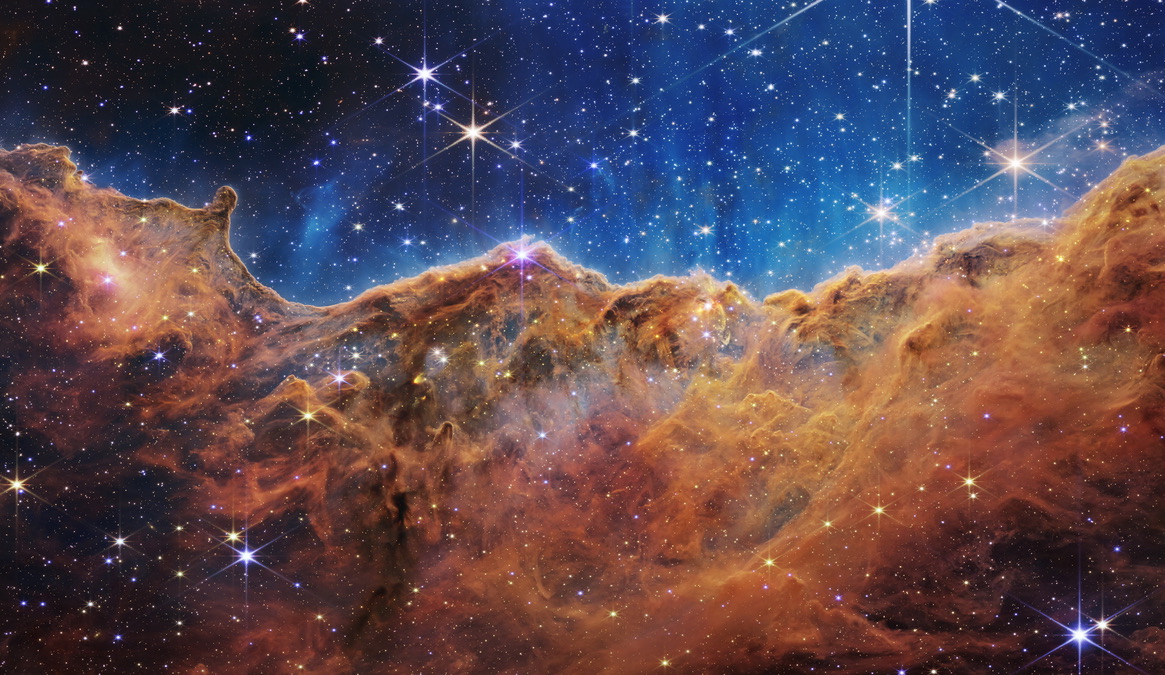
For a brief period earlier this week, social media and the world at large seemed to stop squabbling about politics and culture and united in a moment of wonder as the James Webb Space Telescope (JWST) released its first stunning images of the cosmos. These "extreme deep field" images represent the farthest and the oldest that we have been able to see in the universe, surpassing even the amazing images captured by the Hubble Space Telescope that we have become so familiar with. We will soon see these photographs decorating the walls of classrooms and hospitals everywhere.
The scale of the JWST images is breathtaking. Each dot represents a galaxy or nebula from far, far away. Each galaxy or nebula is home to billions of stars in various stages of life and death. The curved light in the image comes from a classic prediction of Einstein's general theory of relativity called gravitational lensing - the bending of light by gravity that makes spacetime curvature act like a lens.
Some of the stars in these distant galaxies and nebulae are being nurtured in stellar nurseries; others are in their end stages and might be turning into neutron stars, supernovae or black holes. And since galaxies have been moving away from us because of the expansion of the universe, the farther out we see, the older the galaxy is. This makes the image a gigantic hodgepodge of older and newer photographs, ranging from objects that go as far back as 100 million years after the Big Bang to very close (on a cosmological timescale) objects like Stephan's Quintet and the Carina Nebula that are only a few tens of thousands of light years away.
It is a significant and poignant fact that we are seeing objects not as they are but as they were. The Carina Nebula is 8,500 light years away, so we are seeing it as it looked like 8,500 years ago, during the Neolithic Age when humanity had just taken to farming and agriculture. On the oldest timescale, objects that are billions of light years away look the way did during the universe's childhood. The fact that we are seeing old photographs or stars, galaxies and nebulae gives the photo a poignant quality. For a younger audience who has always grown up with Facebook, imagine seeing a hodgepodge of images of people from Facebook over the last fifteen years presented to you: some people are alive and some people no longer so, some people look very different from what they did when their photo was last taken. It would be a poignant feeling. But the JWST image also fills me with joy. Looking at the vast expanse, the universe feels not like a cold, inhospitable place but like a living thing that's pulsating with old and young blood. We are a privileged part of this universe.
There's little doubt that one of the biggest questions stimulated by these images would be whether we can detect any signatures of life on one of the many planets orbiting some of the stars in those galaxies. By now we have discovered thousands of extrasolar planets around the universe, so there's no doubt that there will be many more in the regions the JWST is capturing. The analysis of the telescope data already indicates a steamy atmosphere containing water on a planet about 1,150 light years away. Detecting elements like nitrogen, carbon, sulfur and phosphorus is a good start to hypothesizing about the presence of life, but much more would be needed to clarify whether these elements arise from an inanimate process or a living one. It may seem impossible that a landscape as gargantuan as this one is completely barren of life, but given the improbability of especially intelligent life arising through a series of accidents, we may have to search very wide and long.
I was gratified as my twitter timeline - otherwise mostly a cesspool of arguments and ad hominem attacks punctuated by all-too-rare tweets of insight - was completely flooded with the first images taken by the JWST. The images proved that humanity is still capable of coming together and focusing on a singular achievement of science and technology, how so ever briefly. Most of all, they prove both that science is indeed bigger than all of us and that we can comprehend it if we put our minds and hands together. It's up to us to decide whether we distract ourselves and blow ourselves up with our petty disputes or explore the universe as revealed by JWST and other feats of human ingenuity in all its glory.
Image credits: NASA, ESA, CSA and STScl
Book Review: "The Rise and Reign of the Mammals: A New History, From the Shadows of the Dinosaurs to US", by Steve Brusatte
Book Review: "Don't Tell Me I Can't: An Ambitious Homeschooler's Journey", by Cole Summers (Kevin Cooper)
I finished this book with a profound sense of loss combined with an inspired feeling of admiration for what young people can do. Cole Summers grew up in the Great Basin Desert region of Nevada and Utah with a father who had tragically become confined to a wheelchair after an accident in military training. His parents were poor but they wanted Cole to become an independent thinker and doer. Right from when he was a kid, they never said "No" to him and let him try out everything that he wanted to. When four-year-old Cole wanted to plant and grow a garden, they let him, undeterred by the minor cuts and injuries on the way.
Should a scientist have "faith"?
Scientists like to think that they are objective and unbiased, driven by hard facts and evidence-based inquiry. They are proud of saying that they only go wherever the evidence leads them. So it might come as a surprise to realize that not only are scientists as biased as non-scientists, but that they are often driven as much by belief as are non-scientists. In fact they are driven by more than belief: they are driven by faith. Science. Belief. Faith. Seeing these words in a sentence alone might make most scientists bristle and want to throw something at the wall or at the writer of this piece. Surely you aren’t painting us with the same brush that you might those who profess religious faith, they might say?
But there’s a method to the madness here. First consider what faith is typically defined as – it is belief in the absence of evidence. Now consider what science is in its purest form. It is a leap into the unknown, an extrapolation of what is into what can be. Breakthroughs in science by definition happen “on the edge” of the known. Now what sits on this edge? Not the kind of hard evidence that is so incontrovertible as to dispel any and all questions. On the edge of the known, the data is always wanting, the evidence always lacking, even if not absent. On the edge of the known you have wisps of signal in a sea of noise, tantalizing hints of what may be, with never enough statistical significance to nail down a theory or idea. At the very least, the transition from “no evidence” to “evidence” lies on a continuum. In the absence of good evidence, what does a scientist do? He or she believes. He or she has faith that things will work out. Some call it a sixth sense. Some call it intuition. But “faith” fits the bill equally.
If this reliance on faith seems like heresy, perhaps it’s reassuring to know that such heresies were committed by many of the greatest scientists of all time. All major discoveries, when they are made, at first rely on small pieces of data that are loosely held. A good example comes from the development of theories of atomic structure.
When Johannes Balmer came up with his formula for explaining the spectral lines of hydrogen, he based his equation on only four lines that were measured with accuracy by Anders Ã…ngström. He then took a leap of faith and came up with a simple numerical formula that predicted many other lines emanating from the hydrogen atom and not just four. But the greatest leap of faith based on Balmer’s formula was taken by Niels Bohr. In fact Bohr did not even hesitate to call it anything but a leap of faith. In his case, the leap of faith involved assuming that electrons in atoms only occupy certain discrete energy states, and that figuring out the transitions between these states somehow involved Planck’s constant in an important way. When Bohr could reproduce Balmer’s formula based on this great insight, he knew he was on the right track, and physics would never be the same. One leap of faith built on another.
To a 21st century scientist, Bohr’s and Balmer’s thinking as well as that of many other major scientists well through the 20th century indicates a manifestly odd feature in addition to leaps of faith – an absence of what we call statistical significance or validation. As noted above, Balmer used only four data points to come up with his formula, and Bohr not too many more. Yet both were spectacularly right. Isn’t it odd, from the standpoint of an age that holds statistical validation sacrosanct, to have these great scientists make their leaps of faith based on paltry evidence, “small data” if you will? But that in fact is the whole point about scientific belief, that it originates precisely when there isn’t copious evidence to nail the fact, when you are still on shaky ground and working at the fringe. But this belief also supremely echoes a famous quote by Bohr’s mentor Rutherford – “If your experiment needs statistics, you ought to have done a better experiment.” Resounding words from the greatest experimental physicist of the 20th century whose own experiments were so carefully chosen that he could deduce from them extraordinary truths about the structure of matter based on a few good data points.
The transition between belief and fact in science in fact lies on a continuum. There are very few cases where a scientist goes overnight from a state of “belief” to one of “knowledge”. In reality, as evidence builds up, the scientist becomes more and more confident until there are not enough grounds for believing otherwise. In many cases the scientist may not even be alive to see his or her theory confirmed in all its glory: even the Newtonian model of the solar system took until the middle of the 19th century to be fully validated, more than a hundred years after Newton’s death.
A good example of this gradual transition of a scientific theory from belief to confident espousal is provided by the way Charles Darwin’s theory of evolution by natural selection, well, evolved. It’s worth remembering that Darwin took more than twenty years to build up his theory after coming home from his voyage on the HMS Beagle in 1836. At first he only had hints of an idea based on extensive and yet uncatalogued and disconnected observations of flora and fauna from around the world. Some of the evidence he had documented – the names of Galapagos finches, for instance – was wrong and had to be corrected by his friends and associates. It was only by arduous experimentation and cataloging that Darwin – a famously cautious man – was able to reach the kind of certainty that prompted him to finally publish his magnum opus, Origin of Species, in 1859, and even then only after he was threatened to be scooped by Alfred Russell Wallace. There can be said to be no one fixed eureka moment when Darwin could say that he had transitioned from “believing” in evolution by natural selection to “knowing” that evolution by natural selection was true. And yet, by 1859, this most meticulous scientist was clearly confident enough in his theory that he no longer simply believed in it. But it certainly started out that way. The same uncertain transition between belief and knowledge applies to other discoveries. Einstein often talked about his faith in his general theory of relativity before observations of the solar eclipse of 1919 confirmed its major prediction, the bending of starlight by gravity, remarking that if he was wrong it would mean that the good lord had led him down the wrong garden path. When did Watson and Crick go from believing that DNA is a double helix to knowing that it is? When did Alfred Wegener go from believing in plate tectonics to knowing that it was real? In some sense the question is pointless. Scientific knowledge, both individually and collectively, gets cemented with greater confidence over time until the objections simply cannot stand up to the weight of the accumulated evidence.
Faith, at least in one important sense, is thus an important part of the mindset of a scientist. So why should scientists not nod in assent if someone then tells them that there is no difference, at least in principle, between their faith and religious faith? For two important reasons. Firstly, the “belief” that a scientist has is still based on physical and not supernatural evidence, even if all the evidence may not yet be there. What scientists call faith is still based on data and experiments, not mystic visions and pronouncements from a holy book. More importantly, unlike religious belief, scientific belief can wax and wane with the evidence; it importantly is tentative and always subject to change. Any good scientist who believes X will be ready to let go of their belief in X if strong evidence to the contrary presents itself. That is in fact the main difference between scientists on one hand and clergymen and politicians on the other; as Carl Sagan once asked, when was the last time you heard either of the latter say, “You know, that’s a really good counterargument. Maybe what I am saying is not true after all.”
Faith may also interestingly underlie one of the classic features of great science – serendipity. Unlike what we often believe, serendipity does not always refer to pure unplanned accident but to deliberately planned accident; as Alexander Fleming memorably put it, chance favors the “prepared mind”. A remarkable example of deliberate serendipity comes from an anecdote about his discovery of slow neutrons that Enrico Fermi narrated to Subrahmanyan Chandrasekhar. Slow neutrons unlocked the door to nuclear power and the atomic age. Fermi told Chandrasekhar how he came to make this discovery which he personally considered – among a dozen seminal ones – to be his most important one (From Mehra and Rechenberg, “The Historical Development of Quantum Theory, Vol. 6”):
Chandrasekhar’s invocation of Hadamard’s thesis of unconscious discovery might provide a rational underpinning for what we are calling faith. In this case, Fermi’s great intuitive jump, his seemingly irrational faith that paraffin might slow down neutrons, might have been grounded in the extensive body of knowledge about physics that was housed in his brain, forming connections that he wasn’t even aware of. Not every leap of faith can be explained this way, but some can. In this sense a scientist’s faith, unlike religious faith, is very much rational and based on known facts.
Ultimately there’s a supremely important guiding role that faith plays in science. Scientists ignore believing at their own peril. This is because they have to constantly tread the tightrope of skepticism and wonder. Shut off your belief valve completely and you will never believe anything until there is five-sigma statistical significance for it. Promising avenues of inquiry that are nonetheless on shaky grounds for the moment will be dismissed by you. You may never be the first explorer into rich new scientific territory. But open the belief valve completely and you will have the opposite problem. You may believe anything based on the flimsiest of evidence, opening the door to crackpots and charlatans of all kinds. So where do you draw the line?
In my mind there are a few logical rules of thumb that might help a scientist to mark out territories of non-belief from ones where leaps of faith might be warranted. In my mind, plausibility based on the known laws of science should play a big role. For instance, belief in homeopathy would be mistaken based on the most elementary principles of physics and chemistry, including the laws of mass action and dose response. But what about belief in extraterrestrial intelligence? There the situation is different. Based on our understanding of the laws of quantum theory, stellar evolution and biological evolution, there is no reason to believe that life could not have arisen on another planet somewhere in the universe. In this sense, belief in extraterrestrial intelligence is justified belief, even if we don’t have a single example of life existing anywhere else. We should keep on looking. Faith in science is also more justified when there is a scientific crisis. In a crisis you are on desperate grounds anyway, so postulating ideas that aren’t entirely based on good evidence isn’t going to make matters worse and are more likely to lead into novel territory. Planck’s desperate assumption that energy only comes in discrete packets was partly an act of faith that resolved a crisis in classical physics.
Ultimately, though, drawing a firm line is always hard, especially for topics on the fuzzy boundary. Extra-sensory perception, the deep hot biosphere and a viral cause for mad cow disease are three theories which are implausible although not impossible in principle; there is little in them that flies against the basic laws of science. The scientists who believe in these theories are sticking their necks out and taking a stand. They are heretics who are taking the risk of being called fools; since most bold new ideas in science are usually wrong, they often will be. But they are setting an august precedent.
If science is defined as the quest into the unknown, a foray into the fundamentally new and untested, it is more important than ever especially in this age of conformity, for belief in science to play a more central role in the practice of science. The biggest scientists in history have always been ones who took leaps of faith, whether it was Bohr with his quantum atom, Einstein with his thought experiments or Noether with her deep feeling for the relationship between symmetry and conservation laws, a feeling felt but not seen. For creating minds like these, we need to nurture an environment that not just allows but actively encourages scientists, especially young ones, to tread the boundary between evidence and speculation with aplomb, to exercise their rational faith with abandon. Marie Curie once said, “Now is the time to fear less, so that we may understand more.” To which I may add, “Now is the time to believe more, so that we may understand even more.”
First published on 3 Quarks Daily
Man as a "machine-tickling aphid"


.jpeg)
.png)