Field of Science

Oppenheimer's folly: On black holes, fundamental laws and pure and applied science

On September 1, 1939, the same day that Germany attacked Poland and started World War 2, a remarkable paper appeared in the pages of the journal Physical Review. In it J. Robert Oppenheimer and his student Hartland Snyder laid out the essential characteristics of what we today call the black hole. Building on work done by Subrahmanyan Chandrasekhar, Fritz Zwicky and Lev Landau, Oppenheimer and Snyder described how an infalling observer on the surface of an object whose mass exceeded a critical mass would appear to be in a state of perpetual free fall to an outsider. The paper was the culmination of two years of work and followed two other articles in the same journal.

Then Oppenheimer forgot all about it and never said anything about black holes for the rest of his life. 

He had not worked on black holes before 1938, and he would not do so ever again. Ironically, it is this brief contribution to physics that is now widely considered to be Oppenheimer’s greatest, enough to have possibly warranted him a Nobel Prize had he lived long enough to see experimental evidence for black holes show up with the advent of radio astronomy.

What happened? Oppenheimer’s lack of interest wasn’t just because it was published on the same day on which World War 2 was launched. It wasn’t because he became the director of the Manhattan Project a few years later and got busy with building the atomic bomb. It also wasn't because he despised the freethinking and eccentric Zwicky who had laid the foundations for the field through the discovery of black holes' parents - neutron stars. It wasn’t even because he achieved celebrity status after the war, became the most powerful scientist in the country and spent an inordinate amount of time consulting in Washington until his carefully orchestrated downfall in 1954. All these factors contributed, but the real reason was far more mundane – Oppenheimer just wasn’t interested in black holes. Even after his downfall, when he had plenty of time to devote to physics, he never talked or wrote about them. The creator of black holes basically did not think they mattered.

Oppenheimer’s rejection of one of the most fascinating implications of modern physics and one of the most enigmatic objects in the universe - and one he sired - is documented well by Freeman Dyson who tried to initiate conversations about the topic with him. Every time Dyson brought it up Oppenheimer would change the subject, almost as if he had disowned his own scientific children.

The reason, as attested to by Dyson and others who knew him, was that in his last few decades Oppenheimer was stricken by a disease which I call “fundamentalitis”. Fundamentalitis is a serious condition that causes its victims to believe that the only thing worth thinking about is the deep nature of reality as manifested through the fundamental laws of physics.

As Dyson put it:

“Oppenheimer in his later years believed that the only problem worthy of the attention of a serious theoretical physicist was the discovery of the fundamental equations of physics. Einstein certainly felt the same way. To discover the right equations was all that mattered. Once you had discovered the right equations, then the study of particular solutions of the equations would be a routine exercise for second-rate physicists or graduate students.”

Thus for Oppenheimer, black holes, which were particular solutions of general relativity, were mundane; the general theory itself was the real deal. In addition they were anomalies, ugly exceptions which were best ignored rather than studied. As Dyson mentions, unfortunately Oppenheimer was not the only one affected by this condition. Einstein, who spent his last few years in a futile search for a grand unified theory, was another. Like Oppenheimer he was uninterested in black holes, but he also went a step further by not believing in quantum mechanics. Einstein’s fundamentalitis was quite pathological indeed.

History proved that both Oppenheimer and Einstein were deeply mistaken about black holes and fundamental laws. The greatest irony is not that black holes are very interesting, it is that in the last few decades the study of black holes has shed light on the very same fundamental laws that Einstein and Oppenheimer believed to be the only thing worth studying. The disowned children have come back to haunt the ghosts of their parents.

Black holes took off after the war largely due to the efforts of John Wheeler in the US and Dennis Sciama in the UK. The new science of radio astronomy showed us that, far from being anomalies, black holes litter the landscape of the cosmos, including the center of the Milky Way. A decade after Oppenheimer’s death, the Israeli theorist Jacob Bekenstein proved a very deep relationship between thermodynamics and black hole physics. Stephen Hawking and Roger Penrose found out that black holes contain singularities; far from being ugly anomalies, black holes thus demonstrated Einstein’s general theory of relativity in all its glory. They also realized that a true understanding of singularities would involve the marriage of quantum mechanics and general relativity, a paradigm that’s as fundamental as any other in physics.

In perhaps the most exciting development in the field, Leonard Susskind, Hawking and others have found intimate connections between information theory and black holes, leading to the fascinating black hole firewall paradox that forges very deep connections between thermodynamics, quantum mechanics and general relativity. Black holes are even providing insights into computer science and computational complexity. The study of black holes is today as fundamental as the study of elementary particles in the 1950s.

Einstein and Oppenheimer could scarcely have imagined that this cornucopia of discoveries would come from an entity that they despised. But their wariness toward black holes is not only an example of missed opportunities or the fact that great minds can sometimes suffer from tunnel vision. I think the biggest lesson from the story of Oppenheimer and black holes is that what is considered ‘applied’ science can actually turn out to harbor deep fundamental mysteries. Both Oppenheimer and Einstein considered the study of black holes to be too applied, an examination of anomalies and specific solutions unworthy of thinkers thinking deep thoughts about the cosmos. But the delicious irony was that black holes in fact contained some of the deepest mysteries of the cosmos, forging unexpected connections between disparate disciplines and challenging the finest minds in the field. If only Oppenheimer and Einstein had been more open-minded.

The discovery of fundamental science in what is considered applied science is not unknown in the history of physics. For instance Max Planck was studying blackbody radiation, a relatively mundane and applied topic, but it was in blackbody radiation that the seeds of quantum theory were found. Similarly it was spectroscopy, the study of light emanating from atoms, that led to the modern framework of quantum mechanics in the 1920s. Scores of similar examples abound in the history of physics; in a more recent case, it was studies in condensed matter physics that led physicist Philip Anderson to make significant contributions to symmetry breaking and the postulation of the existence of the Higgs boson. And in what is perhaps the most extreme example of an applied scientist making fundamental contributions, it was the investigation of cannons and heat engines by French engineer Sadi Carnot that led to a foundational law of science – the second law of thermodynamics.

These days there is a lot of valid discussion about how the pursuit of pure science usually leads to unexpected applied results, but sometimes the opposite is also true: the pursuit of what Subrahmanyan Chandrasekhar called “derived science” leads to new horizons in pure science. Derived science consists of exploring the implications and results of pure science, but as the history of science has regularly demonstrated, this investigation can also feed back into the advancement of pure science itself.

Today many physicists are again engaged in a search for ultimate laws, with at least some of them thinking that these ultimate laws would be found within the framework of string theory. These physicists probably regard other parts of physics, and especially the applied ones, as unworthy of their great theoretical talents. For these physicists the story of Oppenheimer and black holes should serve as a cautionary tale. Nature is too clever to be constrained into narrow bins, and sometimes it is only by poking around in the most applied parts of science that one can see the gleam of fundamental principles.

As Einstein might have said had he known better, the distinction between the pure and the applied is often only a "stubbornly persistent illusion". It's an illusion that we must try hard to dispel. 

Seeing the 2016 election through Jonathan Haidt's moral foundations theory

One of the best social science books that I have read is NYU psychologist Jon Haidt's "The Righteous Mind". Recently Haidt has become well known for opposing what he sees as clampdowns on free speech and dissenting views on college campuses, the paucity or suppression of conservative views on these campuses and the coddling of students, but he is still primarily known for his writings on political psychology. As someone who describes himself as a moderate libertarian, I largely agree with Haidt's views on these matters.

The basic premise of "The Righteous Mind" is that liberals, conservatives and libertarians use different moral metrics to judge the veracity and fitness of political candidates and of their world views in general. Their outrage or praise at statements that politicians make depends on how well or badly these statements score on their spectrum of moral values. Haidt's point is that most of the disagreement on political issues between liberals and conservatives boils down to a subset of six moral 'foundations' that they score politics on. 

The six moral foundations are: care/harm, liberty/oppression, fairness/cheating, loyalty/betrayal, authority/subversion and sanctity/purity. Based on several studies conducted by him and his colleagues, Haidt has concluded that in general, liberals value the first three values disproportionately while conservatives value all six values equally. Thus as an example, liberals get very worked up about the oppression of minorities because it scores very badly on the "care/harm" and "liberty/oppression" metrics, while religious conservatives get very worked up by LGBT rights because it scores very badly on their "sanctity/degradation" and "liberty/oppression" metrics. Libertarians view the liberty/oppression axis as being as overwhelmingly important.

The following chart neatly illustrates these differences:


Haidt also refers to these moral foundations as sacred values, considering how intensely liberals and conservatives often cling to them. Seen through this lens of sacred values, it's very interesting to look at the Giant Conflagration of 2016 (otherwise known as the 2016 US election). When Trump said all those obnoxious things about Hispanics or women or Muslims, he scored very low on liberals' main moral values (the three on the left): by insulting certain racial or demographic groups, he was showing that he did not care about them, he was purportedly infringing on their liberties and he was also not being fair to them. As the chart shows, concern for the care and liberties of victims of oppression is liberals' most sacred value, although it is also valued highly by conservatives. Minorities and women are often thought to fall in this category, and so the violation of this value disqualified Trump in the eyes of liberals right away.

What they failed to realize was that he was still scoring very high on the three conservative values on the right. Many conservatives who supported him disavowed his words, but that wasn't why they would have a big problem supporting him. He was clearly showing loyalty to disgruntled working class whites, he was being an authority figure to them, and in some sense he also seemed to be preserving the sanctity of their way of life. It's not that conservatives didn't care about the left three values, it's just that all the supposedly disqualifying things he said still made him score very high on the values on the right. On balance he thus still scored favorable.

The mistake liberals made was in thinking that his words would be as important to conservatives as they were to them, but because those words didn't really affect the three major values on the right that conservatives found important, they didn't matter much to them. It's a good case of missing the forest for the trees, and hopefully liberals won't make the same mistake next time. All six foundations are important, however, so liberals cannot be faulted for being angry at Trump's shoddy treatment of the three on the left; as Haidt says, even conservatives value these foundations.

The next four years are going to be a giant experiment in testing all these moral foundations. If the worst that everyone thinks about Trump comes to pass, this country will be in bad shape. That would be because he would have failed on all six foundations: for instance, if he does not deliver on promises to bring jobs to the white working class, the moral foundation of betrayal/loyalty and authority/subversion which they have largely staked their support for him on would take a potentially existential hit. He would have then failed both liberals and conservatives. If on the other hand, he manages to actually follow up on the positive promises that he has made, especially regarding job creation, and also manages not to significantly hurt the other moral foundations on the chart, who knows, perhaps everybody would have been wrong about him after all. For now the best strategy is the one recommended by the Zen Master: "We'll see".

Richard Feynman on our difficult times: "Whatever else is going on, we've always got our physics."

At this unfortunate moment, one of the best things I can think of is an anecdote about Richard Feynman from Stephen Wolfram's new book "Idea Makers". Wolfram was a graduate student with Feynman, and he recounts an episode from one of his visits to Feynman's place.
"If there's one moment that summarizes Richard Feynman and my relationship with him, perhaps it's this. It was probably 1982. I'd been at Feynman's house, and our conversation had turned to some kind of unpleasant situation that was going on. I was about to leave. And Feynman stopped me and said, "You know, you and I are very lucky. Because whatever else is going on, we've always got our physics."
To which I may add, we also have friends, family and our hobbies. Whichever direction the maelstrom of political winds blows our ship, we may take solace in these relative constants of our life. 

It does not mean that we lose ourselves in them to the extent of completely withdrawing from the larger national dialogue - the next few years more than any others demand our participation in that dialogue - but it's very reassuring to know that a carbon-carbon bond, or a supernova, or a protein molecule, or a semiconductor, or an equation, simply don't care who the president of the United States is. Moreover, as Einstein once said, time itself is no more than a "stubbornly persistent illusion", and if time might be illusory, then politics is a vanishingly transient ghost in the grand scheme of things.

I find cool succor in this pristine, untouched domain of science and ideas, and I hope most of us will in the difficult days ahead.

BAGIM event on computational chemistry careers

I want to note an event organized by BAGIM - a Boston area group that organizes talks and discussions on computational chemistry and related topics. It's being held on November 10th and will feature a panel discussion on careers in computational chemistry.

The event should be of special interest to postdocs and graduate students. It's a topic that's interesting partly because it's kind of tricky. It's tricky because computational chemistry is a very interdisciplinary field and its practitioners come from a variety of backgrounds - most commonly from organic and physical chemistry but also increasingly from biology and computer science. 

These days the definition of the field has also greatly expanded to include analysis of large-scale data and bioinformatics. What part you exactly need to know and what employers are looking for are facts that you would probably know only after talking to a few people in the field.

That's why I think these kinds of panel discussions might be useful, especially for people who are just getting into industry and academia. It's worth checking out if you are in the area.

Lise Meitner's 48 Nobel Prize nominations

It's Austrian physicist Lise Meitner's birthday today. Meitner was one of the most remarkable scientific figures of the twentieth century. After doing massive scientific work in radioactivity, she figured out the mechanism of nuclear fission with her nephew Otto Frisch in the depressing winter of 1938, after her colleagues Otto Hahn and Fritz Strassmann observed uranium improbably breaking up into barium.

Meitner continues to be one of the most notable scientists not to have won a Nobel Prize. The omission stands out especially because Hahn won it in 1945. By all accounts Meitner and Hahn enjoyed a very productive working relationship for almost thirty years before the tide of fascism tore their lives apart. Their relationship was warm and friendly, but still formal; both were after all products of the rigid and hierarchical German society of their time.

Meitner's lack of a Nobel Prize is stark not only because of the seminal importance of nuclear fission, but because a search of the Nobel Prize nomination database reveals a striking fact: Meitner was nominated for the Nobel Prize in physics or chemistry no less than 48 times between 1937 and 1948 alone. That's almost five nominations a year. Other great scientists have also received dozens of nominations - for instance the chemist R. B. Woodward had 92 before he finally won - but Meitner's is certainly on the higher side. The database runs to 1965, and it's rather curious to see no nominations after 1948.

The list of scientists nominating her is a roster of the who's who of twentieth century physics: Max Planck, Niels Bohr, Werner Heisenberg, Arthur Compton and Max Born all nominated her multiple times. Hahn nominated her once. Curiously, Albert Einstein who thought highly of Meitner does not seem to have nominated her even once; given Einstein's freethinking views and liberal persona this is rather strange.

Given the number of prominent personalities advocating her work, Meitner's omission from a Nobel Prize will continue to be a blot on the history of the prizes. This hole stands out even more because Meitner was otherwise highly decorated and publicly recognized, receiving for instance the prestigious Enrico Fermi Award from the United States Atomic Energy Commission. A combination of factors likely contributed to the failure of the prize committee. Sexism, certainly, but I don't think sexism played as prominent a role as it did in the careers of some other deserving female scientists. Part of the reason why I don't think it played an overriding role is that nuclear physics was the only field until then in which two women - Marie Curie (who shares a birthday today with Meitner) and Irene Joliot-Curie - had received Nobel Prizes. The physicist Maria Goeppert Mayer would very soon become only the second woman to win a physics Nobel Prize, again for nuclear physics. Also, Otto Frisch and Fritz Strassmann who were instrumental in both discoveries also did not receive the prize, and their omission of course cannot be ascribed to gender discrimination.

The real reason remains muddy and is likely a collage of fuzzy factors. Some have speculated it was anti-semitism, although given the number of Jewish prize recipients until then it would appear to be a minor determinant. Others think that the relatively low opinion of her work held by some prominent members of the Nobel committee might have contributed. Personally I also think it might have been an honest albeit misguided view of the contributions of the four scientists involved in discovering fission: Hahn's work might have been regarded as a proper "discovery" while Meitner and Frisch's might have been regarded as a mere "explanation". Strassmann could have been omitted because he was presumably Hahn's "assistant" (which he wasn't).

All these factors likely played a role, and no single factor might have been dominant. At the very least, Meitner's lack of a prize is as disappointing as Frisch and Strassmann's. In fact I always think that if there is an underappreciated hero of the nuclear fission story, it's not Meitner but Fritz Strassmann. This quiet and industrious man did much of the tedious grunt work that was key to solving the puzzle of the breakup of uranium. The kind of craftsmanship that he exhibited is too often overlooked, by the public as well as by prize committees. Morally too he was a hero; during those perilous years he hid a Jewish friend in his apartment for many years at considerable risk to his life. 

Meanwhile, Frisch was instrumental in helping his aunt work out the exact mathematics of the fission process and then performing the first fission experiment outside Berlin. Working with Rudolf Peierls in Birmingham, he later established the first value for the critical mass of a bomb and helped convince key members of then slow-moving Manhattan project that nuclear weapons were possible. He also fine tuned this critical mass value at Los Alamos by performing dangerous experiments which were christened 'tickling the dragon's tail'.

Niels Bohr rightly suggested that the physics Nobel Prize should have been split between Meitner and Frisch, the chemistry prize between Hahn and Strassmann. But the prize is a human institution after all, and a fallible human committee created by fallible human beings does not always obey the logical dictates of history. Hahn and Meitner are now largely remembered, Strassmann and Frisch are now largely forgotten. But Meitner stands out, for her brilliance and experimental acumen, for her perseverance and doggedness, for her stoic will during tumultuous and painful times, for great personal fortitude. She may not have won a Nobel Prize, but her 48 nominations provide a tribute to her remarkable personality as a scientist and human being. She deserves to be constantly remembered and celebrated.

Jack Roberts and Dorothy Semenow - Caltech's first female graduate student

The New York Times has an obituary today of pioneering Caltech chemist Jack Roberts who passed away last week at the ripe age of 98. Roberts was a truly incredible organic chemist, contributing massively to a diversity of fields that most scientists can only dream of crisscrossing. Even a short listing of the fields he enriched includes NMR spectroscopy, molecular orbital theory, reaction mechanisms and kinetic isotope effects. 

But one of Roberts' most notable achievements was human - when he moved from MIT to Caltech, he brought with him Caltech's first female graduate student, Dorothy Semenow.

Roberts certainly played an important role in admitting the institute's first woman, but Semenow's transition would likely have not been possible without the intervention of one of the world's greatest scientists, Linus Pauling, who was then chairman of Caltech's chemistry department. Here's what Roberts says in his autobiography about Pauling's stamp on this historic change:
"Caltech, unlike MIT, did not admit women as students, although there were a few female postdoctoral fellows. I talked to Linus about Dorothy and her strong desire to come to Caltech. To my surprise, he showed immediate interest. He told me that the question of admitting women had been raised not many years earlier, and that the faculty had voted not to change. Furthermore, he said that the Institute's trustees had taken note of the faculty action and had endorsed it. But he said he wanted to try again with a specific case, and asked that Dorothy submit an application as soon as possible. 
I wasn't on hand and had no idea what happened at Caltech during the decision-making process. It was certainly to the credit of both Caltech and Linus that the matter was settled by the end of the academic year, including approval by the trustees. There were stories that I had said I would not come if Dorothy was not admitted. That was not true. I only presented the case and others carried the ball, but it was wonderful to be associated with an institution that could act so quickly to change a very strong tradition."
It is certainly to Roberts' credit that he pressed for the change. It is also to his credit that he admits at the end that his role in the whole affair was not as gallant as the New York Times and others think it was. At Caltech Semenow did very strong work validating one of Roberts' key contributions to chemistry, the discovery of benzyne which is a very unusual benzene double with a triple bond. After an academic career in which she also acquired a PhD in psychology, she now seems to be advancing chemical education through games.

Interestingly, I found a reference to Dr. Semenow in a 1953 Caltech publication which seems to be some kind of monthly campus newsletter. After acknowledging her admission, the newsletter curiously says the following:
"This gallant action is not, however, an open invitation to the ladies. It applies only to "women of exceptional ability who give promise of great scientific contributions." And, before she can enroll, a woman must get the approval of the academic division in which she intends to work, as well as that of the Committee on Graduate Study.' With such hurdles as these, it is hardly likely that the campus will ever be swarming with female students. Most admissions of women, in fact, will probably involve the use of unique or outstanding research facilities here."
Yes, that charming second paragraph does seem to put a dent into the unprecedented event which it heralds, reassuring its readers not to worry about the campus "swarming" with the ladies (who understandably would of course distract all the gents). In fact, until 1967, Caltech's catalog proclaimed that female students would be admitted, "but only in exceptional cases". Now I am willing to cut Caltech some slack here - it was 1953 after all - but it does show how far they still had to go even after Semenow moved there from the more egalitarian MIT. 

How times have changed. Today Caltech has about 30% female graduate students, and while there clearly can be an improvement in this number, it was Dorothy Semenow, Jack Roberts and Linus Pauling who blazed that trail.

Steve Jobs on what happens to companies when sales people take over product people

Here's a great quote from Steve Jobs (from this interview) about what happens when technology companies, and especially ones with a monopoly, pivot from being product-driven to sales-driven. The italics are mine.
“The technology crashed and burned at Xerox. Why? I learned more about this with John Sculley later on. What happens is, John came from Pepsico. And they—at most—would change their product once every 10 years. To them, a new product was a new sized bottle. So if you were a ‘product person’, you couldn’t change the course of that company very much. So, who influences the success at Pepsico? The sales and marketing people. Therefore they were the ones that got promoted, and they were the ones that ran the company. 
 
Well, for Pepsico that might have been okay, but it turns out the same thing can happen at technology companies that get monopolies. Like IBM and Xerox. If you were a ‘product person’ at IBM or Xerox: so you make a better copier or better computer. So what? When you have a monopoly market-share, the company’s not any more successful. So the people who make the company more successful are the sales and marketing people, and they end up running the companies. And the ‘product people’ get run out of the decision-making forums. 
 
The companies forget how to make great products. The product sensibility and product genius that brought them to this monopolistic position gets rotted out by people running these companies who have no conception of a good product vs. a bad product. They have no conception of the craftsmanship that’s required to take a good idea and turn it into a good product. And they really have no feeling in their hearts about wanting to help the costumers.”

I have noted a similar quote by Jobs regarding the decline of Microsoft before, but this quote really fleshes out the problem in detail. What Jobs is saying about technology companies applies equally or even more to science-driven companies like pharmaceuticals and biotechnology. Nobody is saying that sales and marketing are not important, but when your company's basic foundation is fundamentally based on new products like drugs, then sales people can only get you so far, and beyond a point they can even destroy your raison d'etre. Interestingly, Microsoft itself is a good recent example of how a product-driven strategy can actually shore up a company's fortunes: a lot of the recent uptick in Microsoft's recent stock price and performance has come from the development of a new product - their cloud computing platform Azure. 


OpenEye CEO Anthony Nicholls has noted how the decline of Big Pharma's fortunes from the 90s onwards tracks well with the replacement of product people at the helm with sales people and lawyers. That seems to be too much of a coincidence. CEOs and CSOs definitely set the tone for what's important, and it's hard to see how a lawyer from a company that has nothing to do with making drugs can truly appreciate how to improve a drug-making company's core competency. Nor does being product-driven entail sucking up other firms in mergers and acquisitions. The problem is that while your company's fortunes may get a brief shot in the arm because of new products developed by other companies, at some point those companies' products may themselves run out. More importantly, if your primary goal is to simply acquire other companies, then you are no longer a pharmaceutical R&D organization, you are more like a holding house for other companies' products which you simply acquire and sell. At the very least you should then call yourself a holding house.

Of course, all this is more comprehensible (although still not excusable) when you consider how skewed the incentive systems are. When a new CEO is given a mandate to make a hefty profit in five years by impatient investors, their goals are totally limited to satisfying that narrowly defined demand, and since drug discovery (new product creation, that is) almost always looks at ten year horizons, the likelihood of that particular activity meeting their requirements is slim. Instead, acquiring the small neighborhood biotech and keeping investors happy for five years is the primary goal; after that you and your ten million dollar bonus are out anyway, so who cares?


In some sense Jobs' wisdom can be summed up very simply: if your company is based on a product, you should make better and more product. Selling it is important, but that comes next. If you invert the order or make sales your exclusive focus, then the very thing you are selling will one day cease to exist.

A really bad year for chemistry and chemists

The shocks just keep on coming. Monday brought news of University of Illinois computational chemist Klaus Schulten's demise. Schulten was a student of Martin Karplus who made great strides in using molecular dynamics to simulate the behavior of not just single proteins but giant protein assemblies like viruses. He contributed to both the science and the technology, popularizing parallel MD calculations along with their impact on key biological systems.

What's troubling is that news of Schulten's passing comes on the heels of similar bad news about two other chemistry and biology leaders - Jack Roberts and Susan Lindquist...and that's just in the last two days.

And these aren't even the first world-class scientists in the field to pass into the great beyond this year. There's also Harry Kroto, Ahmed Zewail and Roger Tsien, all Nobel Laureates. As far as the passing of great chemists into history goes, this has been as bad a year as any that I at least can remember.

If I believed in an all-powerful deity, I would probably think that some malevolent deity who failed high school chemistry and has held a grudge against all things chemical since is tampering with the lifelines of chemistry's leading practitioners. The more mundane but still depressing explanation is that this unfortunate set of coincidences is just that, a bad set of coincidences compounded with the raw fact of people dying at the end of a natural life span.

The one thing we can say is that all these giants have left their indelible footprints on their fields. These are fields that span a vast landscape: physical and organic chemistry, spectroscopy, chemical biology, cancer and neurodegenerative disease research, materials science. The fact that even such a small sampling of chemists corresponds to such a large sampling of scientific topics is a testament both to their intellectual prowess and the versatility of chemistry. 

They have all left us a lot of work to do.

How chemistry exemplifies the Fermi method

In my review of the new biography of Enrico Fermi I alluded to one of Fermi's most notable qualities - his uncanny ability to reach rapid conclusions to tough problems based on order of magnitude, back of the envelope calculations. This method of approximation has since come to be known as the Fermi method, and problems which can especially benefit from applying it are called Fermi problems.

It struck me that chemistry is an especially fertile ground for applying the Fermi method, and in fact many chemists probably use the technique unconsciously in their daily work without explicitly realizing it. For understanding why this so, it's worth taking a look at some of the details of the method and the kinds of problems to which it can be fruitfully applied.

At the heart of the Fermi method is a way to make educated guesses about different factors and quantities that could affect the answer to a problem. Usually when you are looking at complicated problems not just in physics or chemistry but in psychology or economics for that matter, much of complex problem solving involves examining different factors that could influence the magnitude and nature of the solution. For instance, say you were calculating the trajectory of a bomb dropped from an airplane. In that case you would consider parameters like the velocity of the plane, the velocity of the bomb, air resistance, the weight of the bomb, the angle at which it was dropped etc. If you were trying to gauge the impact of a certain economic proposal on the economy, you would consider the market and demographic to which the proposal was applied, the presence or absence of existing elements which could interact positively or negatively with the proposed policy, rates of inflation, potential changes in the prices of certain goods relevant to the policy etc. The first part of the Fermi method simply involves writing down such factors and making sure you have a more or less comprehensive list.

The second part of the Fermi method consists of making educated guesses for each of these factors. The crucial aspect of this part is that you don't need to make highly accurate predictions for each factor to the fourth or fifth decimal place. In fact it was precisely this approach that made Fermi such a novelty in his time; it was because physicists could calculate quantities to four decimal places that they were often tempted to do this. Fermi showed that they didn't have to, and in some sense he weaned them away from this temptation. The fact of the matter is you don't always need a high degree of accuracy to reach actionable, semi-qualitative conclusions; you just need to know some rough numbers and get the answer right to an order of magnitude. That was the key insight from Fermi's technique.

Now, before I proceed and discuss how these two aspects of the Fermi method may apply to chemistry, it's worth noting that there are of course several examples in which an order of magnitude answer is simply not good enough. A famous example concerns the very Manhattan Project of which Fermi was such a valued member. In the early phases of the project when General Leslie Groves was picked as head of the project, he quizzed the scientists in Chicago about how much fissile material they would need. When they said that at that point all they give him was an answer correct to an order of magnitude, he was indignant and pointed out that that would be tantamount to ordering a wedding cake and not knowing whether to order enough cake for ten people or one person or a hundred people.

Notwithstanding such specific cases though, it's clear that there are in fact several example of general problems which can benefit from Fermi's technique. Chemistry in fact is a poster child for both the key aspects of the method illustrated above. Many problems in chemistry involve estimating the various kind of forces - electrostatic, hydrophobic, hydrogen bonds, Van der Waals - influencing the interaction of one molecule with another. For instance when a drug molecule is interacting with a protein, all these factors play an important role. Sometimes they synergize with each other and sometimes they oppose each other. Using the Fermi method then, you would first simply make sure you are listing all of them as comprehensively as possible. The goal is to come up with a total number resulting from all these contributions that would crucially provide you with the strength or free energy of interaction between the drug and the protein; a quantity measured in units of kcal/mol.

This part is where the method is especially useful. When you are trying to come up with numbers for each of these forces, it's valuable simply to know some ranges; you don't need to know the answers to three decimal places. For instance, you know that hydrogen bonds can contribute 2-5 kcal/mol, electrostatic interactions usually add 1-2 kcal/mol, and all the hydrophobic interactions will add a few kcal/mol to the mix. There are some trickier estimates such as those for the entropy of interaction, but there are also approximations for these. Sum up these interactions and you can come up with a reasonable estimate for the free energy of binding. The job becomes easier when what you are interested in are differences and not absolute values. For instance you may be given a list of small molecules and asked to rank these in order of their free energies. In those cases you just have to look at differences: for instance, if one molecule is forming an extra hydrogen bond and the other isn't, you can say that the first one is better by about 2-3 kcal/mol. You can also use your knowledge of experimental measurements for calibrating your estimates, another trait which Fermi supremely exemplified.

This then is the Fermi method of approximate guesses in action. One of the reasons it's far more prevalent in chemistry than physics is because unlike physics, in chemistry it's usually not even possible to calculate numbers to very high accuracy. Therefore unlike some physicists, chemists would not even be tempted to attempt to do this and would have already resigned themselves (if you will) to making do with approximate solutions. Today the Fermi method is incorporated in both the minds of seasoned working chemists as well as in computer programs which try to automate the process. Both the seasoned chemist and the computer program try to first list all the interactions between molecules and then try to estimate the strengths of each interaction based on rough numbers, adding up to a final value. 

The method does not work all the time since every interaction is modeled, so it may potentially miss some important real life component. But it works well enough for chemists and computers to employ it in a variety of useful tasks, from narrowing down the set of drug molecules that have to be made to prioritizing molecules for new materials and energy applications. Enrico Fermi's ghost lives on in test tubes, computers, fume hoods and spectrometers, more than even his wide-ranging mind could have imagined.

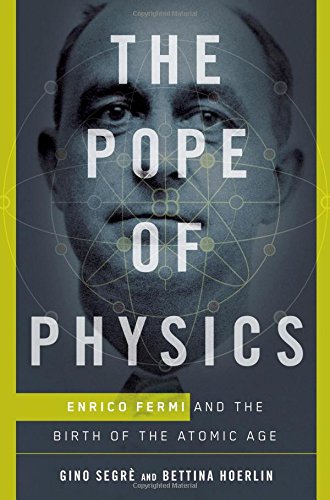
The man with an inside track to God: A new biography of Enrico Fermi

Scientists come in at least as many flavors as fruit. Some are inspired philosophers, others are get-your-hands-dirty mechanical craftsmen, yet others are like birds which can survey multiple parts of the scientific landscape from a very high altitude. But whatever other classification you may use, there are two distinctions which scientists have always exemplified. They can be either theoreticians or experimentalists, and especially these days, they are all specialists. In an age where it can take a lifetime to understand the complexities of even a narrow part of your science, excelling at every subfield of a scientific discipline, let alone both theory and experiment, would seem like an impossible feat.

Enter Enrico Fermi, the likes of whom we are unlikely to see for a very long time. Bucking almost every neat scientific distinction, Fermi was the only scientist of the twentieth century who was supremely accomplished in both theoretical and experimental physics. Almost any of his discoveries would have been enough to net a Nobel Prize, and yet he made at least half a dozen of them. In addition he was one of the three or four physicists of the century who were universalists, making contributions to and displaying a sound grasp of pretty much every branch of physics, from the microscopic to the cosmic. In my opinion, among his contemporaries only Hans Bethe, John von Neumann, Richard Feynman and Luis Alvarez came close to demonstrating the same breadth, and none of them excelled in both theory and experiment. You could ask Fermi any problem, and as long as he could calculate it he could give you an answer: no wonder that his colleagues called him the "Pope of Physics". It also helped that he lived through a century in which physics made momentous contributions to the human intellect and condition, and he was both fortunate and supremely qualified to be a major part of these contributions. As just one aspect of his extraordinary imprint on physics, no scientist has as many measurements, rules, laws, particles, statistics, units, and energy levels named after him as Fermi. He was also one of America's greatest immigrants.

This is a fine biography of Fermi written by Gino Segre and Bettina Hoerlin - a practicing physicist and a historian of science - who both had connections to Fermi through their families. Hoerlin's father worked on the Manhattan Project. Segre is the nephew of Emilio Segre, Nobel Prize-winning physicist and one of Fermi's closet friends and collaborators. The authors document Fermi's upbringing in Italy at the turn of the century. The Fermis came from a verdant, hilly region of Italy known for its industrious farming community, and throughout his life Fermi maintained his love for manual labor and the mountains, qualities endemic to many people from this region. His father was a railway inspector. Enrico was a child prodigy who combined great intellect with hard self-reliance and perseverance, qualities which were inculcated by his hardworking parents. A life-changing tragedy at age fifteen - the sudden death of his brother with whom he was best friends - turned him toward physics and mathematics. His performance as a seventeen year old in the entrance examination for a well-known university in Pisa displayed knowledge that would have been substantial for a graduate student. From then on his scientific development proceeded smoothly, and before he was 30 he was both Italy's leading physicist as well as one of the world's greatest scientists.

The book lays out many of Fermi's major discoveries. Two in particular bracket his unsurpassed talents as both a theoretician and an experimentalist. In 1933 Fermi came up with a mathematical theory of radioactive decay and the weak nuclear force. And in 1942 he and his team assembled the world's first nuclear reactor. It is almost impossible to imagine any other scientist accomplishing these two very different and very important feats; the famed historian C. P. Snow paid Fermi the ultimate tribute in this regard when he said that, had Fermi been born twenty years before, he could have discovered both Niels Bohr's quantum theory of the atom (theory) and Ernest Rutherford's atomic nucleus (experiment). In the 1930s Fermi and his team became the world expert on neutrons; life in the physics institute on Via Panisperna in Rome was bucolic in spite of being intense. He almost single-handedly discovered the power of slow neutrons which are used to harness nuclear energy in reactors. He and other leading physicists also narrowly missed discovering nuclear fission, mistaking fission products for elements beyond uranium. Rome under his scientific tutelage became a magnet for scientists like Hans Bethe and Edward Teller who learnt the art of problem-solving in physics from the master. Fermi's marriage to a very intelligent and resourceful woman, Laura, cemented his family life. But the pall of fascism was dropping on Italy through the person of Benito Mussolini. Laura was Jewish, and by 1938 Fermi realized that he had to emigrate to another country. Fortunately the receipt of the 1938 Nobel Prize gave him the perfect opportunity to flee to the United States. Along with other brilliant scientists like Bethe, Albert Einstein, Leo Szilard and John von Neumann, Fermi became one of fascism's greatest gifts to this country.

In the United States Fermi was already known as the leading nuclear physicist of his generation. When nuclear fission was discovered in Germany at the end of 1938, there were legitimate fears that the Nazis would harness it to build an atomic bomb. Efforts to investigate fission in the US kicked into high gear, especially after Pearl Harbor. It was not surprising that the scientific community turned toward Fermi to assemble the world's first nuclear reactor. The book's account of this tremendous feat involving black graphite bricks and faces, the squash stand at the university and the sometimes amusing consequences of secrecy is worth reading. First at Columbia and then memorably at Chicago, Fermi and his team achieved the first self-sustaining nuclear reaction on December 6, 1942: a coded telegram went out to the leaders of the Manhattan Project saying that the "Italian navigator had landed in the New World". Even if he had accomplished nothing else this would have been sufficient to enshrine Fermi's name in history. But he kept on making major contributions, first at Chicago and then at Los Alamos. At Los Alamos Fermi's universal expertise was so valued that Oppenheimer created an entire division named after him (the F division). He became a kind of all-round troubleshooter who could solve any problem in theoretical or applied physics, or in engineering for that matter. He had an uncanny feel for numbers, and became known for posing and solving 'Fermi problems' which benefited from quick, back of the envelope, order-of-magnitude estimates. The iconic realization of the Fermi method was during the world's first atomic test in New Mexico on July 16, 1945, when, as the shockwave reached him, Fermi threw pieces of paper into the air and calculated the yield of the test based on the distance at which they fell. This calculation compared favorably with more sophisticated measurements that took several days to acquire.

After the war Fermi became a professor at Chicago where he again served as a magnet for the new generation of physicists exploring the frontiers of particle physics and cosmology. He was an incredibly clear and succinct teacher, and gave his students a true feel for the entire landscape of physics. Teaching was not just limited to classrooms but spilled over into the lunch cafeteria and on hikes. Physicists like Freeman Dyson and Richard Feynman made pilgrimages to see him from around the country, and six of his students received Nobel Prizes. Even after winning enough accolades for a lifetime, he worked harder and more diligently than anyone else. His colleagues joked that he was the man with an inside track to God, so all-encompassing were his scientific and computing abilities. His notes on thermodynamics, quantum mechanics and nuclear physics are still available and they attest to his clarity. At Chicago he not only made important contributions to experimental particle physics but he also made the first forays into computing. The so-called Monte-Carlo method which allows one to explore features of a system by making random jumps bears his imprint.

While not a very sentimental man, Fermi's friendliness, integrity, modesty and impartial, non-emotional attitude endeared him to almost everyone he came in contact with. He was friendly and had an impish sense of humor, but while not cold was also not a warm person who engaged intimately with those around him; this quality led to a family life which while not unhappy was also not particularly joyous, and his relative lack of affection was reflected in the brisk relationship that Fermi had with his daughter and son. He despised politics but still served on important government committees because of his feelings of duty toward his adopted country. Remarkably, his neutrality through some very politically fraught times was not detested, and he was one of the very few scientists who was admired by people who were each other's sworn enemies. While he opposed the hydrogen bomb on moral terms and testified on behalf of Oppenheimer during the latter's infamous hearing, he also served as a consultant to Los Alamos once he realized that the Russians might also get the bomb; characteristically enough, he correctly predicted how long it would take them to build their first thermonuclear weapon. People looked to him for impartial guidance in almost every matter which could benefit from rational introspection.

Art and music baffled Fermi, but his rational analysis of these things only endeared him more to his friends and colleagues. At an art exhibit on the immigrant experience for instance, he calculated the ratio of the lengths of legs and heights of the immigrants in the photos and concluded that his own dimensions fit the statistical distribution. At Los Alamos he quickly memorized the rules of square dancing and danced with unerring accuracy but almost zero passion. His modesty and tendency to shun the limelight was also a great draw. He could as easily chat with janitors as with other Nobel Laureates. No task was beneath him, and his great ability to perform routine work without complaints or fatigue was instrumental in his success: whatever it took to solve a problem, Fermi would do it. When flabbergasted scientists asked him how he did it, Fermi would often reply with a smile, "C.i.f, con intuito formidable" ("with formidable intuition"). Often his distinguishing quality was pure stamina; whether it was a tennis match or a physics problem, he would beat the problem (and his opponents) into submission by sheer perseverance and doggedness. His manner of playing sports mirrored his manner of doing science: shun the style and elegance, and go straight and relentlessly for the solution using every technique at your disposal. The method of approximate guesses which came to be named after him has been used to estimate a wide variety of disparate numbers, from the number of extraterrestrial civilizations in the galaxy to the number of piano tuners in Chicago (his favorite example).

This giant of science was struck down by cancer in 1954 when he was still in his prime. The book talks about visits made by various famous scientists and friends to the hospital where he was installed after exploratory surgery indicated no hope. They could not believe that the indefatigable Enrico would soon be no more. All came away shaken, not because they saw an emotionally fraught man in pain but because they saw a perfectly calm and rational man who had reconciled himself with reality. He knew exactly what was happening to him and was making plans for publishing his last set of notes. Characteristically, he was measuring the rate of saline intake and calculating how many calories he was getting from it. When he came home and his wife rented a hospital bed for him, he predicted that he would only need it until the end of the month. True to his amazing calculating prowess, he passed away two days before the predicted date, on November 28, 1954.

This book in general lays out a warm and engrossing picture of Enrico Fermi. As I see it, it is up against two challenges. Firstly, it's relatively sparse on the science and does not always provide adequate background. In this context it is a light read and comes across unfavorably compared to Richard Rhodes' seminal book "The Making of the Atomic Bomb" which goes into great depth regarding Fermi's work, especially on the Chicago nuclear reactor. Rhodes' volume is also better on giving us a detailed picture of Fermi's contemporaries. Secondly, it cannot resist comparison with two old Fermi biographies. His wife Laura's endearing biography of him named "Atoms in the Family", published only a few months before his death, provides as intimate a picture of the personally reticent Fermi as we can expect. This book's view understandably is not as intimate. The same goes for "Enrico Fermi: Physicist", a biography of Fermi written by his friend, fellow Nobel laureate and uncle of one of the present book's authors, Emilio Segre. Segre was a top-notch physicist who worked with Fermi from the beginning and who does much recreating the early days of Fermi's childhood and his experiments in Rome. That description provides another personal touch which is again not as vivid in this volume.

Notwithstanding these comparisons, I am glad that Segre and Hoerlin wrote this book to introduce one of history's greatest and most unique scientists to a new generation. No scientist has contributed more practically and in a more versatile manner to modern physics. And few scientists have combined extraordinary and universal scientific talents with the kind of personal humility and decency that Fermi exemplified. For all this his life story needs to be known anew.